

If you run low batch numbers or a moving process, single-use usually costs less upfront. If you run high volumes at steady use, stainless steel often wins over time.
For bioprocess engineers, cell culture scientists, and cultivated meat R&D teams, the cost split is fairly clear:
- Single-use cuts initial plant spend, trims utility demand, and shortens site delivery to around 18–24 months
- Stainless steel needs more fixed plant and longer delivery, often 36–60 months
- Single-use changeovers are often 4–8 hours, while stainless steel can need 8–24 hours for CIP/SIP
- Stainless steel tends to pull ahead when you reach about >5,000 L and roughly 30+ batches per year
- At 100–200 batches per year, per-batch consumables in single-use can start to weigh heavily
- The trade-off is simple: bags, filters, and tubing every batch (plus integrated bioreactor sensors) versus CIP/SIP, WFI, steam, labour, and cleaning validation
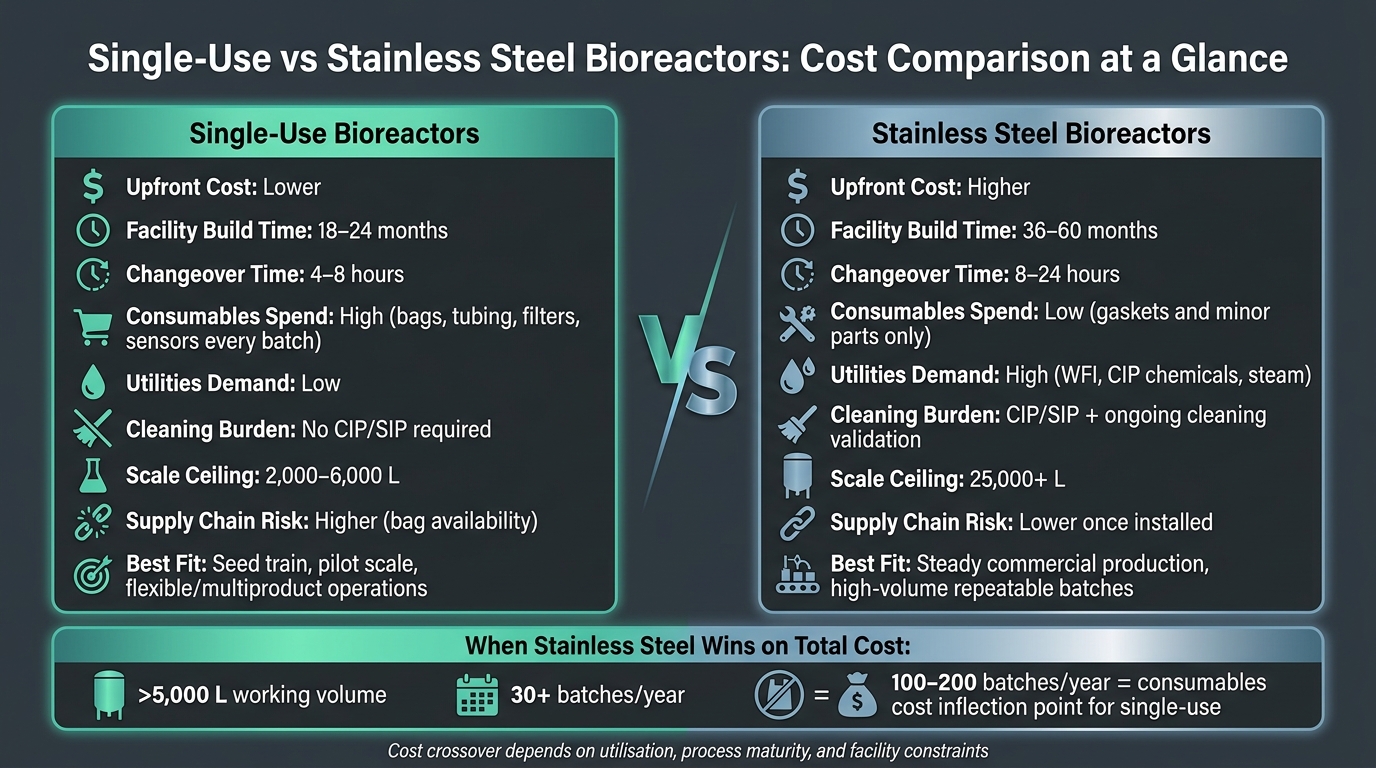
Single-Use vs Stainless Steel Bioreactors: Cost Comparison at a Glance
Single - Use vs Stainless Steel Bioreactors: Drivers of the Shift | Insights by Ravikiran
sbb-itb-ffee270
Quick comparison
| Criteria | Single-use bioreactors | Stainless steel bioreactors |
|---|---|---|
| Upfront cost | Lower | Higher |
| Facility build time | 18–24 months | 36–60 months |
| Fixed utility load | Lower | Higher |
Managing these costs requires efficient utility system design to handle the varying loads of each vessel type. | Changeover time | 4–8 hours | 8–24 hours | | Consumables spend | High | Low | | Cleaning burden | No CIP/SIP | CIP/SIP plus cleaning validation | | Typical scale ceiling | 2,000–6,000 L | >25,000 L | | Supply risk | Higher due to bag supply | Lower once installed | | Best fit | Seed train, pilot, moving process | Steady commercial production |
My short take: I would use single-use where process settings are still shifting, where speed matters, or where multiproduct work is likely. I would lean towards stainless steel only when the process is stable, batch cadence is known, and vessel use is high enough to spread the fixed plant cost.
That is the single-use vs reusable bioreactor cost analysis this article lays out, without getting lost in list prices that change by supplier and configuration.
Single-use bioreactors: lower upfront costs, higher recurring consumables spend
Upfront investment and facility setup
Single-use bioreactors strip out a big chunk of fixed plant from facility design. That means less hard infrastructure on day one and a lower barrier to getting started.
A single-use facility can often be designed, built, and validated in 18 to 24 months, versus 36 to 60 months for a similar stainless steel facility [2]. For a cultivated meat company pushing towards commercial scale, that time gap matters. Navigating the challenges of scaling cultivated meat requires balancing these infrastructure timelines with market entry goals. It gets process data earlier, without locking capital into a fixed utilities build.
That’s why single-use systems tend to suit teams that are still tightening up the process. If the cell line changes, the media formulation shifts, or the culture protocol needs reworking, a single-use facility can usually take that in its stride more easily than a site built around fixed stainless steel vessels and dedicated utility lines.
Operating costs, changeovers, and supply-chain exposure
Once the site is up and running, the economics change. The saving on infrastructure gives way to a steady stream of disposable purchases. Every batch needs a new pre-sterilised polymer bag, tubing set, filter assembly, and disposable sensor parts. At high utilisation, those repeat buys can become the main cost driver.
Changeovers are also faster. Single-use systems usually turn around in 4 to 8 hours between batches, compared with 8 to 24 hours for a stainless steel CIP/SIP cycle [2]. Less downtime gives teams more room in the production schedule and cuts labour linked to cleaning validation. Single-use systems can also reduce water demand sharply versus stainless steel at the same scale.
The main operating risk sits in the supply chain. Critical consumables often come from a small group of suppliers, which can leave a facility exposed if lead times slip or stock runs tight. In practice, qualifying backup suppliers for key consumables is a sensible move.
The table below summarises the main cost drivers across both system types [2]:
| Cost Driver | Single-Use | Stainless Steel |
|---|---|---|
| Consumables | High - recurring per-batch spend on bags, tubing, filters, sensors | Low - gaskets and minor replacement parts |
| Utilities | Low - minimal water and steam demand | High - WFI, CIP chemicals, steam |
| Labour | Lower - no CIP/SIP monitoring or cleaning validation | Higher - intensive cleaning and validation cycles |
| Waste handling | High - solid plastic waste, often requiring specialised disposal or incineration | High - wastewater treatment and chemical effluent |
| Downtime per batch | Short - typically 4–8 hours for bag changeover | Long - 8–24 hours for CIP/SIP cycles |
| Validation burden | Extractables and leachables (E&L) studies per bag type | Ongoing cleaning validation for carryover |
Where single-use fits in cultivated meat production
This cost profile makes the most sense where flexibility matters more than peak utilisation. Single-use fits process development, seed train expansion, and pilot-scale work, especially in multiproduct settings or where the process is still moving. The lack of cleaning validation between products is a clear plus when the same facility runs several cell lines or media formulations.
As production volume climbs and utilisation increases, the consumables-led model can start to bite. A common crossover point shows up when working volumes and batch frequency get high enough that consumables cancel out the flexibility advantage. Below that point, single-use is often the more flexible option. Above it, stainless steel starts to look stronger on total cost compared to other bioreactor types.
Stainless steel bioreactors: higher capital costs, better economics at sustained scale
Single-use systems cut early spend. But once output is steady and volumes are high, stainless steel starts to look much stronger on cost.
Capital costs and facility complexity
Stainless steel needs fixed plant from day one. And the vessel is only one piece of the bill.
Most of the capital spend sits in the surrounding systems: Clean-in-Place (CIP) skids, Steam-in-Place (SIP) networks, Water for Injection (WFI) systems, floor drains built for hygienic processing, 316L stainless steel pipework, and the control systems needed to run and validate everything with confidence. On top of that, qualification adds a lot of work before the first batch even starts.
This setup fits cultivated meat teams that already have stable process settings and repeatable production plans. If you're still changing media, feeds, or culture conditions, that level of commitment can become a costly bet. The trade-off is simple: high fixed capital upfront, lower recurring spend later.
Operating costs and throughput at commercial scale
Once the plant is commissioned, the cost picture changes. Recurring spend is driven mostly by utilities, cleaning chemicals, maintenance, and the labour tied to cleaning validation. In plain terms, the cost burden moves away from disposable materials and towards utilities, maintenance, and validation work.
Throughput is a major part of the case for stainless steel too. These systems support much larger working volumes than single-use platforms, scaling beyond 25,000 L [2]. At that size, unit economics improve a lot, even when you factor in the longer turnaround time from CIP and SIP.
The table below shows the main operating differences not covered in the single-use section:
| Factor | Stainless Steel | Single-Use |
|---|---|---|
| Scale ceiling | Scales beyond 25,000 L [2] | Typically 2,000 L to 6,000 L [2][1] |
| Vessel life | 15–20 years [1] | Not applicable |
| Supply chain risk | Low once installed | Moderate to high (bag availability) |
Cleaning validation is not a one-off task. It continues through routine operation, with written procedures, residue testing, and revalidation after process changes [1].
When stainless steel becomes the more cost-effective option
Stainless steel becomes cheaper when high working volumes run at steady utilisation. Industry data points to a crossover above 5,000 L scale and at around 30 or more batches per year [2]. At that point, the repeated cost of single-use materials usually starts to outweigh the long-run economics of stainless steel.
For cultivated meat producers, this tends to matter when moving from pilot campaigns into repeatable commercial manufacturing: long runs of the same product, with predictable scheduling and fewer process changes. At high utilisation, the fixed cost of the plant is spread across more batches. That sets up the lifecycle trade-offs in the next comparison.
Direct comparison: cost trade-offs by facility stage and operating model
Side-by-side cost comparison across the production lifecycle
Single-use cuts upfront spend and gets capacity online faster. Stainless steel starts to look better once utilisation is high enough to spread plant and utility costs across a large number of batches.
The day-to-day difference isn't just about capex versus opex. Labour matters too. Single-use removes much of the work tied to monitoring and validating CIP/SIP cycles [2]. But that comes with a trade-off: you rely on consumables, and those supplies can be hit by lead-time swings or supplier constraints [1][2].
Crossover scenarios in cultivated meat production
The main question isn't which platform looks cheaper on paper. It's when plant use becomes high enough for the fixed cost of stainless steel to pay back.
Early-stage R&D almost always leans towards single-use. Process parameters are still moving, and stainless steel cleaning validation brings a long tail of work: analytical method validation, residue detection, and routine monitoring for as long as the equipment stays in service [1]. At this point, that extra work slows learning without giving much in return.
Pilot demonstration is where things get more nuanced. Single-use usually stays lower-cost at smaller scales and lower batch frequency [2]. As utilisation climbs, consumable spend keeps stacking up, and that can start to offset the lower initial plant cost. The batch-frequency crossover, where total cost starts to level out, usually sits between 100 and 200 batches per year [2].
Commercial manufacturing pushes the economics much more firmly towards stainless steel once volume is steady and the production rhythm is high [2].
For many cultivated meat teams, a hybrid setup makes the most sense: single-use for upstream seed train steps, where flexibility and contamination control matter most, and stainless steel for large production vessels, where steady output can justify the capital outlay [1][2].
Buying criteria for technical and procurement teams
Procurement decisions should follow the operating model, not a built-in preference for one equipment type.
QA should review validation duties early. Once a site commits to stainless steel, cleaning validation becomes a standing part of operations rather than a one-off job [1]. Production teams also need a blunt view of utilisation, because batch frequency and production cadence shift the crossover point [2].
For engineers, contamination control needs close review. Single-use systems are designed with no cleaning step between runs. Stainless steel depends on validated cleaning procedures that show media residues have been removed [1].
Facility footprint and utility limits can also override a simple cost model. Single-use facilities can be built and validated in 18–24 months, while stainless steel facilities more often take 36–60 months [2]. If speed to market is a major driver, that timing gap can shape the decision before anyone even gets deep into the equipment cost numbers.
Conclusion: match your bioreactor choice to utilisation, process maturity, and long-term cost structure
Single-use systems cut the upfront burden, shorten facility build timelines, and remove cleaning validation work. That makes them the better fit when the process is still moving, media and operating windows are still being tuned, and capital needs to stay available for iteration. Stainless steel starts to make more sense when utilisation is high, the process is stable, and fixed costs can be spread across more batches [1][2].
In practice, many cultivated meat teams start with single-use, then move to stainless steel when volume and utilisation can justify the fixed plant. Teams that look at development stage, batch frequency, process stability, and facility constraints together are in a much stronger position to avoid infrastructure mismatches as they scale with a production planner [1][2].
FAQs
How do I estimate the crossover point for my process?
Estimate it by looking at your production scale and how often you run batches. Industry guidance usually puts the scale crossover at 2,000 to 5,000 litres and the frequency crossover at 100 to 200 batches per year.
Below those thresholds, single-use systems usually come out with lower total costs. At larger scale and higher batch frequency, stainless steel systems tend to become more efficient.
When does a hybrid bioreactor setup make sense?
A hybrid bioreactor setup that combines single-use and stainless steel systems often makes sense in cultivated meat production because it balances the strengths of both.
In practice, this approach works well when producers need the flexibility and fast turnaround of single-use components in upstream processing, while still relying on the high-volume capacity and better long-run cost profile of stainless steel systems in downstream operations.
What risks matter most beyond direct operating costs?
Beyond direct operating costs, cultivated meat producers also need to account for day-to-day operating risk.
For single-use systems, the main pressure points are fairly clear. You’re more exposed to the supply chain, lead times for specialised biocontainers can swing, and there are volume ceilings that may push you towards stainless steel once you move to industrial scale.
For stainless steel, the risk profile looks different. The biggest issues are strict cleaning validation, tight contamination control, and the heavy utility load that comes with the supporting infrastructure.
Single-use bags also need extractables and leachables studies to confirm product quality.


