

- Key Contaminants: Bacteria, fungi, mycoplasma, viruses, cross-cell line contamination, and endotoxins.
- Detection: Use real-time monitoring (pH, dissolved oxygen, turbidity), molecular testing (qPCR, ELISA), and AI-driven systems for early identification.
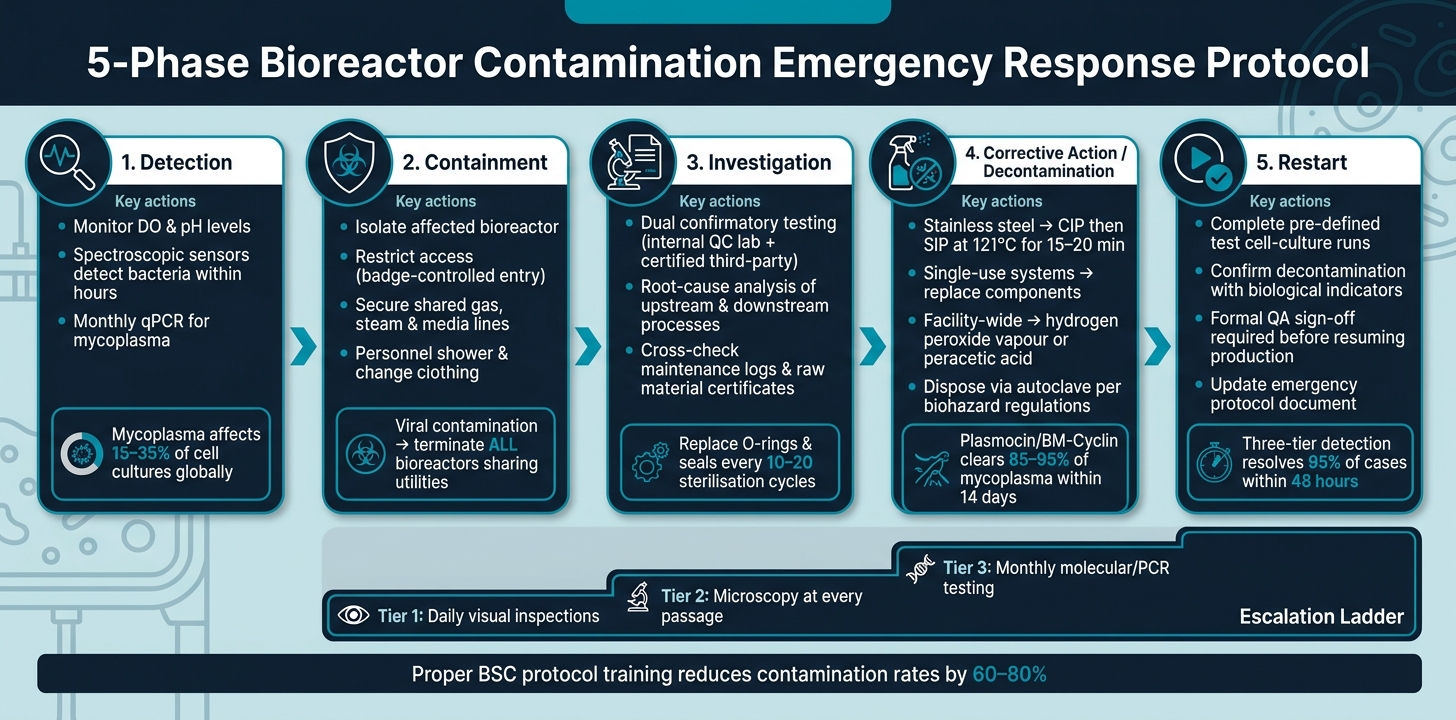
- Response Framework: Follow a 5-phase protocol: detection, containment, investigation, corrective action, and restart.
- Containment: Isolate affected bioreactors, restrict access, and secure connected systems.
- Decontamination: Use CIP/SIP for stainless-steel systems or replace single-use components. Employ hydrogen peroxide vapour for facility-wide sterilisation if needed.
- Prevention: Conduct risk assessments, ensure raw material screening, and align with HACCP, GCCP, and GMP standards.
- Training: Regular drills and staff education reduce human error, the leading cause of contamination.
Key takeaway: A structured protocol ensures faster resolution, reduces downtime, and strengthens production integrity.
Read on for detailed steps, tools, and expert insights into managing contamination effectively.
Identifying Risks and Regulatory Alignment
Common Contamination Scenarios
After understanding the various types of contamination, it's crucial to pinpoint the most likely threats in your production environment. The primary concerns typically include bacteria, fungi, viruses, and cross-contamination risks [5].
Two scenarios are particularly concerning in large-scale operations. First, viruses like Bovine Viral Diarrhoea Virus (BVDV) can remain latent in animal-derived raw materials, only becoming apparent during later production stages - long after those materials have been discarded. Second, in facilities producing multiple products, cross-contamination between cell lines is a major risk. For instance, a faster-growing culture can silently outcompete a slower one, potentially compromising the integrity of the product without any immediate warning. Industry data shows that microbiological contamination leads to batch failures at an average rate of 11.2% [5].
These examples highlight the importance of a thorough and proactive risk assessment.
How to Conduct a Risk Assessment
"The most common vectors were related to personnel, equipment, and the production environment, while the most commonly reported type of microbiological contaminant was bacteria." - PubMed [5]
To carry out a risk assessment effectively, examine every stage of production for potential contamination routes. This includes cell line generation, media preparation, and harvesting. Focus on vulnerabilities stemming from personnel, equipment, and the production environment. Implement strict quarantine and documentation protocols for raw materials and cell banks to minimise risks. As production scales up, equipment interfaces become more susceptible to contamination, so regular inspections are essential.
Raw materials should be verified using Certificates of Analysis and, where necessary, third-party testing. Both master and working cell banks must undergo rigorous screening for bacteria, fungi, viruses, and mycoplasma before being introduced into bioreactor systems. This ensures that if contamination does occur, its source can be quickly identified and addressed.
Regulatory and Quality Frameworks
Aligning the findings from your risk assessment with regulatory standards ensures a robust biosafety strategy. Emergency protocols should be seamlessly integrated into your quality management system. For cultivated meat producers, combining Hazard Analysis and Critical Control Points (HACCP) with Good Cell Culture Practice (GCCP) and Good Manufacturing Practice (GMP) offers a practical solution. HACCP applies food safety principles to identify critical control points, while GCCP and GMP establish the procedural and documentation standards expected by regulators [5].
In the UK, any contamination incident must be reported immediately to the appropriate national authorities. Comprehensive documentation is essential for traceability and root-cause investigations. To minimise contamination risks, sterile techniques and closed-system designs should be prioritised, eliminating the need for antimicrobial agents wherever possible [3].
Detection and Escalation Procedures
Monitoring Systems and Early Warning Signs
Keeping a close eye on dissolved oxygen (DO) and pH levels is crucial. Sudden drops in DO or rapid shifts in pH - such as a colour change from pink to yellow in phenol red indicator media - often signal microbial contamination early on [2][4].
In addition to these standard parameters, spectroscopic sensors offer real-time insights. By monitoring optical density alongside pH and DO, these sensors can detect bacterial contamination within hours, thanks to distinct spectral signatures [3]. For precise detection of microbial DNA, particularly for mycoplasma, qPCR is indispensable. This is especially critical given that mycoplasma affects an estimated 15–35% of cell cultures globally and often goes unnoticed under standard microscopy [2]. Monthly molecular testing is, therefore, an essential part of a robust monitoring strategy.
"The earlier a contamination gets detected the better." - Tony Allman, INFORS HT [4]
To strengthen detection efforts, combine real-time sensor data with periodic techniques like qPCR, ELISA, and flow cytometry. ELISA is highly effective for identifying endotoxins from gram-negative bacteria, even after the bacteria themselves have been removed [3]. Meanwhile, flow cytometry can distinguish between viable cultured cells and contaminants based on size, shape, and fluorescence [3]. Emerging AI-driven monitoring systems are also making strides, tracking multiple large-scale bioreactors simultaneously and identifying deviations before they escalate - a major step forward as bioreactor capacities in cultivated meat production now reach up to 15,000 litres [3]. These rapid detection methods are key to guiding the next steps in escalation protocols.
Escalation Protocols and Decision Trees
When contamination is identified, a tiered escalation structure ensures swift and systematic action.
- Tier 1: Daily visual inspections
- Tier 2: Microscopy at every passage
- Tier 3: Monthly molecular or PCR testing [2]
Each tier builds on the previous one, ensuring anomalies are addressed promptly and systematically, avoiding reliance on individual judgement. Early detection should immediately trigger the escalation protocol.
A contamination decision tree provides a structured approach. It starts with visual symptoms, progresses to microscopic analysis, and concludes with molecular identification to decide whether to treat or discard the affected culture. The response varies depending on the contaminant type: bacterial and fungal infections often require immediate disposal, while rare or irreplaceable cultures with mycoplasma may be considered for treatment before a final decision is made [2].
Clearly defining roles within the protocol is essential. The escalation plan should outline who is responsible for isolating a bioreactor, leading the investigation, and liaising with quality assurance and regulatory teams. This clarity prevents delays and ensures no time is wasted.
| Contamination Type | Detection Timeline | Key Warning Signs | Action Pathway |
|---|---|---|---|
| Bacterial | 24–48 hours | Turbidity, pH drop, yellow media | Immediate discard [2] |
| Fungal | 48–72 hours | Fuzzy colonies, branching hyphae | Immediate discard [2] |
| Mycoplasma | Days to weeks | No visible signs; altered growth rate | PCR testing → treat or discard [2] |
| Viral | Variable | Often none; poor cell performance | Specialised assay → discard [2] |
Emergency Response Procedures
5-Phase Bioreactor Contamination Emergency Response Protocol
Immediate Containment Actions
When a contamination event is detected, acting quickly is critical to safeguard production and ensure product safety in cultivated meat operations. Begin by isolating the affected bioreactor, shutting down the compromised system, and immediately restricting access to the contaminated area using badge-controlled entry. Secure all connected systems, such as shared gas lines, steam lines, and media feeds, to prevent the contamination from spreading further. If viral contamination is confirmed, terminate all bioreactors that share utilities or space with the impacted unit without delay [1].
Personnel who have accessed the contaminated zone must shower and change clothing before entering clean production areas [1]. Additionally, quarantine all in-process intermediates, raw materials, and harvests until the full scope of the contamination is determined.
"A 'quick kill' of the process will save cost and resources before any investigation has even started." - Tony Allman, INFORS HT [4]
Once containment is in place, proceed with confirmatory testing and initiate a detailed root-cause investigation.
Confirmatory Testing and Root-Cause Investigation
Conduct confirmatory testing simultaneously in your internal quality control (QC) lab and a certified third-party laboratory. This dual approach minimises the risks of false negatives, which could allow contamination to persist, or false positives, which might lead to unnecessary process shutdowns [1].
Root-cause analysis should cover both upstream and downstream processes. For upstream checks, re-plate a sample of the original inoculum onto a rich growth medium to detect any contaminants that may have entered before the bioreactor stage [4]. Inspect mechanical components such as O-rings and seals, which should be replaced after 10–20 sterilisation cycles. Also, verify the condition of gas and vent filters, as wet filters can encourage microbial growth [4]. Cross-check these findings with maintenance logs, raw material certificates, and environmental monitoring data to identify the contamination source [3].
| Detection Method | Target Contaminant | Key Advantage |
|---|---|---|
| qPCR / PCR | Bacteria, Fungi, Viruses | Highly sensitive; detects DNA at trace levels [3] |
| NGS / Microarrays | Adventitious Viruses | Broad-spectrum identification of unknown agents [1] |
| ELISA | Endotoxins | Identifies gram-negative bacterial residues post-clearance [3] |
| Gram Staining | Bacteria | Rapid, low-cost visual confirmation [4] |
Once the contaminant is identified, proceed immediately with decontamination efforts.
Bioreactor Decontamination and Waste Disposal
The decontamination method will depend on the type of bioreactor in use. For stainless-steel bioreactors, use a validated Clean-in-Place (CIP) process followed by Steam-in-Place (SIP) sterilisation. The CIP process typically involves three stages: physical removal of visible organic material, an alkaline detergent wash to dissolve protein residues, and an acid cleaning step to eliminate mineral deposits and biofilms [3]. The SIP step is performed at 121°C for 15–20 minutes [3]; thorough pre-cleaning is essential for effective sterilisation.
For single-use bioreactors and flexible tubing, replacement is necessary since their decontamination cannot be reliably validated [4]. In cases of severe contamination requiring facility-wide fumigation or treatment of heat-sensitive equipment, hydrogen peroxide vapour or peracetic acid are effective options [3][1].
Dispose of all contaminated materials - including raw materials, process intermediates, wash fluids, and disposables - by autoclaving them in accordance with biohazard regulations [1][2].
sbb-itb-ffee270
Prevention, Training, and Continuous Improvement
Corrective and Preventive Actions (CAPA)
After decontamination, implementing a strong CAPA framework is essential. Use root-cause analyses to refine cleaning protocols, improve supplier qualifications, and reassess material screening processes. To minimise contamination risks, consider using closed-system bioreactors, positive-pressure environments with HEPA filtration, or single-use systems. These approaches help limit the number of potential ingress points for contaminants [3].
The cultivated meat industry is increasingly moving away from using antibiotics and antimycotics in production. This shift is driven by regulatory concerns over antimicrobial resistance and the potential for these substances to interfere with cellular metabolism or affect the final product’s quality [3]. These changes pave the way for more targeted staff training and rigorous emergency preparedness drills.
Staff Training and Emergency Drills
Even the best-written protocol is only effective if the team executing it is well-prepared. Since personnel are a primary source of contamination, structured and regular training is non-negotiable. The most effective training programmes are managed by a dedicated Virus Risk Mitigation (VRM) team. This team oversees service contracts, maintains emergency contact lists, and ensures regular training cycles are carried out [1].
Drills should be conducted in a dedicated training laboratory equipped with non-operational unit operations such as bioreactor mock-ups, gowning areas, and purification skids. This non-GMP environment allows teams to practise their response activities without the pressures of live production [1]. Including floor operators in these exercises is critical, as their hands-on expertise often highlights communication gaps and workflow issues that might otherwise go unnoticed.
"Having a plan is not enough; practicing it regularly... helps ensure that all people involved would perform their respective response activities as expected according to plan and that the plan is kept up-to-date and subject to continuous improvement." - Yuval Shimoni [1]
Training programmes should also include external validations. For example, periodically test contract testing laboratories by sending them blinded samples to evaluate their turnaround times and identification accuracy. Similarly, verify the effectiveness of decontamination vendors by placing biological indicators during mock exercises to confirm that their methods perform as required [1]. Contracts alone do not guarantee reliability.
Restart Criteria and Long-Term Readiness
Resuming production after an incident requires a formal, pre-defined restart process. This process should include a set number of successful test cell-culture runs and confirmation of decontamination efficacy using biological indicators strategically placed throughout the affected area [1]. Quality Assurance must formally approve all restart criteria and corrective actions before production can resume [1]. This disciplined approach reinforces the importance of continuous improvement in emergency protocols.
Maintaining long-term readiness involves treating your emergency protocol as a dynamic document. The VRM team should regularly review and update the protocol, incorporating insights from drills, contamination incidents, and advancements in technologies like AI-driven sensors and Next-Generation Sequencing [1] [3]. With cultivated meat production volumes projected to reach between 400,000 and 2.1 million tonnes by 2030 [3], the stakes for inadequate preparation are only increasing. Building continuous improvement into your processes now is far less disruptive than addressing gaps after a major incident.
Using Cellbase for Emergency Preparedness
When contamination strikes, having the right tools and materials on hand can make all the difference in ensuring a swift and effective response. Building on strict response protocols, facilities must prioritise securing critical equipment and resources for rapid recovery.
Sourcing Critical Equipment and Materials
Fast access to specialised tools is essential for managing contamination effectively. Equip your facility with spectroscopic sensors to monitor pH, dissolved oxygen, and optical density. These sensors enable bacterial detection within hours, providing a crucial early warning system [3]. Additionally, pre-stock qPCR kits, specialised mycoplasma tests, and ELISA assays to confirm contamination quickly [2][3]. Mycoplasma, which impacts a significant number of cultures and often evades detection through standard microscopy, underscores the importance of these testing kits [2].
Equally important are decontamination materials. Facilities should have a range of cleaning agents on hand, including alkaline detergents for protein residues, acid cleaners for biofilms, and chemical sterilants like hydrogen peroxide vapour or peracetic acid for heat-sensitive equipment [3]. For facilities working with irreplaceable cell cultures, having access to specialised treatments like Plasmocin or BM-Cyclin, which can clear 85–95% of mycoplasma contamination within 14 days, is critical. These treatments should be readily available instead of being sourced reactively during an emergency [2].
Cellbase, the first B2B marketplace designed specifically for the cultivated meat industry, simplifies this process by connecting facilities with verified suppliers. From spectroscopic sensors to decontamination agents and single-use bioreactor components, Cellbase provides procurement teams with tools to identify GMP-compliant products quickly. This streamlined approach supports rapid detection, containment, and decontamination, ensuring the integrity of cultivated meat production processes.
Building Procurement Contingencies
In addition to equipment, securing reliable supplies of reagents and media is essential. Contamination from growth media and reagents accounts for 20–25% of incidents, making supplier pre-qualification a top priority [2]. Facilities should maintain a stock of at least 3–5 days' worth of antibiotic-free media to prevent false negatives caused by antimicrobial suppression [2]. When sourcing serum, prioritising 0.1 µm filtered options significantly lowers the risk of mycoplasma contamination [2].
Through its curated supplier network, Cellbase ensures access to vendors specialising in cultivated meat production inputs that meet GMP standards, even during emergencies. For facilities scaling to commercial volumes, the platform also facilitates procurement of single-use bioreactor components, which simplify decontamination by eliminating the need for complex Clean-in-Place (CIP) and Steam-in-Place (SIP) procedures [3]. By establishing procurement contingencies with pre-qualified suppliers, facilities can respond to contamination events in hours rather than days, minimising downtime and maintaining production efficiency.
Conclusion
Bioreactor contamination poses a serious challenge to cultivated meat production, with the financial and reputational damage from unpreparedness far outweighing the cost of preventive measures. Combining strong prevention strategies with a clear emergency protocol is essential to maintain production integrity.
An effective protocol hinges on four key elements: thorough risk assessment, tiered detection methods, rapid response capabilities, and ongoing refinement. For instance, a three-tier detection system - including daily visual inspections, microscopy at every cell passage, and monthly PCR testing - can address 95% of contamination cases within 48 hours when supported by a structured decision-making framework [2].
Key Takeaways
Protocols only work if they are practised regularly. Conducting frequent drills, especially those involving floor operators, can reveal communication weaknesses and improve response times [1]. Additionally, proper training and strict adherence to Biological Safety Cabinet (BSC) protocols have been shown to reduce contamination rates by 60–80% [2].
FAQs
When should a contaminated culture be treated or discarded?
When contamination is detected using techniques such as qPCR, ELISA, or flow cytometry, the typical response is to discard the culture. This is because contaminants like bacteria and fungi proliferate much faster than cultivated meat cells, increasing the risk of spreading throughout the facility.
To mitigate this, isolate and safely dispose of the affected batch immediately. Afterward, conduct a rigorous decontamination process to prevent recurrence. For those seeking reliable tools to uphold sterility, Cellbase provides a specialised marketplace offering equipment tailored for maintaining strict contamination control standards.
What tests confirm contamination fastest after an alarm?
To swiftly verify contamination following an alarm, rely on rapid molecular or biochemical methods instead of traditional culture-based tests. Techniques like ATP bioluminescence can deliver results in just minutes to hours. Similarly, LAMP (Loop-Mediated Isothermal Amplification) and real-time PCR offer detection of contaminants within a timeframe of 1 to 3.5 hours. Cellbase serves as a bridge between cultivated meat producers and suppliers of specialised diagnostic tools tailored for these rapid testing needs.
What evidence is needed before restarting production?
Before restarting cultivated meat production, it's crucial to ensure the decontamination process has been successful. This involves both visual inspections and chemical tests. While surfaces may appear clean, they can still harbour microorganisms, making this step non-negotiable. Once the system is verified clean, perform a re-sterilisation to prepare it for the next production cycle.
For sourcing equipment and validation tools essential to these protocols, Cellbase provides access to vital materials tailored for cultivated meat operations.


