

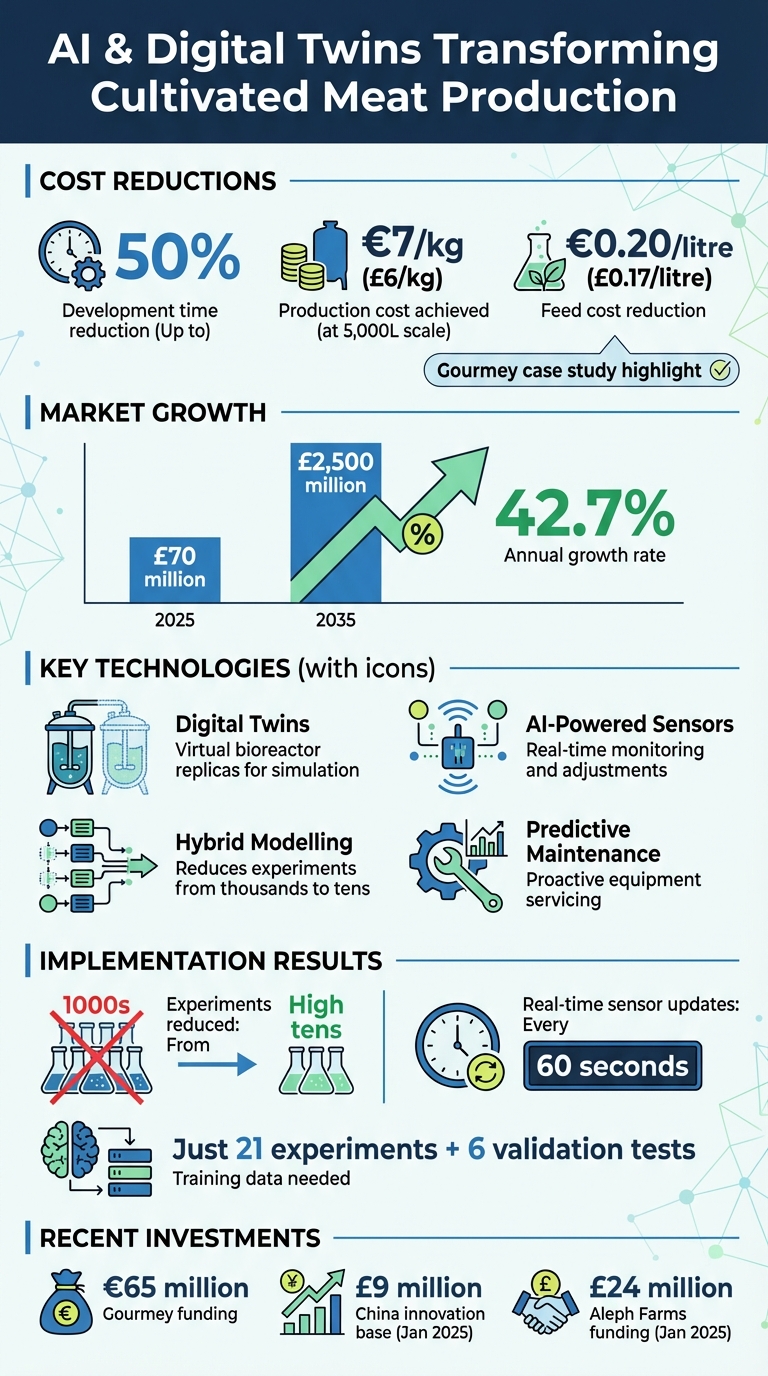
Scaling cultivated meat production is expensive and time-consuming. Moving from small lab setups to commercial bioreactors often fails due to unpredictable biological outcomes. But AI and digital twins are changing this. These tools simulate and optimise processes virtually, cutting costs and development time by up to 50%. Here's how:
- Digital twins create virtual replicas of bioreactors, simulating conditions like fluid dynamics and nutrient distribution. They predict outcomes without risking physical equipment.
- AI-powered sensors enable real-time monitoring and adjustments, improving efficiency and reducing waste.
- Companies like Gourmey have used these technologies to lower production costs and reduce feed expenses significantly.
From optimising cell growth to preventing equipment failures, AI and digital twins are reshaping the path to scalable, cost-efficient cultivated meat production. Keep reading to learn how these tools are implemented and their impact on the industry.
AI and Digital Twins Impact on Cultivated Meat Production Costs and Efficiency
Application of AI and Digital Twins for Bioprocessing: Pitfalls and Solution Paths for...
sbb-itb-ffee270
Benefits of AI and Digital Twins for Cultivated Meat Production
AI and digital twins are making a big impact on cultivated meat production by improving process control, cutting costs, and paving the way for large-scale commercial operations.
Improved Bioreactor Control and Monitoring
Digital twins allow producers to simulate bioreactor conditions - such as geometry, fluid dynamics, and physical settings - making it possible to run "what-if" scenarios. These simulations help fine-tune critical parameters like temperature, pH levels, and nutrient supply without the need for costly physical adjustments [1] [6] [4].
AI plays a key role through "soft sensing", which enables real-time monitoring of variables that are hard to measure directly. Virtual sensors estimate details like dissolved oxygen levels and glucose concentration in areas where physical sensors fall short. Data from bioreactors is constantly compared to virtual models, helping to spot discrepancies or early signs of equipment issues. This enables predictive maintenance, as highlighted by Octocells:
"By predicting when a machine is likely to fail or require servicing, maintenance will be scheduled proactively, reducing downtime and extending the lifespan of the equipment." [1]
Additionally, causal AI helps producers understand molecular interactions, predicting how specific molecules will influence cell behaviour [4]. These capabilities enhance reliability while reducing costs, creating a solid foundation for scaling up production.
Cutting Costs Through Process Optimisation
Better control over bioreactors directly reduces operational costs by minimising waste and optimising the use of cell culture media - the largest expense in cultivated meat production. Digital twins allow for virtual testing of cell behaviour and media changes, significantly cutting the need for expensive wet lab experiments.
A great example comes from Gourmey, a French start-up that teamed up with biotech firm DeepLife in June 2025. Together, they developed a digital twin of poultry cells by analysing sequencing data from millions of avian cells and integrating it with media perturbation data. Nicolas Morin-Forest, CEO of Gourmey, explained:
"Optimising these parameters boosts yield, reduces feed waste, which is a primary cost driver in cultivated meat, and directly lowers production costs." [4]
Jonathan Baptista, CEO of DeepLife, further noted:
"The model is fine-tuned using Gourmey data on media perturbations, enabling it to predict how different molecules will affect the behaviour of each cell population." [4]
Beyond media optimisation, digital twins also help reduce capital expenditure. Companies can create virtual factory replicas to test layouts, equipment placements, and workflows before construction begins, ensuring maximum efficiency [1]. These simulations also provide a safe, cost-effective way to train operators, speeding up readiness and lowering training expenses.
Scaling Up to Commercial Production
Digital twins play a crucial role in scaling operations from the lab to full-scale production. This transition often comes with engineering challenges, particularly in ensuring fluid flow and nutrient distribution in large bioreactors. Digital twins, combined with computational fluid dynamics (CFD), help optimise these factors [7].
By simulating designs and processes, producers can bridge the gap between experimental setups and large-scale manufacturing. As FUDZS points out:
"By identifying the most efficient design through simulation, investors will ensure that every dollar or euro spent on construction yields the highest possible return on investment!" [1]
At a commercial scale, digital twins continue to monitor equipment performance in real-time, comparing it to virtual benchmarks to detect early signs of wear. This proactive approach minimises downtime, ensuring continuous production to meet market demand [1].
AI-driven simulations also speed up research and development by reducing reliance on traditional wet lab experiments. This allows producers to quickly refine cell lines, media formulas, and production processes while staying within budget and on schedule.
How to Implement AI and Digital Twins in Bioprocess Automation
Bringing AI and digital twins into cultivated meat production requires a strong foundation in data management, hybrid modelling techniques, and suitable hardware. The starting point is building a data layer that streams critical bioreactor data - such as pH, dissolved oxygen, torque, agitation speed, and feed mass - into a plant historian. This step lays the groundwork for effective implementation [5].
The next phase involves creating a hybrid model. This approach blends mechanistic principles, like mass balances and oxygen transfer rates, with machine learning algorithms. Known as a "grey box" model, it goes beyond traditional physics-based methods to better predict complex biological behaviours. As James Westley, Associate Director at Cambridge Consultants, puts it:
"The approach begins by supplementing AI with 'real intelligence'... combining AI with domain expertise to cut the number of experiments – from the low thousands to the high tens" [2].
By reducing the number of experiments needed, this method can significantly lower costs while maintaining accuracy. Once the foundation is in place, the focus shifts to training the digital twin and integrating it into real-time process control.
Training Digital Twins with Experimental Data
For a digital twin to function effectively, it needs quality data from physical experiments. Traditional models often require hundreds or even thousands of data points. However, hybrid modelling simplifies this by incorporating known physical and chemical relationships, like how increased CO₂ affects pH, reducing the data burden [2].
Using AI-guided Design of Experiments (DoE) with Bayesian optimisation further streamlines the process. This method prioritises the most informative experiments, avoiding the inefficiency of trial-and-error. For example, in one study, researchers trained a hybrid model using just 21 experiments and validated it with 6 additional tests. The model accurately predicted biomass growth and glucose consumption [8].
These advantages are not just theoretical. In June 2025, French start-up Gourmey teamed up with biotech firm DeepLife to develop a digital twin for cultivated poultry production. By analysing sequencing data from millions of avian cells and integrating it into Large Language Models (LLMs), they simulated intracellular mechanisms. This allowed them to optimise feed formulations virtually before conducting physical experiments. As Nicolas Morin-Forest, CEO of Gourmey, explained:
"By combining Gourmey's proprietary cell cultivation platform and advanced analytical tools with DeepLife's leading digital twin technology, we can now simulate and optimise every stage of production" [4].
Such methods not only reduce costs but also enhance control over the production process.
Integrating AI for Real-Time Adjustments
Once a digital twin is trained, it can be used for real-time process control through Model Predictive Control (MPC) or Reinforcement Control (RC). These systems adjust parameters like pH, dissolved oxygen, and feed rates based on the twin's predictions [5]. This type of closed-loop control relies on Process Analytical Technology (PAT), with advanced sensors such as Raman or FTIR spectroscopy measuring key metabolites approximately every 60 seconds [5].
Before fully automating processes, it’s wise to test the system in "shadow mode". This allows AI recommendations to be compared against operator decisions without risk, building trust in the system's capabilities [5]. For instance, Elise Biopharma used a digital twin with MPC in a 1,000-litre fed-batch process. This revealed oxygen-transfer issues caused by broth viscosity. By rebalancing agitation and back-pressure, the system resolved the issue and improved yield [5].
To ensure success, equipment must support continuous data streaming and bidirectional information flow. AI-powered "soft sensors" are particularly valuable here, as they infer variables that are difficult to measure directly, offering insights beyond the reach of physical sensors [5].
Using Cellbase for Equipment Procurement
Scaling AI and digital twins from lab to commercial production requires specialised hardware that generalist lab suppliers might not provide. Essential equipment includes bioreactors with integrated data connectivity, advanced inline sensors like Raman and FTIR probes, off-gas mass spectrometers, and multi-well parallel bioreactors with microfluidics. Additionally, growth media must be carefully tracked, as variations in composition can significantly impact biological responses [2][5].
Cellbase simplifies this process by serving as a centralised marketplace tailored to the cultivated meat industry. Rather than navigating multiple suppliers, teams can source verified bioreactors, growth media, and advanced sensors from a single platform. Listings include detailed specifications, such as scaffold compatibility or GMP compliance, helping production teams minimise technical risks.
For companies scaling cultivated meat processes from research to commercial production, Cellbase connects them with suppliers who understand the unique challenges of cultivated meat. This includes equipment designed for "scale-down" models, like 2-litre discovery pods, which replicate the physics of larger systems up to 3,000 litres. These tools help prevent model drift during scaling and ensure a smoother technology transfer process.
Case Study: Digital Twins and AI in Cultivated Meat Production
DeepLife-Gourmey Avian Digital Twin
This case study dives into how AI and digital twin technology are transforming the cultivated meat industry, focusing on a collaboration between French cultivated meat company Gourmey and biotech firm DeepLife.
In June 2025, Gourmey and DeepLife unveiled the first avian digital twin - a virtual model of poultry cells aimed at optimising growth conditions. The project concentrated on duck embryonic stem cells, gathering multi-omics data over seven days. This data was analysed using Large Language Models, which identified intracellular mechanisms and predicted how various molecules influence cell behaviour [4][9].
The digital twin uses causal AI to map cause-and-effect relationships within cells. A Target-Action-Metabolite (TAM) framework links cellular outcomes, like improved cell viability or enhanced fat synthesis, to specific metabolites and process parameters [9]. This allows thousands of virtual experiments, cutting down on expensive and time-intensive wet lab trials. The insights gained have led to measurable production advancements.
One standout discovery was the role of oleoyl-lysophosphatidic acid (LPA). The AI suggested that LPA could activate the energy-regulating gene SIRT6, boosting cell viability and balancing lipid levels. This enabled media optimisation without needing genetic modifications [9]. Nicolas Morin-Forest, CEO of Gourmey, highlighted the impact of this technology:
"Integrating DeepLife's digital twin technology into our platform allows us to model how avian cells respond to different culture conditions before entering the lab. This accelerates our R&D cycles, reduces reliance on costly trial-and-error, and ultimately sharpens our ability to optimise production economics at scale" [10].
The results are impressive. Gourmey reports achieving a notably low production cost at a commercial scale of 5,000 litres, according to an independent techno-economic assessment [10]. Additionally, the company says it has significantly reduced the cost of its food-safe feed [10]. With over €65 million in funding, Gourmey's 60-person team in Paris continues to refine the digital twin, using it to enhance sensory aspects like umami intensity and fat structure. This collaboration demonstrates how AI and digital twins can deliver scalable and impactful advancements in cultivated meat production [10].
Challenges and Future Trends in AI and Digital Twins for Bioprocessing
Adoption Challenges and Data Requirements
Creating a digital twin for cultivated meat production is no small feat. Developing a general-purpose AI model for bioprocessing demands extensive datasets - hundreds to thousands of data points. This process isn't just time-intensive; it can also cost millions and take years to complete [2]. The challenge lies in the biology itself, where at least ten process variables interact in highly complex, non-linear ways [2].
The infrastructure needed to support this endeavour is equally demanding. Companies require high-throughput lab automation for media preparation, bioreactors equipped with real-time monitoring sensors (tracking pH, temperature, dissolved oxygen, and nutrients), and high-performance computing systems to handle AI simulations [11]. Additionally, the cost of materials remains a hurdle - foetal bovine serum and microcarriers for large bioreactor tanks can be particularly expensive [11]. Another significant barrier is the lack of avian-specific datasets, which limits the ability of AI models to generalise across different poultry species [12].
To overcome these obstacles, companies are adopting hybrid modelling - a method that blends AI with domain expertise and first-principle physics. By integrating known relationships, such as the inverse correlation between CO₂ levels and pH, these models can significantly cut down the number of physical experiments required [2][13]. Tackling these challenges is crucial to fully harnessing AI-driven automation in the cultivated meat sector. Despite the difficulties, emerging trends are paving the way for transformative changes in bioprocess automation.
Future Trends in AI-Driven Bioprocess Automation
The industry is responding to these challenges with cutting-edge innovations. The global AI market in cultivated meat is forecast to grow from £70 million in 2025 to an impressive £2,500 million by 2035, with an annual growth rate of 42.7% [11]. Several key trends are driving this expansion. For instance, AI-integrated 3D bioprinting is optimising material formulations and printing parameters to create scaffold structures that replicate the texture of natural meat [11]. Similarly, predictive maintenance systems are being deployed to monitor bioreactor conditions, helping to anticipate and prevent issues like batch failures or contamination [11][12].
In January 2025, China took a bold step by launching the 'New Protein Food Science and Technology Innovation Base' in Beijing, backed by major investment. This facility integrates AI and blockchain technologies to enable real-time monitoring and traceability throughout the cultivated meat production process, from research to retail [11]. Around the same time, Israeli start-up Aleph Farms secured additional funding to enhance its AI-driven pilot facility and work towards commercialising cost-effective whole-cut cultivated steaks [11].
Looking ahead, digital twins are expected to evolve beyond just improving yield. They aim to enhance sensory attributes - modelling volatile compounds, proteins, and lipids to refine the taste and texture of cultivated meat [3]. The rise of open-source AI hubs, like the AI4CM Hub, is also fostering collaboration and innovation in this field [11]. As these technologies progress, companies investing in automated inline sensors, miniaturised parallel bioreactors, and hybrid AI models will be better equipped to scale production efficiently while navigating regulatory landscapes. Achieving scalable and cost-effective cultivation will be key to commercial success in this rapidly advancing industry.
Conclusion
AI and digital twins are reshaping bioprocess automation in cultivated meat production. By refining feed formulations, speeding up research with virtual simulations, and improving predictability during scale-up, these technologies significantly reduce costs and make the industry more appealing to investors [2][4]. As James Westley, Associate Director at Cambridge Consultants, points out, these tools enhance scalability, which is critical for attracting investment. This digital shift is driving a more data-driven and efficient production process.
The move towards Industry 4.0, marked by autonomous systems, is becoming a necessity for businesses aiming to thrive in this space [13]. Hybrid modelling, which blends mechanistic physics with machine learning, is making predictive digital twins more accessible - even for smaller companies [2]. Real-time monitoring further boosts efficiency by enabling quick adjustments and reducing the likelihood of batch failures [2].
Key to this transformation is the adoption of advanced tools such as automated inline sensors, miniaturised parallel bioreactors, high-performance computing, and PAT tools. Platforms like Cellbase play a pivotal role here. As the first B2B marketplace dedicated to the cultivated meat sector, Cellbase connects researchers and manufacturers with trusted suppliers offering the specialised sensors, bioreactors, and analytical tools needed for AI-driven bioprocess automation.
The future of cultivated meat production is undeniably digital. Companies that embrace AI and leverage platforms like Cellbase can transition from lab-scale to commercial production more quickly and with reduced financial risk.
FAQs
What data do I need to build a useful digital twin for cultivated meat?
To build a dependable digital twin for cultivated meat production, gathering precise data on both biological and process parameters is crucial. Key factors to monitor include real-time measurements of pH, temperature, dissolved oxygen, glucose levels, and cell growth. Alongside this, information about bioreactor conditions, fluid dynamics, and mass transfer plays a vital role. High-frequency, accurate data collection ensures that the digital twin mirrors the bioreactor environment closely, enabling AI to optimise processes effectively.
How do hybrid (grey-box) models reduce the number of wet-lab experiments?
Hybrid, or grey-box, models blend mechanistic models with machine learning to create accurate virtual simulations of processes. These models allow for effective scenario testing and reduce the need for extensive physical experiments. By relying on computational predictions, they help save both time and resources while offering valuable insights.
What sensors and equipment are essential for real-time AI control in bioreactors?
To maintain optimal conditions in bioreactors, several sensors play a critical role in real-time monitoring and control. These include:
- Temperature sensors (RTDs): Essential for keeping the bioreactor at the precise temperature required for cell growth.
- pH sensors: Available as glass or ISFET types, these ensure the acidity or alkalinity levels are just right for the process.
- Dissolved oxygen sensors (optical): Crucial for tracking oxygen levels, which directly impact cell metabolism.
- Metabolite sensors: Used to monitor key compounds like glucose and lactic acid, helping maintain the balance needed for efficient production.
These sensors work together to provide the detailed data needed for AI systems to fine-tune bioprocess conditions, ensuring the success of cultivated meat production.


