

AI-driven biosensors are transforming cultivated meat production by enabling real-time monitoring of bioreactor conditions. Unlike older methods, which could take days to detect issues, these advanced systems provide instant insights into critical parameters like glucose, pH, and cell growth. This technology helps producers maintain batch quality, reduce waste, and automate processes.
Key highlights:
- Real-time monitoring: Tracks metabolites like glucose and lactic acid at ultra-low concentrations.
- AI integration: Predicts and adjusts parameters using advanced algorithms like RNNs and reinforcement learning.
- Process Analytical Technology (PAT): Embeds quality control directly into production, shifting focus from end-product testing to continuous monitoring.
- Challenges: Sensor placement, fouling, and managing complex bioreactor conditions remain hurdles.
Introduced by companies like The Cultivated B in 2025, these biosensors are already making production more efficient while addressing scaling challenges. Platforms like Cellbase simplify procurement, connecting producers with tailored tools for their needs. AI-powered biosensors are shaping the future of cultivated meat production by improving precision and reducing manual intervention.
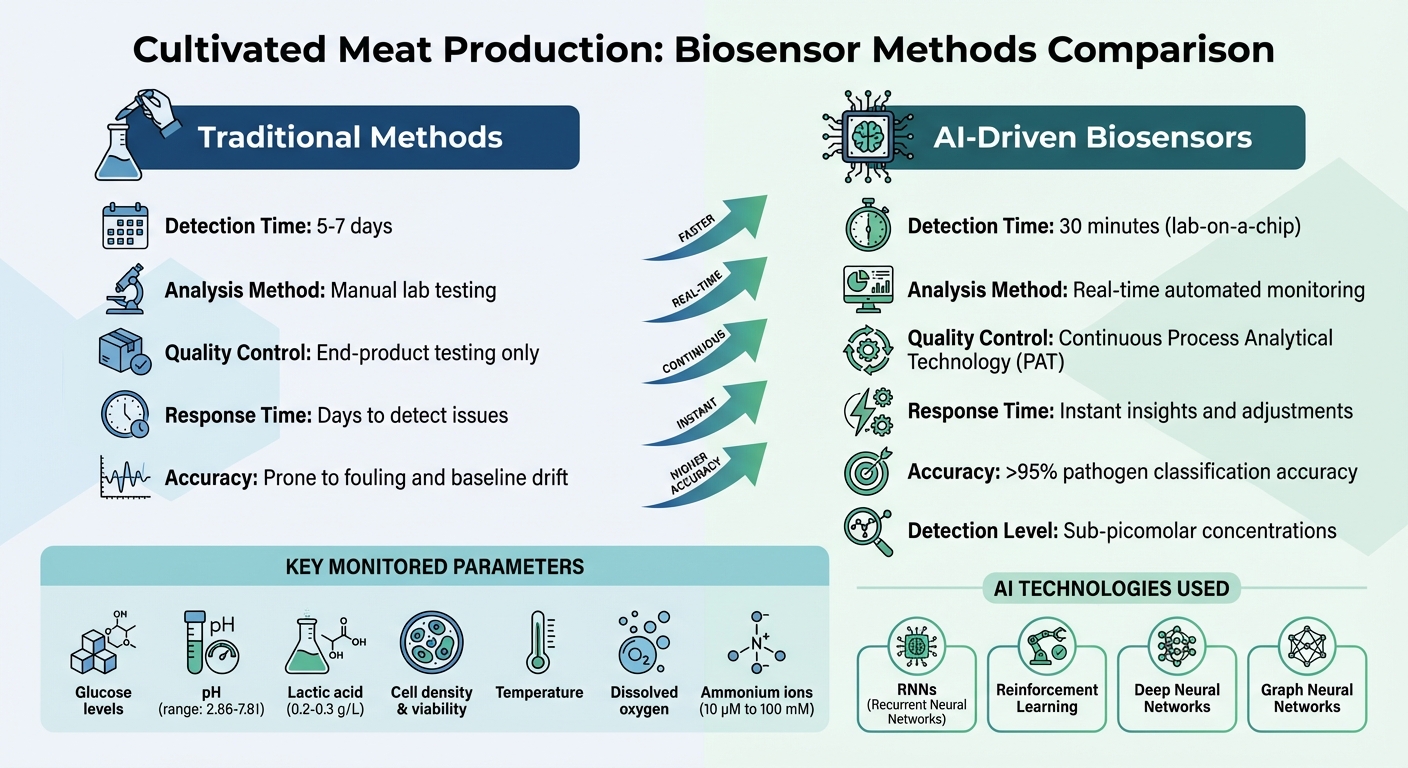
Traditional vs AI-Driven Biosensors in Cultivated Meat Production
Automation and AI in Cultured Meat Manufacturing - CMS23
AI-Driven Biosensor Technologies for Cultivated Meat
AI is making waves in cultivated meat production, especially through its integration with cutting-edge biosensor technologies. These tools are being fine-tuned to deliver real-time data, enabling precise process control and faster decision-making.
RealSense Biosensor Integration for Bioreactors
Lab-on-a-chip platforms have revolutionised bioprocessing by reducing analysis times to just 30 minutes, compared to the 5–7 days required by traditional methods [7]. Their compact design not only saves time but also minimises reagent use, making them ideal for scale-down experiments. These smaller-scale tests simulate the behaviour of large bioreactors, offering a cost-efficient way to refine processes before full-scale production [6][7].
Impedimetric sensors, particularly those using interdigitated electrode (IDE) designs, have emerged as a standout technology for monitoring biomass. In April 2023, researchers at the BioSense Institute (University of Novi Sad) introduced a microfluidic platform equipped with an inkjet-printed impedimetric sensor. This system monitored the growth of MRC-5 mammalian cells over 96 hours, effectively tracking all four growth phases - lag, exponential, stationary, and dying - by measuring cell membrane capacitance. Operating at radio frequencies up to 100 kHz, these sensors deliver high precision without requiring labelling or direct contact with the cells [6].
When paired with AI, these rapid detection systems become even more powerful, offering enhanced precision and adaptability.
The Cultivated B AI-Enhanced Multi-Channel Biosensors
The Cultivated B's biosensor system goes beyond simple monitoring. It provides actionable insights, such as real-time recommendations for adjusting media formulations. This ensures consistent batch quality while reducing material waste, making it a valuable tool for optimising production [2].
Meanwhile, microfluidic platforms are also gaining traction for their ability to provide continuous, scalable monitoring.
Microfluidic Platforms for Scale-Down Analysis
Thread-based sensing microprobes represent another innovative approach. In August 2023, researchers from Tufts University, including David L. Kaplan, demonstrated a portable, 3D-printed microprobe. This device continuously monitored key parameters like pH (range 2.86 to 7.81) and ammonium ion concentrations (10 μM to 100 mM) in cultivated meat bioreactors. By delivering real-time data, it helps maintain optimal conditions for cell growth and phenotype preservation [3].
These advancements highlight how biosensor technologies, combined with AI, are shaping the future of cultivated meat production. By enabling real-time monitoring and actionable insights, they are paving the way for more efficient and scalable processes.
AI Applications in Sensor Data Analysis
Biosensors combined with artificial intelligence are reshaping how sensor data is utilised, turning raw inputs into immediate adjustments for improved processes. By continuously analysing data from multiple sensors, AI delivers actionable insights that optimise cultivated meat production [2]. This setup not only anticipates potential issues but also reacts quickly to anomalies.
AI for Process Parameter Prediction and Adjustment
Recurrent Neural Networks (RNNs) excel at processing time-series data from bioreactor sensors. They retain long-term information, making them ideal for predicting future states of essential parameters like pH, temperature, and dissolved oxygen [1]. If any of these parameters start to drift, the system can automatically adjust media formulations or environmental settings to maintain optimal cell growth conditions.
Reinforcement Learning (RL) takes a dynamic approach by allowing an AI agent to directly interact with the bioreactor environment. Through sequential decision-making, the system maximises cumulative rewards, such as achieving the best possible cell yield or growth rate. Over time, the AI learns from each production cycle, refining its strategies for better outcomes [1].
Deep Neural Networks (DNNs) address the complexity of biological processes by combining data from diverse sources. These models integrate sensor readings with multi-omics data - like genomics, transcriptomics, and metabolomics - to provide a comprehensive understanding of the bioprocess. Meanwhile, Graph Neural Networks (GNNs) simulate metabolic pathways and protein interactions, predicting how changes in nutrients might affect the entire cell population [1].
"Machine learning has the potential to accelerate cultured meat technology by streamlining experiments, predicting optimal results, and reducing experimentation time and resources." - Michael E. Todhunter et al., Frontiers in Artificial Intelligence [1]
Machine Learning for Anomaly Detection in Bioprocessing
While predictive models help maintain optimal conditions, machine learning also plays a critical role in identifying problems early. Catching deviations quickly is essential for ensuring consistent product quality. Unsupervised learning methods, such as k-means and hierarchical clustering, analyse unlabelled sensor data to uncover patterns that might indicate contamination or batch issues - problems that might go unnoticed by human operators [1][4].
In fact, machine learning applied to biosensor data has demonstrated pathogen classification accuracies above 95% in some cases [4]. These capabilities allow for real-time protocol adjustments, shifting quality control from traditional end-product testing to continuous monitoring throughout the production cycle [5]. This proactive approach safeguards quality and reduces waste.
sbb-itb-ffee270
Challenges in Integrating AI-Driven Biosensors
AI-driven biosensors hold great potential, but their implementation in cultivated meat bioreactors comes with notable challenges. The biological complexity of these systems can undermine the reliability and precision of sensors. Addressing these issues is key to creating effective monitoring solutions, especially when combined with AI-driven improvements.
Sensor Placement and Accuracy in Bioreactors
One of the biggest hurdles is determining the optimal placement for sensors in large-scale bioreactors. Uneven flow patterns within the reactor lead to inconsistent fluid movement. Studies using Computational Fluid Dynamics (CFD) simulations and MRI velocimetry show that flow often follows specific paths, creating localised areas with varying levels of nutrients and oxygen [9]. This makes it impossible for a single sensor to capture an accurate picture of the entire system.
Another issue is fouling and baseline drift, where proteins and other biomaterials accumulate on sensor surfaces over time, reducing their accuracy [8]. Sensors also need to endure rigorous sterilisation processes, such as autoclaving, without losing their calibration [8]. The challenge is amplified by the complex composition of growth media and the extremely low concentrations of some analytes, which demand high specificity from the sensors [7][8].
In February 2025, a team at the University of Lyon encountered these challenges while developing a framework for bioprinted fibroblast tissues (10.8 cm³). During initial tests, oxygen regulation deviated by 128%. However, by implementing a cascaded PID loop, they reduced deviations to 22% [9]. Using 7 Tesla MRI velocimetry, they mapped flow patterns and pinpointed dead zones, which informed their final sensor placement strategy.
"In situ sensors must be capable of functioning without fouling over prolonged periods of time... The common problems related to in situ probes are fouling and baseline drift due to precipitation of proteins and/or other biomaterial on the contact surface." - J.M.S. Cabral and L.P. Fonseca [8]
These placement challenges also complicate the design of automated feedback systems, particularly for media recycling.
Automated Feedback Loops for Media Recycling
Once sensors are placed, creating automated feedback loops adds another layer of complexity. For instance, automating media recycling requires balancing multiple factors. Gas regulation competition is one example - adjusting one gas can inadvertently disrupt others. For example, injecting nitrogen to manage oxygen levels can displace CO₂, leading to pH imbalances [9]. This interplay demands advanced control algorithms to manage competing variables effectively.
Low concentrations of waste products, typical in tissue cultures, further complicate monitoring. For instance, lactic acid concentrations often range between 0.2–0.3 g/L, which challenges standard sensors to deliver accurate readings [9]. To address this, the Lyon team used Raman spectroscopy calibrated with chemometric models. This approach achieved a prediction precision error of just 0.103 g/L for lactic acid, enabling real-time monitoring without manual sampling [9].
The slower growth rates in 3D cultures add another challenge. For example, human dermal fibroblasts in 3D environments have a doubling time of 3.5 days compared to 1.7 days in 2D monolayers [9]. This slower pace demands tighter control over environmental conditions for extended periods. High-frequency data from embedded sensors provides the detailed insights needed to maintain regulatory compliance and implement quality-by-design strategies in cultivated meat production [9].
Procuring AI-Driven Biosensors via Cellbase
When it comes to advanced technologies, finding the right way to procure them is just as important as the technology itself.
Why Choose Cellbase for Biosensor Procurement?
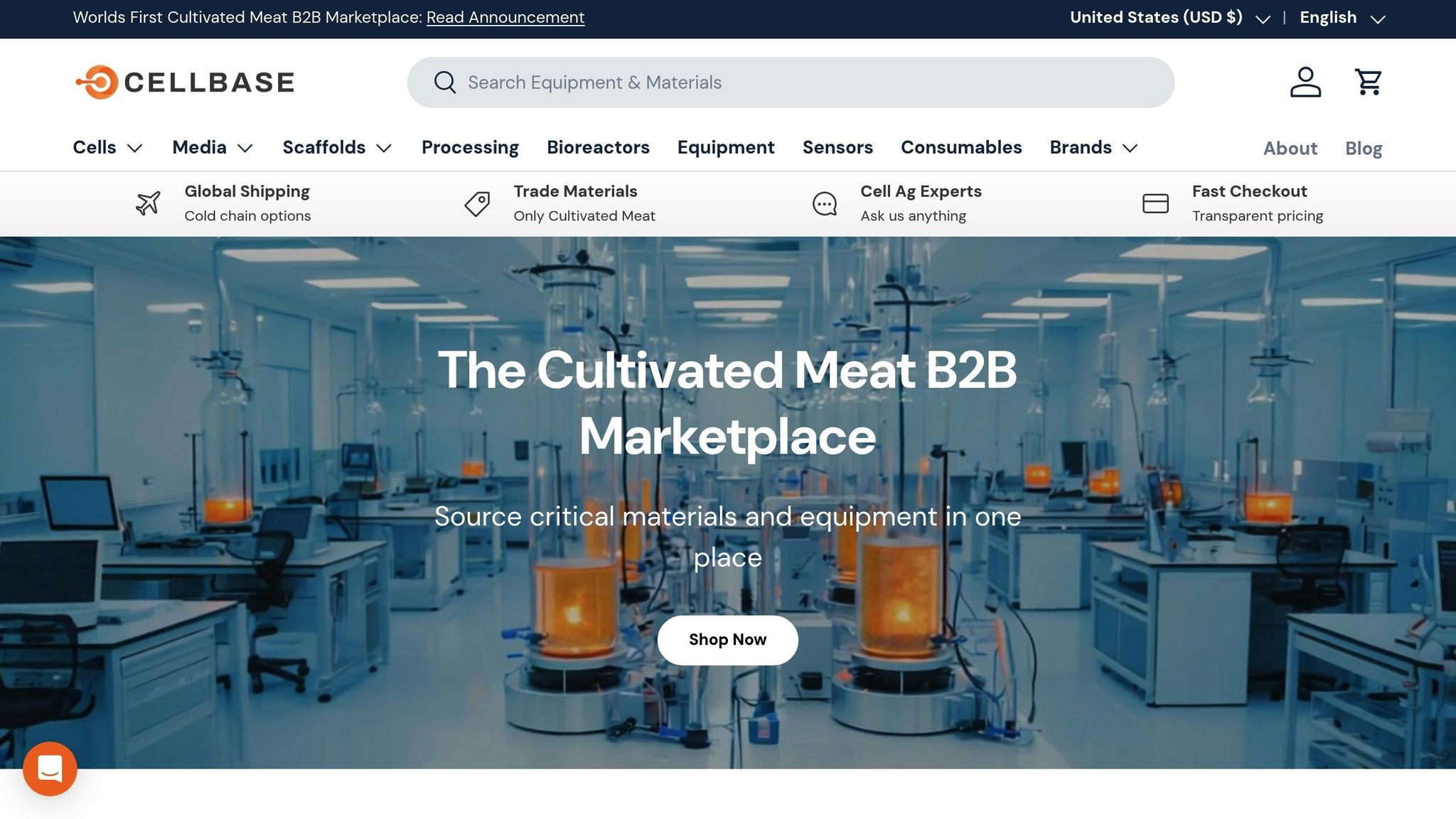
Sourcing AI-driven biosensors for cultivated meat production is no longer a hassle when you move away from generic lab suppliers to a specialised platform. Cellbase, the first-ever B2B marketplace dedicated to cultivated meat, ensures that every product listed is tailored to meet the specific needs of this industry [5].
The platform offers transparency in pricing and a quick checkout process, eliminating the delays often associated with traditional procurement [5]. This is especially critical when scaling up production, where having clear cost estimates is a must. Buyers also benefit from access to Cellbase experts, who provide technical support for tasks like system integration, calibration, and sourcing specific components [5]. These services complement the real-time monitoring capabilities that are already reshaping cultivation processes. By simplifying procurement, Cellbase makes it easier to integrate biosensors into existing bioreactor systems seamlessly.
"Automated monitoring reduces manual intervention whilst providing comprehensive data logging for regulatory compliance and process optimisation." - Cellbase [5]
Additionally, Cellbase handles logistics for delicate and sensitive components, ensuring they arrive safely [5].
Access to Verified Suppliers for Advanced Monitoring Tools
Cellbase connects buyers with trusted suppliers offering cutting-edge Process Analytical Technology (PAT) tools and multi-channel biosensors. These devices can detect molecules at sub-picomolar levels and provide non-invasive, real-time monitoring of crucial parameters like pH, temperature, cell density, viability, and metabolic activity - all without disturbing the culture conditions [10].
If a specific AI-driven sensor isn’t available on the platform, buyers can use the sourcing form to request that Cellbase find and onboard an appropriate supplier [5]. The "Ask us anything" feature allows direct communication with experts who can advise on compatibility with existing bioreactor setups. This proactive guidance helps reduce technical risks and ensures a smoother integration process.
Cellbase regularly updates its offerings, adding new suppliers and products every week. This makes it a go-to hub for the latest monitoring technologies in the cultivated meat industry [5].
Conclusion
AI-powered biosensors are reshaping how cultivated meat producers manage and monitor their bioprocesses. These advanced systems provide continuous, highly accurate tracking of cell growth and metabolic activity, replacing outdated, time-consuming methods with near-instantaneous, real-time analysis. Their ability to detect metabolites at incredibly low concentrations allows for immediate adjustments to culture conditions, significantly reducing the risk of batch failures [2][12].
This technology is no longer just theoretical - it’s already being implemented. In February 2025, The Cultivated B introduced AI-driven multi-channel biosensors capable of analysing bioreactor data in real time and recommending media formulations [2][12]. Similarly, between 2019 and 2022, the RealSense project showcased how microfluidic strategies could enable media recycling in stirred-tank bioreactors, addressing one of the industry's major cost challenges [11].
However, challenges persist. Issues like sensor fouling caused by protein precipitation, baseline drift during sterilisation, and the lack of standardised datasets for machine learning models limit the current potential of these systems [8][1][4]. Additionally, cross-reactivity in complex food matrices can sometimes lead to inaccurate readings, such as false positives [13].
Future advancements will focus on integrating Explainable AI, developing open-access datasets, and designing sensors that remain stable and calibrated even after sterilisation [4][8]. These improvements will streamline workflows and make scalable production more achievable.
Collaboration is key to moving forward. Sensor manufacturers, AI developers, and cultivated meat producers must work together to create specialised solutions tailored for this industry, rather than relying on costly pharmaceutical-grade equipment [14]. Platforms like Cellbase play a vital role, connecting buyers with verified suppliers of these technologies and helping to overcome procurement hurdles. This collective effort will pave the way for the next major step in process automation and commercial-scale production.
FAQs
How do AI-powered biosensors enhance cultivated meat production?
AI-powered biosensors are transforming cultivated meat production by offering real-time monitoring of critical bioprocess parameters like temperature, pH, dissolved oxygen, glucose, and metabolites. These tools ensure bioreactors maintain the ideal conditions needed for steady cell growth and consistent product quality.
With artificial intelligence in the mix, these sensors go beyond simple monitoring. They analyse data in-depth and can automatically adjust conditions to minimise waste, boost yields, and lower contamination risks. Even the slightest changes in the process are detected, allowing for precise adjustments to media formulations and operational settings. This adaptability makes production more scalable and cost-efficient.
By combining AI and biosensor technology, cultivated meat production takes a significant step forward, paving the way for it to become a dependable and efficient food option in the future.
What are the main challenges of using AI-driven biosensors in cultivated meat bioreactors?
Integrating AI-driven biosensors into bioreactors for cultivated meat production isn’t without its hurdles. One major concern is ensuring precise monitoring of critical parameters like temperature, pH, dissolved oxygen, and metabolites. Even slight inaccuracies can throw off cell growth, leading to lower yields. On top of that, sensor drift and calibration issues in the ever-changing bioprocess environment often demand frequent maintenance to keep things on track.
Another tricky aspect is creating smooth integration between sensors, AI systems, and production equipment. Compatibility between these components is essential, and secure data communication is a must to prevent failures or data loss. But it doesn’t stop there - developing effective AI models requires a wealth of high-quality data, which can be challenging to gather consistently in bioreactor conditions.
And let’s not forget the regulatory landscape in the UK. Biosensors and AI systems need to meet strict safety and food production standards, adding another layer of complexity. Overcoming these obstacles is key to enabling real-time monitoring and making cultivated meat production more scalable.
How does Cellbase help cultivated meat producers source AI-driven biosensors?
Cellbase simplifies the process for cultivated meat producers to source AI-driven biosensors by serving as a specialised B2B marketplace tailored specifically to the industry's requirements. It bridges the gap between researchers, scientists, and production managers and verified suppliers who offer advanced biosensor technologies for real-time monitoring and data analysis.
The platform features carefully curated equipment listings, clear pricing details, and access to the latest advancements, eliminating the hassle of lengthy searches and supplier vetting. By enabling direct connections between buyers and suppliers, Cellbase makes it easier for producers to integrate advanced biosensors into their operations efficiently.


