

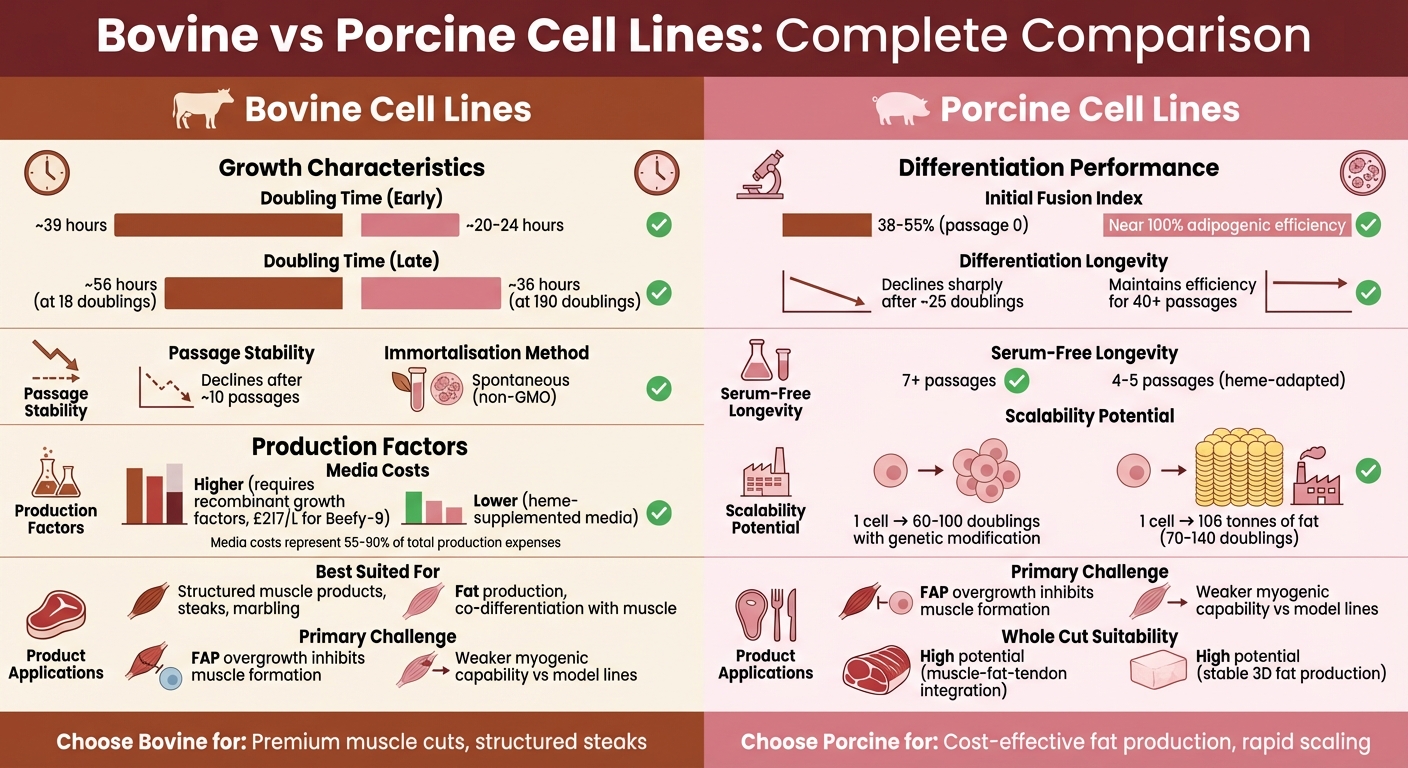
Choosing between bovine and porcine cell lines is a critical decision for cultivated meat production. Each cell type offers distinct advantages and challenges, impacting scalability, media requirements, and the ability to create structured meat products. Here's a quick overview:
- Bovine cell lines are well-suited for muscle tissue production, particularly for products like steaks. They excel in marbling but face challenges with long-term differentiation and require genetic modifications for scalability.
- Porcine cell lines are ideal for fat production, with spontaneous immortalisation and stable growth over hundreds of doublings. They are cost-effective for large-scale production but may require precise timing for co-differentiation with muscle cells.
Quick Comparison
| Attribute | Bovine Cell Lines | Porcine Cell Lines |
|---|---|---|
| Doubling Time | ~39 hours (early passages) | 20–24 hours (early passages) |
| Immortalisation | Requires genetic modification | Spontaneous |
| Differentiation | Strong early, declines after ~25 doublings | Stable adipogenic efficiency (>200 doublings) |
| Media Costs | Higher due to recombinant growth factors | Lower with heme-supplemented media |
| Structured Meat Suitability | Suitable for marbling and muscle-fat separation | Effective for fat-muscle co-differentiation |
Both cell lines have unique strengths and limitations, making the choice dependent on product goals and production strategies.
Bovine vs Porcine Cell Lines Comparison for Cultivated Meat Production
Bovine Cell Lines
Applications in Cultivated Meat
Bovine cell lines are particularly suited for producing structured meat products like steaks and other premium cuts. One of their standout features is their ability to develop authentic marbling - the intramuscular fat responsible for beef's distinct flavour and texture. This marbling is achieved through the role of bovine satellite cells (BSCs), which form the muscle component, and fibro-adipogenic progenitors (FAPs), which generate fat with a fatty acid profile nearly identical to natural bovine subcutaneous fat [2].
Creating proper marbling requires careful coordination during differentiation. Unlike porcine systems, which can simultaneously differentiate muscle and fat, bovine systems typically handle the differentiation of myogenic (muscle-forming) and adipogenic (fat-forming) cells separately. These components are then combined to achieve precise control over the fat-to-muscle ratio. While this method allows for greater customisation, it also introduces additional complexity to the production process [2].
Growth Characteristics
Although bovine cells are effective at generating both muscle and fat, their growth dynamics present challenges for large-scale production. A key issue arises with bovine satellite cells, which lose their ability to differentiate as they continue to proliferate. For example, primary bovine myoblasts can undergo between 60 and 100 population doublings while maintaining a normal karyotype. However, their capacity to fuse into myotubes - an essential step for muscle tissue formation - drops significantly after around 25 doublings. This limitation creates a bottleneck for scaling up production, which requires approximately 2.9×10¹¹ cells per kilogram of wet mass [7].
In May 2023, researchers at the Tufts University Centre for Cellular Agriculture tackled this issue by developing genetically immortalised bovine satellite cells (iBSCs). By introducing bovine Telomerase reverse transcriptase (TERT) and Cyclin-dependent kinase 4 (CDK4), these cells were able to surpass 120 doublings while still forming multinucleated myotubes. Andrew J. Stout from Tufts University emphasised the importance of this breakthrough:
"For cultured meat to succeed at scale, muscle cells from food-relevant species must be expanded in vitro in a rapid and reliable manner to produce millions of metric tonnes of biomass annually." [5]
Growth performance is also heavily influenced by factors like seeding density and media formulation. For example, bovine adipose-derived stem cells (bASCs) showed optimal growth at a seeding density of 1,500 cells/cm², achieving a 28-fold expansion in spinner flasks when using an 80% medium exchange strategy [1]. Additionally, chemically defined serum-free media have been shown to support the exponential growth of bovine myoblasts at rates reaching 97% of those achieved with traditional serum-containing media [6]. This not only reduces costs but also aligns with ethical considerations, making it a promising approach for future production.
These bovine-specific growth traits provide a solid basis for comparing them to porcine cell lines in the context of cultivated meat production.
sbb-itb-ffee270
Porcine Cell Lines
Applications in Cultivated Meat
Porcine cell lines are instrumental in producing mature unilocular adipocytes that closely resemble natural pork fat[9].
One standout example is the FaTTy cell line, created through spontaneous immortalisation. This cell line demonstrates an impressive ~100% adipogenic efficiency across 200 doublings, producing fatty acid profiles that align closely with those found in native pork fat. Cultivated adipocytes derived from this line can achieve lipid volumes as high as 96,670 μm³. As the FaTTy Research Team explains:
"FaTTy is a unique livestock cell line with distinct adipogenic phenotype characterised by the ability to reliably differentiate with high-efficiency under a variety of culture conditions, and to generate mature adipocytes displaying fatty acid profiles comparable to native fat." [9]
Another notable cell line, PK15H, thrives in high-haem media concentrations of up to 40 mM. This feature helps replicate the rich colour and iron-heavy flavour typical of traditional pork[3]. Moreover, cultivated porcine fat can be fine-tuned for healthier lipid compositions, achieving monounsaturated-to-saturated fatty acid ratios of 3.2, compared to the 1.4 ratio commonly found in native tissue[9].
Growth Characteristics
Porcine cell lines are not only adept at fat production but also excel in terms of growth and scalability. They exhibit stable and rapid expansion, making them particularly suitable for large-scale production. For instance, the FaTTy line starts with a population doubling time of 20–24 hours, which only slows slightly to 22–36 hours between the 140th and 190th doublings. This consistency is a game-changer, as a single FaTTy cell expanded from 70 to 140 population doublings could theoretically produce 106 tonnes of fat within an 11-day differentiation period[9].
One major advantage of these cell lines is their spontaneous immortalisation, enabling long-term expansion without the need for genetic modification. This non-GMO status is a regulatory win. Highlighting this, the University of Ulsan College of Medicine noted:
"Our study reports a porcine cell culturable in high-heme media that can be maintained in serum-free conditions." [3]
Additionally, porcine muscle stem cells show remarkable scalability, with expansion rates of 10⁶ to 10⁷ times, capable of producing between 100 g and 1 kg of cultivated meat[10]. Advances in cell sorting techniques, using markers like CD31, CD45, JAM1, ITGA5, and ITGA7, have significantly improved the isolation of high-purity muscle stem cells. These methods deliver a 20% increase in PAX7 positivity rates compared to older techniques[11]. This improvement ensures that myogenic potential is preserved across multiple passages, addressing the common issue of diminished differentiation capacity during prolonged expansion.
These growth and differentiation advantages make porcine cells a standout choice over bovine cells for cultivated meat production.
ICAN Webinar about Cell Lines and Culture Media for Cultivated Meat Applications
Growth Rates and Proliferation Compared
Let’s dive into how porcine and bovine cell lines stack up when it comes to growth and proliferation. porcine cell lines, such as the spontaneously immortalised FaTTy line, are notably quicker. Their initial population doubling time is just 20–24 hours [9]. In contrast, bovine satellite cells, even when grown in optimised serum-free media like Beefy-9, take around 39 hours per doubling [12].
The differences become even clearer over multiple passages. Primary bovine satellite cells tend to lose both their proliferation and differentiation abilities after about 10 passages [2]. On the other hand, the FaTTy porcine line has maintained almost 100% adipogenic efficiency across more than 200 population doublings. Even at later stages, their doubling time only increases modestly to 22–36 hours [9]. A May 2022 study from Tufts University highlighted that bovine cells in Beefy-9 achieved 18.2 population doublings over seven passages (28 days) while retaining over 96% Pax7⁺ stemness [12]. Meanwhile, a January 2025 report from the University of Edinburgh confirmed that the FaTTy line surpassed 200 doublings without losing its differentiation potential [9].
There’s also a stark contrast in how these cells achieve immortalisation. Bovine cells typically need genetic engineering - commonly through TERT and CDK4 overexpression - to sustain long-term expansion beyond 120 doublings [5]. In comparison, porcine cells like the FaTTy line achieve spontaneous immortalisation without genetic modification. This offers a clear regulatory edge, especially in markets wary of GMOs [9].
Comparison Table
| Feature | Bovine Satellite Cells | Porcine MSCs (FaTTy Line) |
|---|---|---|
| Average Doubling Time | ~39 hours (optimised serum-free) [12] | 20–24 hours (early passages) [9] |
| Late-Passage Doubling Time | ~56 hours (at 18 doublings) [12] | ~36 hours (at 190 doublings) [9] |
| Passage Stability | Declines after ~10 passages [2] | Stable for >200 doublings [9] |
| Immortalisation Method | Engineered (TERT/CDK4) [2] | Spontaneous [9] |
| Stemness/Differentiation | >96% Pax7⁺ (up to passage 6) [12] | Near 100% adipogenic efficiency [9] |
It’s worth noting that in vivo satellite cells double in approximately 17 hours, which highlights the difficulty of matching natural growth rates in vitro [12].
Media Requirements and Differentiation Efficiency
Media Dependency Compared
Media costs can dominate cultivated meat production, often making up 55% to 90% of expenses, and in some systems, even exceeding 99% [3][12].
For bovine cells, a common requirement is 20% foetal bovine serum, which can be a significant media expense [12]. A serum-free alternative, Beefy-9, uses a B8 basal medium combined with recombinant human albumin. Costs vary depending on sourcing and order volume, so it’s best to check the supplier or product page for current pricing details [12]. However, high albumin levels in serum-free media can hinder cell adhesion, so recombinant albumin is typically added 24 hours after passaging [12].
Porcine cell lines take a different approach to serum-free adaptation. PK15 cells, for instance, utilise bacterial heme extracts from Corynebacterium [3]. Heme not only reduces serum dependency but also enhances flavour and colour. That said, concentrations above 10 mM can become toxic, although porcine cells can tolerate up to 40 mM due to the upregulation of detoxification genes [3]. Despite this tolerance, porcine cells grown in heme-supplemented media generally remain viable for only 4–5 passages, whereas bovine cells cultured in Beefy-9 can sustain growth for seven or more passages [3][12].
Both cell types heavily rely on fibroblast growth factor-2 (FGF-2). Bovine cells, for example, can maintain short-term growth even when FGF-2 levels are reduced from 40 ng/mL to 5 ng/mL [12]. Additionally, using low-glucose media (1 g/L) helps retain stemness markers in bovine cells [13].
These specific media requirements are critical when scaling production and directly influence differentiation efficiency.
Differentiation Efficiency
While media costs are a significant factor, differentiation efficiency also plays a major role in determining the scalability of cultivated meat.
Bovine cells face challenges with differentiation efficiency as they expand. For instance, bovine myoblasts from Belgian Blue cattle initially achieve a fusion index of about 55% at 14 population doublings, but this drops sharply to less than 10% by 25 doublings [7]. Similarly, foetal-derived bovine cells start with higher fusion indices (around 54.6%) compared to adult-derived cells (approximately 38.0%), yet both experience a decline in differentiation capacity of about 6.81% per passage [7].
Porcine cells, on the other hand, show more stable performance. The immortalised ISP-4 porcine preadipocyte strain retains high adipogenic differentiation efficiency for over 40 passages, achieving a 100-fold increase in lipid accumulation during an 8-day differentiation protocol [8]. This makes porcine cells particularly appealing for fat production, whereas bovine cells are better suited for muscle differentiation in the early passages but struggle with long-term maintenance.
| Feature | Bovine Satellite Cells | Porcine Cell Lines |
|---|---|---|
| Initial Fusion Index | 38–55% (passage 0) [7] | Not specified for muscle |
| Differentiation Longevity | Declines sharply after ~25 doublings [7] | Maintains efficiency for over 40 passages (ISP-4 adipogenic) [8] |
| Serum-Free Longevity | Sustains growth for 7+ passages [12] | Viable for 4–5 passages (heme-adapted) [3] |
| Key Supplements | Recombinant albumin, FGF-2 [12] | Heme extract, insulin, dexamethasone [3][8] |
| Lipid Production | Minimal (muscle focus) | 100-fold increase (ISP-4) [8] |
Suitability for Structured Meat Products
The choice of cell lines plays a pivotal role in shaping not just the growth and media conditions but also the structure of cultivated meat products. When aiming to replicate the texture and appearance of a steak or pork chop, balancing fat and muscle cells in the right proportions is essential.
Fat-Muscle Co-Differentiation
Bovine and porcine cell lines behave differently when it comes to co-differentiation. Bovine cell cultures often face challenges like FAP (fibro-adipogenic progenitor) overgrowth, which disrupts muscle development by lowering the fusion index. Additionally, adipocytes in these cultures release signals, such as myostatin and IL-6, that block myogenin expression, effectively halting muscle fibre formation[16].
To address this, researchers at Mosa Meat created an optimised serum-free growth medium (i-SFGM). This medium includes triiodothyronine (T3) and increased HGF while excluding PDGF-BB to control FAP overgrowth. They also use modular adipospheres (200–400 µm) to keep fat and muscle cells physically separate during early growth stages[4][14].
Porcine cell lines, on the other hand, show a more coordinated approach to co-differentiation. The ISP-4 preadipocyte strain, for instance, works well with porcine muscle satellite cells, producing marbling that resembles conventional meat. This process involves a 48-hour adipogenic induction phase, followed by 96 hours in 2% horse serum to trigger myogenesis. This results in mature muscle fibres interwoven with adipocytes[8]. However, porcine muscle satellite cells tend to have weaker myogenic capabilities compared to standard model lines like C2C12, requiring precise timing to ensure adipocytes don’t dominate the culture[8].
These differences in differentiation highlight the unique challenges and opportunities each cell type presents for scaling up production.
Scalability and Production Challenges
Scaling structured cultivated meat production requires consistent cell performance. Porcine cell lines tend to be more scalable. For example, the spontaneously immortalised FaTTy line maintains nearly 100% adipogenic efficiency over 200 population doublings[9]. Expanding a porcine cell line from 70 to 140 doublings could theoretically produce up to 106 tonnes of fat[9]. Moreover, the ISP-4 strain has demonstrated a 40-fold increase in cell density within six days when grown on microcarriers in a spinner flask system[8].
"FaTTy is a unique livestock cell line with distinct adipogenic phenotype... these features, together with its non-GMO nature, make FaTTy a highly promising foundational tool." – Nature Food, 2025[9]
Bovine cell lines face more hurdles. FAP contamination reduces their ability to differentiate into muscle tissue effectively[4]. Additionally, the high cost of growth factors like FGF-2 and TGF-β - often accounting for over 90% of media expenses - makes scaling bovine cell lines more expensive[17]. These cells also require specialised coatings, such as Laminin-521, to promote satellite cell adhesion and minimise FAP interference[4].
Producing one tonne of cultivated meat involves around 10¹³ cells, and structured products like whole cuts require advanced production systems, such as perfusion or packed-bed reactors, to support the 3D scaffolds and biomaterials needed for their development[15].
Comparison Table
| Attribute | Bovine Cell Lines | Porcine Cell Lines |
|---|---|---|
| Primary Scalability Challenge | FAP overgrowth in muscle cultures[4] | Adaptation to suspension/serum-free culture[9] |
| Differentiation Stability | Declines after ~10 passages[2] | Strains like FaTTy stable for >200 doublings[9] |
| Co-Differentiation | Adipocytes inhibit myogenesis[16] | Successful marbling prototypes achieved[2][8] |
| Structural Strength | High; capable of muscle-fat-tendon integration[14] | Moderate; focus on aligned fibre growth[14] |
| Whole Cut Suitability | High potential, limited by FAP interference[4] | High potential due to stable 3D fat production[9] |
| Texture Challenge | Reduced cohesiveness after cooking[14] | Tends to be softer than commercial pork[14] |
Conclusion
Deciding between bovine and porcine cell lines involves balancing their distinct benefits and challenges in cultivated meat production. Bovine satellite cells are a direct pathway to creating skeletal muscle tissue and benefit from existing serum-free media formulations like Beefy-9 [2]. On the other hand, porcine cell lines have already been used to develop cultivated pork prototypes and show promise in co-differentiating with satellite cells to create marbled meat structures [2].
Scalability remains a major hurdle. Media costs and bioreactor scalability account for 55%–90% of total production expenses, and the availability of optimised cell lines is still limited, slowing down commercial progress [3][2].
"The cell lines used in cultivated meat production ultimately determine many of the downstream variables to consider." – GFI [2]
FAQs
Which cell line is best for whole-cut products like steaks or chops?
Cell lines derived from muscle-resident progenitor cells, like satellite cells, are often ideal for producing whole-cut products such as steaks or chops. These cells have the ability to develop into mature muscle tissue, creating the structured texture and form needed for these types of products.
How do I choose between genetic immortalisation and spontaneous immortalisation?
Choosing how to immortalise cells for cultivated meat production depends on your priorities, including safety, scalability, and regulatory considerations.
Genetic immortalisation involves introducing specific genes, such as telomerase, to achieve precise control over the cells' ability to divide indefinitely. While this method offers predictability and consistency, it may raise concerns about genetic modification and potential risks, such as tumourigenicity.
On the other hand, spontaneous immortalisation occurs naturally over time in long-term cell cultures. This approach avoids genetic engineering, which could make regulatory approval smoother and increase acceptance among consumers wary of genetic modification.
Both methods have their strengths and challenges, offering different paths toward scalable cultivated meat production. The choice ultimately depends on balancing control, regulatory hurdles, and consumer trust.
What’s the biggest cost driver in media for bovine vs porcine cells?
The biggest expense in producing media for bovine and porcine cells comes down to the cost and complexity of its components. Developing and fine-tuning media formulations is a major hurdle, especially since media accounts for at least 50% of variable operating costs. On top of that, adjustments tailored to each species add another layer of complexity. These aspects play a major role in shaping the overall production costs of cultivated meat.


