

Scaffold degradation directly affects the structure, texture, and quality of cultivated meat. For R&D teams, understanding the timing and rate of scaffold breakdown is critical to achieving consistent results. Here’s what you need to know:
- Purpose of Scaffolds: Scaffolds guide cell growth into structured tissues by mimicking the extracellular matrix (ECM). They provide support until cells produce their own ECM.
- Challenges: If scaffolds degrade too fast, tissue collapses. If too slow, remnants can alter texture and require removal.
- Material Choices: Options include edible polysaccharides (e.g., alginate), plant proteins (e.g., soy), and ECM-inspired materials (e.g., collagen). Synthetic polymers need removal due to slow degradation and non-edibility.
-
Key Factors:
- Crosslinking Density: Higher density slows degradation.
- Porosity: More surface area speeds up breakdown.
- Enzymatic Sites: MMP-sensitive scaffolds align degradation with cell activity.
- Testing Methods: Mass loss analysis, texture profile analysis (TPA), and mechanical testing help optimise scaffold design.
- Species-Specific Requirements: Scaffolds for fish must mimic low thermal stability for proper texture, while those for beef need to support collagenous networks during cooking.
Aligning scaffold degradation with cultivation timelines ensures robust tissue formation and desirable sensory qualities. Material selection, culture conditions, and food safety compliance are key to scaling production. For advanced tools and materials, platforms like Cellbase offer tailored solutions.
The Elements of Cultured Meat: Scaffolds 101 with Natalie Rubio | New Harvest 2017

Material Properties That Drive Scaffold Degradation
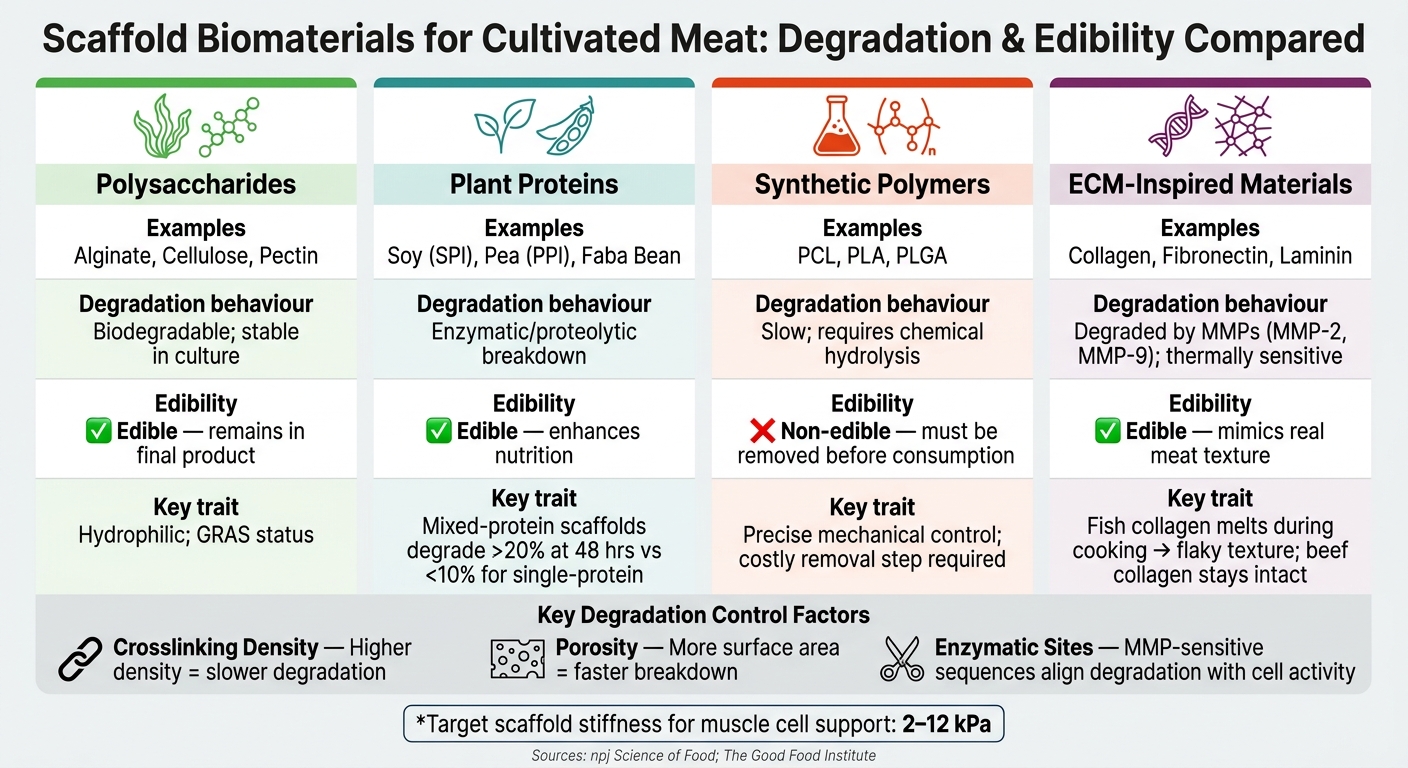
Scaffold Biomaterials for Cultivated Meat: Degradation & Edibility Compared
Common Biomaterial Classes Used in Scaffolds
The material used in scaffolds plays a major role in determining how it degrades during cultivation. Scaffolds are generally grouped into four main categories: polysaccharides, plant-derived proteins, synthetic polymers, and ECM-inspired materials.
- Polysaccharides: Examples include alginate, cellulose, and pectin. These materials are hydrophilic, biodegradable, and suitable for edible scaffolds that remain in the final product.
- Plant Proteins: Soy, pea, and faba bean proteins degrade enzymatically and proteolytically. The rate of degradation depends heavily on how these proteins are blended and processed.
- Synthetic Polymers: Materials like PCL, PLA, and PLGA offer precise mechanical control but degrade slowly. Since they are non-edible, they must be removed before the product reaches consumers.
- ECM-Inspired Materials: Collagen, fibronectin, and laminin are degraded by matrix metalloproteinases (MMPs). These materials mimic the natural remodelling environment of living tissues, making them ideal for guiding myotube formation [3].
| Biomaterial Class | Common Examples | Degradation Behaviour | Edibility |
|---|---|---|---|
| Polysaccharides | Alginate, Cellulose, Pectin | Biodegradable; stable in culture | Edible; remains in product |
| Plant Proteins | Soy (SPI), Pea (PPI), Faba Bean | Enzymatic/proteolytic breakdown | Edible; enhances nutrition |
| Synthetic Polymers | PCL, PLA, PLGA | Slow; often requires chemical hydrolysis | Usually removed; non-edible |
| ECM-Inspired | Collagen, Fibronectin, Laminin | Degraded by MMPs; thermally sensitive | Edible; mimics real meat texture |
The industry is increasingly favouring edible, food-grade scaffolds to avoid the costly dissociation step required when synthetic polymers are used [1][2]. These choices in material lay the groundwork for how intrinsic properties influence scaffold degradation.
Key Properties That Control Degradation Rate
Several intrinsic properties of scaffold materials determine how quickly they degrade under culture conditions.
- Crosslinking Density: This is a key factor. Crosslinking, whether achieved physically (ionic or thermal), chemically, or enzymatically (e.g., using transglutaminase), affects the scaffold's resistance to enzymatic and hydrolytic breakdown [1]. Denser crosslinking slows degradation, which is useful during cell proliferation but can be a challenge when softening is needed during maturation.
- Porosity and Surface Area: High porosity increases the surface area exposed to enzymatic or hydrolytic attack, speeding up degradation [1]. Hydrophilic materials, like soy-based proteins or alginate, absorb water readily, making them more accessible to degrading agents [4]. For instance, mixed-protein scaffolds degrade faster, exceeding 20% degradation at 48 hours, compared to single-protein scaffolds, which degrade less than 10% during early incubation [4].
- Enzymatic Degradability: Scaffolds designed with specific MMP cleavage sites are broken down by enzymes like MMP-2 and MMP-9, which target components such as collagen IV, fibronectin, and laminin [3]. This process is essential for myotube formation but must align with the culture timeline.
- Thermal Stability: This varies by material source. For example, fish collagen has lower thermal stability than mammalian collagen, causing it to melt during cooking. Cultivated fish scaffolds must replicate this behaviour to achieve the desired flaky texture [3].
Balancing these properties is crucial for achieving the right tissue maturity and texture in cultivated meat.
Methods for Measuring Scaffold Degradation
To optimise scaffold design, it’s essential to measure degradation accurately. Several techniques are used to assess how scaffolds break down over time:
- Mass Loss Analysis: This simple method involves tracking the percentage reduction in the dry weight of scaffolds. It is commonly used in studies on plant protein scaffolds [4].
- Texture Profile Analysis (TPA): This measures properties like hardness, springiness, and cohesiveness, offering insights into how degradation affects sensory characteristics [3][4].
- Warner–Bratzler Shear Force (WBSF): For cooked samples, this test measures the force needed to cut through the scaffold. As a benchmark, tenderness thresholds for beef are around 40 N, which can guide cultivated meat development [3].
- Mechanical Testing: Measuring stiffness (Young’s modulus) provides insights into structural integrity. A target range of 2–12 kPa is often cited for supporting muscle cell behaviour [3][1].
- Scanning Electron Microscopy (SEM): This technique visualises micro-scale changes in pore structure and surface erosion, complementing other measurements [4][1].
These methods help ensure that scaffold degradation aligns with the desired cell growth and structural goals for cultivated meat.
How Scaffold Degradation Affects Meat Structure and Texture
Effects on Overall Product Structure
The timing of scaffold degradation plays a critical role in cultivated meat production. If the scaffold degrades too early - before cells have secreted sufficient extracellular matrix (ECM) to maintain the structure - the entire construct may collapse. On the other hand, if degradation is too slow, the scaffold can occupy space that should be replaced by cell-secreted ECM, compromising the final product's composition and texture.
In conventional meat, around 90% of its volume is made up of mature muscle fibres, while the remaining 10% consists of fat and connective tissue [3]. To replicate this in cultivated meat, scaffolds must remain stable long enough for cells to form a robust fibre network, then gradually degrade as the biological tissue matures. Striking this balance is essential to avoid structural failure or unwanted scaffold remnants in the final product.
"The majority of muscle's load-bearing ability arises from this dense ECM and not the muscle fibers themselves, revealing the importance of a strong support structure for mature muscle cells." - Claire Bomkamp, Senior Scientist, The Good Food Institute [3]
Synthetic polymers like PLA and PLGA can pose challenges here. Their slow degradation rates often result in their persistence beyond their structural usefulness, sometimes necessitating an additional cell-dissociation step, which can be both complicated and costly [1]. This balance between scaffold integrity and degradation directly impacts cellular behaviour, which is explored further below.
Changes at the Cellular and Microstructural Level
Scaffold degradation is not merely a mechanical process - it is deeply biological. Enzymatic remodelling of the scaffold enables myoblasts to migrate and fuse into multinucleated myotubes, a critical step in muscle fibre formation [3]. Scaffolds that lack accessible MMP cleavage sites or have high crosslink density can block this process, leading to reduced cell density and poorly formed muscle fibres.
Fibre alignment is another key factor. Mature muscle fibres, like those in terrestrial animals, range from 10 to 100 µm in diameter and can extend up to 40 mm in length [3]. Proper scaffold degradation ensures that cells follow directional cues, leading to the anisotropic architecture typical of conventional meat. Research on pig muscle highlights this importance: tissue stretched transversely shows stress values over seven times higher than when stretched longitudinally [3]. This demonstrates how scaffold remodelling shapes both the mechanical properties and structure of the final product.
As scaffolds degrade, they are replaced by cell-secreted collagen, proteoglycans, and glycoproteins. This biological transition is crucial for creating a microstructure that mirrors conventional meat, ultimately influencing the texture and sensory experience of cultivated meat.
Texture, Mouthfeel, and Consumer Expectations
The way scaffolds degrade and are replaced by biological material has a direct impact on the sensory qualities of cultivated meat. Residual scaffold material can create an undesirable mouthfeel, deviating from what consumers expect. Shear force values, which are critical for perceived tenderness, can be negatively affected by scaffold remnants, leading to a tougher product [3].
Scaffold behaviour must align with the textural needs of different types of cultivated meat. For example, in cultivated fish, the scaffold must either degrade completely during culture or have low thermal stability, mimicking the melting of fish collagen during cooking. This process is what gives fish its characteristic flaky texture. As noted in npj Science of Food:
"Scaffolds for cultivated fish will need to recapitulate this lower thermal stability either by having a lower melting temperature themselves or by providing an environment conducive to the secretion of appropriate collagens, together with degradation of the original scaffold, if the cooked product is to have the appropriate texture." [1]
For terrestrial meat, the requirements are different. Scaffolds must support a collagenous network that remains intact during cooking. Texture Profile Analysis (TPA), which evaluates properties like hardness, springiness, and cohesiveness, is often more reliable than shear force alone in predicting consumer perceptions of juiciness and tenderness in cooked meat [3]. This makes TPA a valuable tool for assessing how scaffold remnants influence the final sensory experience.
How Scaffold Degradation Affects Cell Viability and Growth
Nutrient and Oxygen Diffusion in 3D Constructs
Scaffold degradation plays a crucial role in maintaining cell viability and growth, especially in thick, three-dimensional tissue constructs. These scaffolds aren't just structural supports; they actively facilitate the transport of oxygen, nutrients, and waste products throughout the construct, ensuring that cells deep within the material remain healthy. As Claire Bomkamp, Ph.D., Senior Scientist at The Good Food Institute, explains:
"The scaffold often plays a vital role in ensuring the efficient transport of oxygen, nutrients, and waste products to and from the cells, controlling the growing tissue's geometry and cell type distribution." [3]
This process becomes even more critical as degradation progresses. Increased porosity within the scaffold allows cells to migrate and spread, rather than being confined to limited proliferation zones. For instance, studies on nanocellulose (CNF) hydrogels show that cells embedded in non-degrading CNF fail to proliferate. However, when controlled degradation occurs over 21 days, L929 fibroblast cells spread and grow as the scaffold is gradually replaced [5].
Additionally, 3D scaffolds help manage shear stress from flowing culture media in bioreactors. This not only protects delicate cells but also maintains the chemical gradients essential for cell organisation and movement [3]. As the scaffold environment evolves, it improves nutrient flow and creates mechanical cues that can drive cell differentiation.
Scaffold Stiffness and Cell Differentiation
Scaffold degradation doesn't just improve nutrient diffusion - it also influences the mechanical environment, which directly impacts cell development. The stiffness of the scaffold plays a significant role in determining cell fate. For example, skeletal muscle tissue typically exhibits stiffness in the range of 2–12 kPa [1][3]. Scaffolds that maintain this stiffness during the early stages of cell proliferation are better suited for expanding muscle progenitor cells. As the scaffold degrades and its stiffness changes, these mechanical shifts can signal cells to differentiate into mature muscle fibres.
This is why materials with tunable properties over time are gaining attention. A scaffold that begins soft to maximise cell growth but later stiffens or degrades to encourage differentiation mimics natural muscle development more effectively than static materials. Enzymatic remodelling is a key factor here. Enzymes like MMP-2 and MMP-9 (gelatinases) break down components like collagen IV and fibronectin to facilitate cell migration, while MMP-1 and MMP-13 (collagenases) dismantle structural fibres to allow tissue expansion [3]. Scaffolds without accessible cleavage sites for these enzymes can hinder remodelling, ultimately limiting cell density and fibre maturation.
Matching Scaffold Stability to Culture Timelines
Timing is perhaps the most critical factor in scaffold design for cultivated meat production. If the scaffold degrades too quickly, cells can't establish their extracellular matrix, leading to structural collapse. Conversely, if degradation is too slow, the scaffold occupies space needed for biological matrix deposition.
One promising solution involves embedding enzyme-loaded carriers within the scaffold to control degradation rates. Researchers at RWTH Aachen University, including Céline Bastard and Professor Ronald Gebhardt, demonstrated in early 2025 that encapsulating cellulase within casein microparticles (CMPs) extended the degradation timeline of nanocellulose scaffolds by approximately 8 days (200 hours) compared to using free enzymes [5]. This controlled release allowed the scaffold to degrade gradually over a 21-day culture period, aligning closely with typical cultivation cycles. As Professor Gebhardt noted:
"Encapsulation of the cellulase in CMPs can extend the duration of degradation by 200 h, i.e. approx. 8 days compared to the free enzyme." [5]
Such precision is essential for ensuring consistent quality in cultivated meat production. At larger scales, uneven degradation across bioreactor runs can lead to variability in cell viability, fibre formation, and overall product quality. This makes aligning scaffold stability with the specific phases of cell culture a fundamental requirement rather than a secondary consideration.
sbb-itb-ffee270
Food Safety and Regulatory Considerations
Food-Grade and Edibility Requirements
Once scaffold degradation has been fine-tuned for tissue formation, producers must confirm that all residual scaffold materials and their by-products are safe for consumption. As npj Science of Food highlights, "Even if scaffolds are biocompatible and safe for medical use, they need to meet specific food safety regulations" [1].
Residual scaffold materials must meet food-grade standards, and degradation by-products must be non-toxic. For instance, synthetic polymers like PLA, PCL, and PLGA must be entirely removed if their breakdown products fail to meet food safety criteria [1]. On the other hand, materials such as bacterial cellulose, alginate, and fungal mycelium are considered generally recognised as safe (GRAS), simplifying the regulatory pathway [1].
Allergenicity is another critical factor. Scaffolds sourced from common allergens like soy, wheat, or oats pose a risk of triggering allergic reactions in sensitive individuals. Even after degradation, protein fragments from these materials may retain allergenic properties. To address this, producers must carry out rigorous allergenicity testing and include clear labelling on the final product [1].
| Scaffold Material | Origin | Key Safety Consideration |
|---|---|---|
| Soy/Wheat Proteins | Plant | High allergenicity risk; requires labelling [1] |
| Synthetic Polymers (PLA, PCL, PLGA) | Synthetic | Non-edible; removal or non-toxic degradation needed [1] |
| Alginate/Cellulose | Algae/Bacteria | GRAS status; generally edible [1] |
| Fungal Mycelium | Fungi | Edible; may enhance nutritional profile [1] |
Sensory Effects Beyond Texture
Scaffold degradation impacts more than just safety - it also plays a role in shaping the sensory qualities of cultivated meat. Flavour, for instance, can be affected by degradation by-products. Ensuring these by-products are flavour-neutral is essential, as is their ability to support intramuscular fat development, which contributes to juiciness [3].
Cooking behaviour is another important consideration, and it varies by species. For example, cultivated fish requires scaffolds that mimic the low thermal stability of fish collagen to achieve the characteristic flaking texture when cooked. If the scaffold is too stable, the product may become tough. Claire Bomkamp, Lead Scientist at The Good Food Institute, explains:
"Scaffolds for cultivated fish will need to recapitulate this lower thermal stability either by having a lower melting temperature themselves or by providing an environment conducive to the secretion of appropriate collagens." [3]
This underscores the importance of species-specific scaffold selection - what works for beef may not deliver the desired texture for fish.
Quality Control and Testing Protocols
After addressing food safety and sensory factors, maintaining product consistency through rigorous quality control becomes paramount. For synthetic scaffolds that are not edible, validated assays must confirm that residual materials are below regulatory safety limits before the product is released [1].
Producers use methods like Warner-Bratzler Shear Force (WBSF) and Texture Profile Analysis (TPA) to assess scaffold degradation. Emerging non-destructive techniques, such as MRI and ultrasound, are also gaining traction. Given that meat is anisotropic, measurements must account for both longitudinal and transverse orientations of muscle fibres, as stress values can vary significantly - sometimes by more than sevenfold depending on direction [3]. Establishing strict acceptance criteria and validated testing protocols is crucial for ensuring the product meets commercial and regulatory standards.
These combined food safety and quality control measures are essential to align scaffold degradation with the rigorous demands of cultivated meat production.
How to Control Scaffold Degradation for Better Product Quality
Controlling scaffold degradation is a critical step in producing high-quality cultivated meat, as it directly impacts structural integrity, texture, and cell viability.
Material and Design Modifications
To manage degradation effectively, scaffold properties should be carefully engineered from the start. A key factor is crosslinking density. Physical crosslinking methods, like ionic bridges or temperature-triggered gelation, tend to be more biocompatible, while chemical crosslinking offers enhanced mechanical stability [1]. The choice of method depends on the target tissue type and the desired culture timeline. Instead of merely observing degradation, the goal is to actively regulate its rate.
Incorporating enzyme-sensitive sequences into scaffolds allows for cell-mediated remodelling. For instance, peptide sequences that respond to matrix metalloproteinases (MMPs) enable degradation to align with cell activity rather than following a fixed chemical schedule. Combining these sequences with RGD adhesion motifs supports both cell attachment and controlled remodelling as tissues develop [3][1].
Porosity also plays a crucial role. A well-designed porous structure helps regulate shear stress from flowing media, ensuring cells remain viable while still receiving essential nutrients [3]. For cultivated fish, scaffolds should be tailored for lower thermal stability, enabling the final product to achieve its characteristic flaky texture when cooked [3].
Culture Conditions and Bioreactor Settings
While material design sets the parameters for degradation, culture conditions determine how scaffolds behave within those limits. Monitoring MMP activity in the bioreactor allows for precise control of scaffold turnover. Adjustments can be made through media additives or by engineering cell lines to balance MMPs and their inhibitors (TIMPs) [3]. Environmental factors such as temperature, pH, and flow rate also influence scaffold stability. For example, pH fluctuations can compromise certain polymers, and perfusion rates can affect the physical wear on scaffold structures. Temperature control is especially critical when using temperature-sensitive crosslinks or collagen analogues tailored to specific species.
Scaffold stiffness should evolve with the culture stage. A gradual increase in stiffness encourages differentiation into muscle fibres as tissues mature [3]. Rather than maintaining static conditions, bioprocesses should adapt to these developmental changes to ensure consistent and structurally sound tissue production.
Achieving such precise control requires advanced scaffolds and monitoring tools, which platforms like Cellbase can provide.
Sourcing Scaffolds and Analytical Tools via Cellbase

Implementing these strategies relies on access to the right materials and analytical tools. Cellbase, the first B2B marketplace dedicated to the cultivated meat industry, connects R&D teams with verified suppliers of scaffolds and monitoring equipment. For example, Cellbase offers scaffolds pre-integrated with RGD motifs or tailored degradation profiles, as well as tools to track scaffold behaviour during cultivation.
Key techniques for monitoring degradation include Differential Scanning Calorimetry (DSC), which evaluates thermal stability, and Scanning Electron Microscopy (SEM), which visualises changes in porosity and microstructure as scaffolds break down [6]. Cellbase's listings are organised by use-case specifications, such as scaffold compatibility and GMP compliance, making it easier to source materials that meet specific degradation needs. Whether you need a fast-degrading hydrogel for short culture cycles or a durable synthetic polymer for longer maturation periods, Cellbase simplifies the procurement process to align materials with bioprocess requirements.
Conclusion: Aligning Scaffold Degradation with Cultivated Meat Production Goals
Scaffold degradation plays a pivotal role in determining the quality of cultivated meat. It influences everything from the stiffness needed for muscle progenitor expansion to achieving the delicate, flaky texture required for cultivated fish [3].
These effects extend beyond structure and texture, impacting production processes and regulatory requirements. If degradation occurs too quickly, the scaffold may collapse before sufficient extracellular matrix forms. On the other hand, slow degradation - especially with non-edible polymers like PCL or PLA - adds the burden of expensive removal steps [1]. Using food-grade, edible materials such as plant-derived proteins, polysaccharides, or fungal mycelium eliminates these complications and simplifies the production pathway.
Regulatory compliance also demands that scaffold degradation products are food-safe. While biocompatibility might suffice in medical applications, non-toxic degradation products are essential for commercial cultivated meat [1]. This is non-negotiable for ensuring consumer safety and meeting industry standards.
Achieving success in this area requires a well-coordinated approach. Material selection, process control, and regulatory alignment must work in harmony. Strategies such as temporal stiffness control, real-time MMP monitoring, and species-specific scaffold designs are integral. Resources like Cellbase provide valuable support, connecting R&D teams with trusted suppliers for scaffolds, analytical tools, and monitoring equipment tailored to the needs of cultivated meat production.
While the field continues to evolve, the goal is clear: scaffolds must be designed to degrade in sync with tissue development. This synchronisation is essential for creating cultivated meat that is structurally robust, texturally appealing, and safe for consumers.
FAQs
How do I choose a scaffold that degrades at the right time?
When selecting a scaffold, aim for one with a degradation rate that aligns with your tissue formation timeline - usually between two and four weeks. The scaffold should offer structural support initially, allowing cells to develop their extracellular matrix, and then gradually degrade as the tissue matures.
To fine-tune scaffold properties, you can blend polymers, such as combining Poly(ε-caprolactone) with PLGA, or adjust the crosslinking density to achieve the desired characteristics. For reliable results, Cellbase provides verified material profiles, ensuring consistent degradation rates tailored to your specific process.
What tests best link scaffold degradation to eating quality?
To link scaffold degradation with the eating quality of cultivated meat, it's essential to focus on tests that evaluate structural changes and their influence on texture and sensory attributes. Key methods to consider include:
- Tensile testing: Measures resistance related to mouthfeel, mimicking the chewing experience.
- Mechanical testing: Includes compression strength tests to ensure the scaffold maintains structural integrity during the maturation process.
- Mass loss monitoring: Tracks the breakdown of the scaffold over time.
- Enzyme resistance tests: Examines how scaffolds interact with digestive processes.
Cellbase provides validated data to help ensure consistent and reliable scaffold selection.
How are scaffold residues and by-products regulated for safety?
For cultivated meat, scaffolds must meet strict requirements: they need to be edible, digestible, and leave behind no inedible residues. Additionally, they must break down into components that are safe for consumption.
When it comes to synthetic polymers and hydrogels, these materials face rigorous evaluation, including detailed analysis of their degradation products to ensure safety. On the other hand, natural materials are often classified as food additives or processing aids, provided they adhere to recognised food-grade safety standards.
To simplify the process of sourcing compliant scaffolds, Cellbase serves as a valuable resource. It connects researchers with verified suppliers, helping ensure the scaffolds meet regulatory requirements while maintaining food safety standards.


