

Nanocomposite scaffolds are transforming cultivated meat production by providing a 3D framework that mimics the extracellular matrix (ECM) of natural tissue. These scaffolds combine biopolymers like proteins or polysaccharides with nanoscale components, enabling precise control over mechanical properties, cell attachment, and nutrient delivery. For bioprocess engineers and R&D professionals, here’s what you need to know:
- Key Features: Adjustable stiffness (2–12 kPa for muscle tissue), nanoscale topography for cell differentiation, and high porosity for nutrient diffusion.
- Materials: Popular options include biomaterials for cultivated meat scaffolds like plant-based polysaccharides (e.g., alginate, cellulose), bacterial cellulose, and plant proteins (e.g., soy, pea). These materials are often food-grade and comply with regulatory requirements.
- Fabrication Methods: Techniques like electrospinning, 3D bioprinting, and freeze-drying produce scaffolds tailored to specific tissue structures (e.g., muscle alignment, fat marbling).
- Applications: Scaffolds support muscle tissue formation, fat structuring, and integration into bioreactors, with edible scaffolds simplifying production at scale.
For cultivated meat teams, selecting the right scaffold involves balancing mechanical properties, biocompatibility, and regulatory compliance. Platforms like Cellbase streamline sourcing by connecting you with suppliers offering tailored solutions for your production needs.
Key Design Requirements for Nanocomposite Scaffolds
Functional and Mechanical Requirements
Getting the mechanics right is crucial. A scaffold must replicate the stiffness of native tissue to ensure proper cell behaviour in cultivated meat production. For muscle progenitor expansion, the ideal stiffness lies between 2–12 kPa [2][3]. Interestingly, stiffness can be adjusted to promote specific outcomes. For instance, starting with lower stiffness supports cell expansion, while increasing stiffness later encourages myogenic differentiation. This is often achieved using hydrogels with tunable properties, allowing for a dynamic approach to cell growth and maturation.
Cultivated meat has anisotropic properties, meaning its mechanical characteristics vary depending on orientation. For example, transverse stress values can be more than seven times higher than longitudinal ones [3]. Techniques like electrospinning and 3D bioprinting help create aligned fibres that mimic this anisotropic structure. When scaffolds are used as bioinks, they need to exhibit shear-thinning behaviour during extrusion and quickly recover their structure to maintain shape and integrity [1]. Additionally, biocompatibility and controlled degradation are key factors. Many plant-derived materials lack natural cell-binding domains, but modifying their surfaces with RGD (arginyl-glycyl-aspartic acid) motifs ensures strong cell adhesion [2]. For cases where scaffold removal is necessary, the process must be gentle enough to avoid damaging cells or leaving unwanted residues in the final product.
Structural and Mass Transfer Requirements
A scaffold’s structure significantly impacts cell viability and nutrient distribution. High porosity and interconnected pores are essential to allow cells to migrate into the scaffold, maximise attachment surfaces, and enable efficient diffusion of oxygen, nutrients, and waste [4][2]. Without proper pore connectivity, cells in the centre of thicker constructs may suffer from nutrient deprivation, a critical challenge when producing whole-cut meats rather than thin sheets.
Adding nanoscale surface features enhances biological functionality. The fibrous nanostructures in nanocomposite scaffolds mimic the collagen fibrils found in muscle endomysium, providing biophysical cues that guide cell alignment and differentiation [2][1]. In bioreactors, the porous architecture of scaffolds offers another advantage by protecting cells from excessive shear stress caused by fluid flow:
"Scaffolding of 3D cultures can reduce or regulate shear stress by a protective soft and elastic surrounding gel or by the porous scaffold wall architecture." - Claire Bomkamp, Senior Scientist, The Good Food Institute [3]
This protective function becomes even more critical at scale, where higher flow rates are needed for nutrient delivery but can exert damaging mechanical forces on cells.
Regulatory and Food Safety Considerations
Regulatory compliance is a driving factor in scaffold material selection. In the UK and EU, cultivated meat and its scaffolds fall under Novel Food regulations, which require extensive safety assessments before market approval [2]. This makes choosing the right materials as much a regulatory decision as a scientific one.
To simplify the regulatory process, materials that are Generally Recognised as Safe (GRAS) or already have food-grade status are preferred. Examples include plant-based polysaccharides (like alginate, cellulose, and gellan gum) and proteins (such as soy, pea, and zein). Crosslinking methods also face scrutiny: toxic chemical crosslinkers must be avoided in favour of safer alternatives like enzymatic agents (e.g., transglutaminase) or physical methods such as ionic or thermal crosslinking [2]. Plant cellulose often requires purification to remove lignin, but bacterial cellulose has an edge here since it is naturally free of lignin and hemicellulose, eliminating the need for harsh chemical treatments [4]. Additionally, scaffolds made from soy, wheat, or pea proteins must meet allergen labelling requirements under UK food regulations [2].
Here’s a quick summary of regulatory considerations:
| Requirement Category | Key Considerations |
|---|---|
| Material Origin | Prefer non-animal, plant-based, or microbial-derived materials |
| Safety Profile | Must be non-toxic, with low cytotoxicity and safe degradation products |
| Allergen Labelling | Disclosure required for common allergens like soy, gluten, and pea |
| Processing | Use food-grade solvents; avoid toxic chemical crosslinkers |
| Regulatory Pathway | Compliance with UK/EU Novel Food framework and safety validation |
sbb-itb-ffee270
Materials Used in Nanocomposite Scaffolds
Plant- and Polysaccharide-Based Nanocomposites
Polysaccharides form the backbone of most food-grade nanocomposite scaffolds. Common examples include alginate, cellulose, pectin, starch, chitosan, and gellan gum. These materials are widely used due to their compatibility with biological systems, non-toxic nature, and acceptance under food regulations. Their ability to retain water and their adjustable porosity make them ideal for supporting cell migration and nutrient exchange.
However, polysaccharides alone are nutritionally limited and lack natural cell-adhesion sites [2]. Reinforcing these hydrogels with nanocellulose or nanoclays can improve both their mechanical strength and flow properties [1].
Bacterial cellulose (BC) stands out as an exceptional example. Produced by bacteria such as Komagataeibacter xylinus, BC forms a nanofibre network that closely resembles the extracellular matrix of muscle tissue. Unlike plant-derived cellulose, BC is naturally free of lignin and hemicellulose, eliminating the need for extensive purification [4]. In September 2025, researchers Christian Harrison and Richard M. Day from UCL’s Division of Medicine explored brewer's spent yeast (BSY) as a cost-effective fermentation substrate for BC production. The resulting scaffolds supported L929 fibroblast attachment at 35.9% ± 2.5% after 24 hours and displayed structural properties comparable to those of traditional meat products [4].
To extend the functionality of these natural polymers, protein-based composites are often incorporated.
Protein-Based Nanocomposites
Plant proteins, such as soy protein isolate (SPI), pea protein isolate (PPI), wheat glutenin, and zein, play a crucial role in enhancing cell attachment and improving the nutritional profile of scaffolds. These proteins are chosen for their amino acid composition and cost efficiency, making them essential for mimicking the muscle environment in cultivated meat.
When combined with polysaccharide matrices, plant proteins create a synergistic effect, yielding properties that neither material achieves independently. For example, research led by Woo-Ju Kim and Nitin Nitin at the University of California, Davis, in partnership with the USDA, investigated pectin-based bioinks enriched with soy or pea protein for 3D printing (March 2025). Adding 10–30% protein isolate to pectin gels significantly improved mechanical stability and printability. These composite materials exhibited storage moduli exceeding 100 Pa and loss moduli over 1,000 Pa [1]. Notably, pectin mixed with 10% pea protein supported cell proliferation at rates comparable to standard tissue culture plates [1].
"The findings collectively indicated that all composite materials and pectin had appropriate physical attributes for 3D printing." - Woo-Ju Kim, Researcher, Seoul National University of Science and Technology [1]
Inorganic and Hybrid Nanocomposite Components
Although organic materials dominate scaffold design, inorganic and hybrid additives are often employed to enhance mechanical properties and crosslinking. For instance, calcium ions (Ca²⁺), typically introduced via calcium chloride, are used to form ionic bridges in polymers like alginate and gellan gum. This results in double-network gels with adjustable stiffness [1][2].
Nanocellulose also plays a dual role, not only reinforcing hydrogels but also fine-tuning their structural and flow characteristics, particularly in hybrid systems [1]. A recent innovation in this area is the "bigel" scaffold, a hybrid system that integrates structured oils (oleogels) into hydrogel matrices. In 2026, researchers developed a bigel scaffold using structured oil in a gelatin matrix (1:4 ratio), stabilised with either 0.1% w/w Tween-20 or 0.2% w/w lecithin. These scaffolds achieved hardness values ranging from 4.8 N to 7.9 N and supported myotube differentiation [1]. This approach offers a promising way to replicate intramuscular fat distribution, a key factor in the texture and flavour of whole-cut cultivated meat.
| Component Type | Example Materials | Primary Role |
|---|---|---|
| Inorganic Ions | Calcium chloride (Ca²⁺) | Ionic crosslinking of alginate and gellan gum [1][2] |
| Nano-fillers | Nanocellulose | Mechanical reinforcement and rheology enhancement [1] |
| Hybrid Phases | Oleogels (bigel systems) | Lipid integration; hardness values of 4.8–7.9 N [1] |
| Composite Proteins | Soy/pea protein isolates | Improved 3D printability and shear-thinning behaviour [1] |
Dr. Amy Rowat: Marbling cultivated meat with hydrogel scaffolds
Fabrication Methods for Nanocomposite Scaffolds
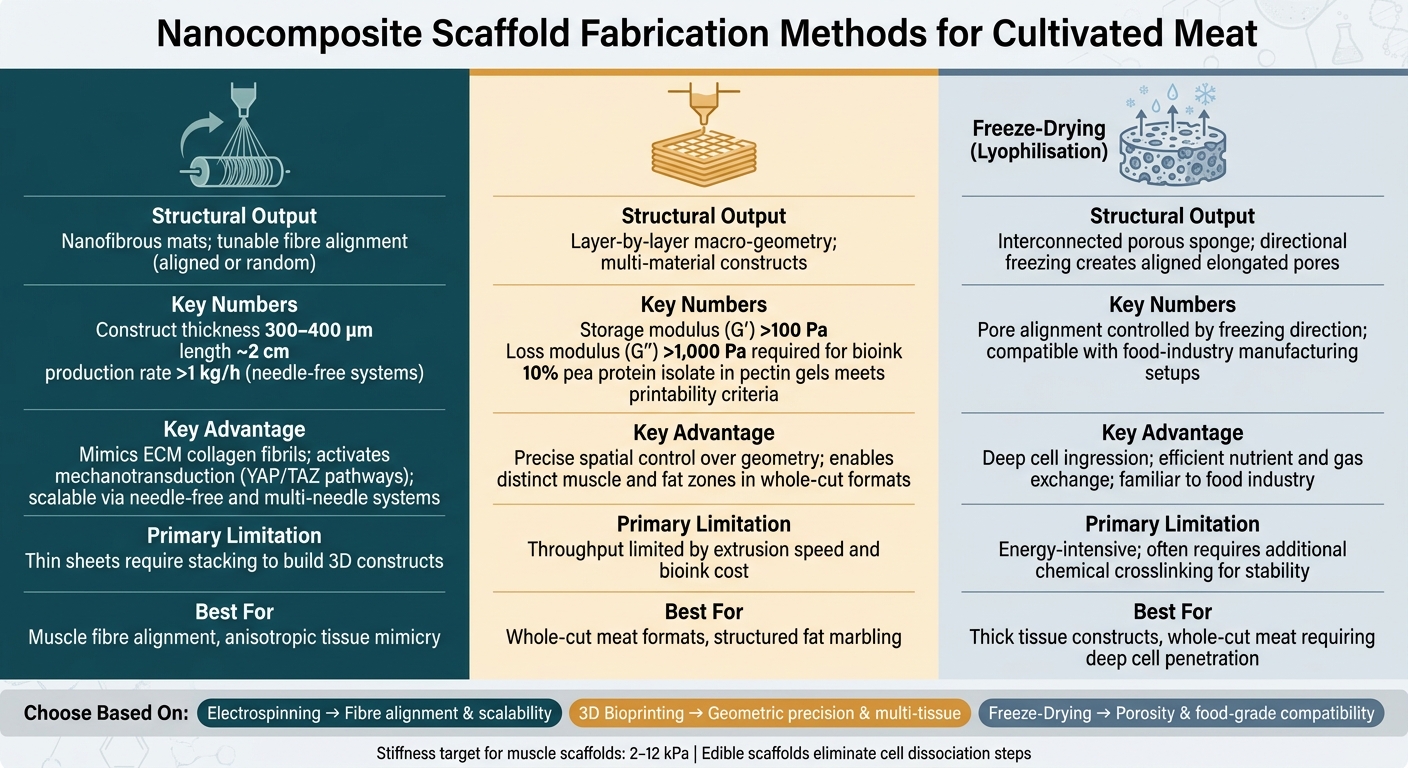
Nanocomposite Scaffold Fabrication Methods for Cultivated Meat
In cultivated meat production, the choice of scaffold fabrication method is a key factor in determining the scaffold's architecture, mechanical properties, and its ability to support cell growth and differentiation. Each method offers distinct advantages and challenges, impacting fibre arrangement, pore structure, and overall functionality.
Electrospinning and Nanofibre Scaffolds
Electrospinning involves using a high-voltage field to produce continuous polymer fibres ranging from nanometre to micron scale. These fibres form mats that replicate the fibrous structure of the extracellular matrix, offering a high surface-area-to-volume ratio.
Aligned fibres can steer myoblasts to fuse along a single axis, mimicking the anisotropic structure of skeletal muscle. In contrast, random fibre arrangements stimulate differentiation through alternative pathways.
"Random CAN [cellulose acetate nanofibers] were able to induce myoblast differentiation even in growth medium conditions, without any external chemical stimuli." - Luciana de Oliveira Andrade, Professor, Federal University of Minas Gerais [5]
This effect, known as mechanotransduction, leverages scaffold topography to activate biological pathways like YAP/TAZ, potentially reducing the need for costly differentiation media. By stacking electrospun sheets, cohesive 3D constructs can be created, typically reaching thicknesses of 300–400 µm and lengths of around 2 cm [5].
Recent advancements, such as needle-free and multi-needle systems, have made it possible to scale electrospinning for industrial applications. For larger-scale constructs, 3D printing offers additional benefits by enabling precise control over macro-geometry.
3D Printing and Bioprinting
Extrusion-based 3D printing allows for the layer-by-layer deposition of composite bioinks, providing precise control over the scaffold's geometry. This technique is particularly suited for creating structured constructs, such as whole-cut formats that require distinct zones for muscle and fat.
Bioink formulation is critical for success. Shear-thinning properties and rapid structural recovery are essential, as is achieving the right balance of mechanical properties. For example, composite pectin–protein bioinks require a storage modulus (G′) above 100 Pa and a loss modulus (G″) exceeding 1,000 Pa to maintain filament integrity. Incorporating 10% pea protein isolate into pectin gels has been shown to meet these criteria, supporting cell proliferation at rates similar to standard tissue culture plates. However, increasing protein concentration beyond this threshold can negatively impact printability [1].
"The excessive addition of proteins could compromise the physical properties and printability of the composite bioinks." - Food Hydrocolloids [1]
Maintaining batch-to-batch consistency through image-based analysis of surface roughness and filament thickness is an effective quality control measure. However, the primary limitation of 3D bioprinting at scale remains throughput, as extrusion speed and bioink costs hinder the rapid production of large tissue volumes.
For scaffolds requiring high porosity, freeze-drying offers a complementary approach.
Freeze-Drying and Porous Scaffold Fabrication
Freeze-drying, or lyophilisation, is a process where water is removed from a frozen hydrogel via sublimation, creating a porous network. These spongy scaffolds are ideal for thicker tissue constructs, as they allow for deep cell penetration and efficient nutrient and gas exchange [1][4].
Directional freeze-drying offers additional benefits for cultivated meat. By controlling the freezing direction, ice crystals form in a specific orientation, creating aligned, elongated pores that closely resemble the fibrous structure of muscle tissue [2]. Achieving this level of anisotropy is difficult with traditional isotropic freezing methods.
Despite its advantages, freeze-drying is energy-intensive. The porous scaffolds often require chemical crosslinking to maintain stability during cell culture. Additionally, batch processing limits throughput compared to continuous methods like electrospinning. However, the food industry's familiarity with freeze-drying could simplify its adoption, especially for teams leveraging existing food-grade manufacturing setups.
These fabrication techniques highlight the precision and quality required for edible scaffolds showcased on platforms like Cellbase.
| Fabrication Method | Structural Output | Key Advantage | Primary Limitation |
|---|---|---|---|
| Electrospinning | Nanofibrous mats; tunable alignment | Mimics ECM fibrils; scalable via needle-free systems [2] | Thin sheets require stacking for 3D constructs [5] |
| 3D Bioprinting | Layer-by-layer macro-geometry | Precise spatial control; multi-material constructs [1] | Throughput limited by speed and bioink cost |
| Freeze-Drying | Interconnected porous sponge | Deep cell ingression; food-industry compatible [4] | Energy-intensive; often requires crosslinking [1][2] |
Applications of Nanocomposite Scaffolds in Cultivated Meat
Muscle Tissue Structuration
A key hurdle in cultivated meat production is organising cells into aligned, functional muscle tissue. Nanocomposite scaffolds tackle this challenge by mimicking the biochemical and physical properties of the native extracellular matrix (ECM) found in muscle.
"The majority of muscle's load-bearing ability arises from this dense ECM and not the muscle fibers themselves, revealing the importance of a strong support structure for mature muscle cells." - Claire Bomkamp, Senior Scientist, The Good Food Institute [3]
Scaffolds designed to replicate the stiffness of skeletal muscle ECM activate mechanotransduction pathways, which encourage myoblast differentiation [2][3]. Research conducted in early 2024 and 2025 highlights the effectiveness of two approaches: random cellulose acetate nanofibre (CAN) meshes and 3D-printed composite gels made from pectin combined with soy and pea protein isolates. These scaffolds successfully supported the differentiation and proliferation of C2C12 myoblasts, producing constructs approximately 300–400 µm thick and 2 cm long [1][5]. These findings underscore the importance of both scaffold material and fibre structure in guiding myogenesis.
Scaffold design also plays a fundamental role in fat tissue development, which is essential for replicating the sensory qualities of meat.
Fat Tissue Development and Marbling
Creating intramuscular fat, or marbling, is crucial for achieving the flavour, juiciness, and texture characteristic of whole-cut meats. Unlike muscle tissue, fat development requires softer scaffolds that support lipid accumulation rather than myogenic differentiation [2][3].
A promising solution is the use of bigel scaffolds, which incorporate a structured oil phase within a hydrogel matrix. A study published in Food Hydrocolloids (Volume 160, Part 3, 2025) demonstrated this using a gelatin hydrogel combined with a canola oil oleogel. The oleogel was structured with 15% monoacylglycerol and 8% stearic acid at a 1:4 ratio. Scaffolds stabilised with 0.1% w/w Tween-20 significantly enhanced cell proliferation and differentiation compared to those using lecithin-based stabilisers [1]. Achieving realistic marbling requires precise spatial control to replicate the natural distribution of fat and muscle. Bigel and hybrid scaffold designs enable this by creating distinct zones for each tissue type within the same construct.
Performance in Bioprocessing
For cultivated meat production, scaffold performance in bioreactor systems is just as critical as their role in tissue structuration. Nanocomposite scaffolds must maintain their shape and structural integrity under dynamic conditions within bioreactors [1]. Features like high porosity and a favourable surface-to-volume ratio are essential, as they ensure efficient oxygen and nutrient diffusion to cells and facilitate metabolic waste removal [2][3][4].
One of the practical advantages of edible nanocomposite scaffolds is their ability to simplify the production process. Since these scaffolds can remain in the final product, they eliminate the need for costly cell dissociation steps typically required when using non-edible synthetic polymers [2][1]. On an industrial scale, these materials can be transformed into edible microcarriers, allowing anchorage-dependent cells to grow in high-density suspension. This scalability is vital for moving from lab-scale prototypes to commercial production volumes [3][6]. Additionally, needle-free electrospinning systems can produce scaffolds at rates exceeding 1 kg/h, bringing production closer to the throughput required for large-scale manufacturing [2].
Practical Considerations for Selecting and Sourcing Scaffolds
Defining Your Technical Requirements
Start by identifying the specific functional requirements of the scaffold. For instance, muscle scaffolds need to replicate the stiffness of skeletal muscle extracellular matrix (ECM), while fat tissue scaffolds should be softer to promote lipid accumulation instead of myogenic pathways. For fish alternatives, scaffolds with lower thermal stability are ideal, as they mimic the flaky texture created by collagen breakdown during cooking [3].
The culture format also plays a significant role in determining structural needs. Suspension cultures require microcarriers with a high surface-to-volume ratio to support anchorage-dependent cells at scale. In contrast, structured whole-cut formats demand anisotropic fibre alignment to facilitate myoblast fusion into multinucleated myotubes [3]. For workflows involving bioprinting, the bioink must exhibit shear-thinning properties and maintain a storage modulus (G') above 100 Pa and a loss modulus (G'') above 1,000 Pa to retain its shape post-extrusion [1].
Additionally, the scaffold's degradation profile must align with the rate of ECM deposition. For non-edible scaffolds, ensure there is a validated protocol for residue-free removal [2].
Once these technical parameters are defined, the focus should shift to ensuring quality and regulatory compliance.
Quality and Regulatory Compliance
Traceability of materials is non-negotiable. Every component of a nanocomposite scaffold - whether it's the nanofillers, crosslinking agents, or stabilisers - must have documented batch consistency and a clear origin to meet food safety standards [4].
Opting for food-grade biopolymers like pectin, alginate, or plant-derived proteins simplifies regulatory approval. Many of these materials already have GRAS (Generally Recognised as Safe) status, which reduces the testing burden compared to synthetic polymers like PCL or PLA [1][2]. Using non-animal materials further lowers zoonotic risks and streamlines documentation. Well-defined material specifications at this stage will directly support regulatory submissions and make supplier selection more straightforward.
Allergen compliance is another critical consideration. Plant-based nanocomposites that include soy, pea, or wheat gluten must comply with allergen labelling regulations under UK and EU food laws [2]. Identifying potential allergen risks early - during material selection rather than at the formulation review stage - avoids complications down the line.
Even food-grade materials need to undergo cytotoxicity testing when used in specific composite formulations. A material that is safe on its own might inhibit cell growth when combined with certain crosslinkers or stabilisers. Scaffold qualification should always include cell attachment and proliferation assays [1][4].
Using Specialised Marketplaces to Source Scaffolds
Once technical and regulatory requirements are established, sourcing the right scaffolds and biomaterials becomes crucial. Conventional laboratory supply platforms often lack the detailed specification tags needed for cultivated meat applications, such as edibility, RGD surface modification, or food-grade certification. This can make finding suitable materials a time-consuming process.
Cellbase offers a solution. As the first B2B marketplace tailored specifically for the cultivated meat industry, Cellbase connects R&D teams and procurement specialists with verified suppliers of scaffolds and related materials. The platform is designed to address the unique technical needs of cultivated meat production. Listings include use-case-specific tags, allowing teams to filter for properties like serum-free formulations, GMP compliance, or scaffold compatibility without wading through irrelevant results.
The structured approach outlined in this section provides a solid foundation for leveraging platforms like Cellbase. For teams in the early stages of development, this curated access is particularly helpful when exploring new scaffold categories. Examples include bacterial cellulose grown on waste feedstocks, hybrid bigel systems for integrating fat, or high-throughput electrospun nanofibre meshes. In these cases, supplier expertise and thorough material documentation are just as important as the products themselves. Additionally, Cellbase supports scalability by connecting buyers with suppliers capable of industrial-scale production - an essential factor for transitioning from bench-scale prototypes to commercial volumes [2][3].
Conclusion
Key Points Recap
Nanocomposite scaffolds bring together materials science, food safety, and bioprocessing to create functional structures tailored for cultivated meat production. Edible materials like plant-based proteins, alginate, cellulose, and microbial sources are gaining traction over synthetic polymers due to their safety and sustainability profiles. However, surface modifications, such as incorporating RGD motifs, are often required to enhance cell adhesion and growth [2].
The chosen fabrication method significantly influences tissue architecture. Techniques such as electrospinning, 3D bioprinting, and freeze-drying yield distinct structural characteristics, making it crucial to align the method with the specific tissue requirements. Advances in industrial-scale electrospinning, with production rates exceeding 1 kg/h, indicate that scalable nanofibre manufacturing is becoming a reality [2].
Mechanical properties must be fine-tuned to replicate the natural stiffness of skeletal muscle, typically between 2 and 12 kPa. Scaffolds falling outside this range may misdirect cell differentiation. Additionally, factors like porosity, degradation rates, and mass transfer properties are vital for achieving consistent results across both laboratory and bioreactor settings [2].
With these foundational principles in place, the field is set to evolve further through emerging trends.
Future Directions
A significant upcoming development is the adoption of edible scaffolds that remain part of the final product. By removing the need for cell dissociation, this approach simplifies the production process, offering a practical step toward challenges of scaling cultivated meat.
Sustainability is also gaining momentum, with waste valorisation presenting exciting opportunities. For example, bacterial cellulose cultivated on brewer’s spent yeast has shown comparable structural properties to cellulose grown on traditional media [4]. This approach demonstrates how alternative feedstocks can lower costs while maintaining scaffold performance.
AI is beginning to revolutionise scaffold design. Machine learning tools are now capable of predicting protein secondary structures, solubility, and mechanical properties, significantly reducing the time required for iterative development and accelerating the journey from prototype to production-ready designs [7].
Platforms like Cellbase are playing a pivotal role in connecting R&D teams with reliable suppliers, facilitating the sourcing and scalable production of advanced scaffolds. These innovations are essential for the industry’s transition from pilot projects to full-scale commercial production of cultivated meat.
FAQs
How do I choose the right scaffold stiffness for muscle vs fat?
Selecting the appropriate scaffold stiffness is crucial because the elasticity of the substrate plays a key role in directing cell differentiation. For example, muscle cells thrive in environments with stiffness levels that encourage myogenic differentiation, while fat cells require a mechanical setting that closely resembles the extracellular matrix of adipose tissue. To procure materials and equipment for analysing these properties, professionals can turn to Cellbase, a dedicated B2B marketplace tailored to the needs of the cultivated meat industry.
What pore size and porosity are needed for thicker whole-cut tissues?
For creating thicker whole-cut tissues, achieving the right balance between scaffold porosity and pore size is crucial for maintaining cell viability and structural integrity. If the pores are too small or the porosity is too low, nutrient and oxygen diffusion becomes limited, which can compromise cell health. On the other hand, excessively large pores can weaken the scaffold's overall structure. Studies indicate that porous structures with pore sizes around 265 μm are ideal for supporting cell migration while preserving the scaffold's strength. Cellbase offers researchers and companies access to specialised materials and tools designed to develop scaffolds tailored for these requirements.
What documentation must scaffold suppliers provide for UK/EU Novel Food compliance?
Scaffold suppliers are required to deliver comprehensive documentation detailing the material's composition, origin, and manufacturing process to comply with UK/EU Novel Food regulations. This includes providing proof of safety through toxicological, allergenicity, and microbiological assessments, along with complete material characterisation to verify consistency across batches. Conducting hazard assessments is a critical step to show that potential safety risks have been addressed. Cellbase facilitates connections between companies and suppliers who meet these stringent documentation and standard requirements for cultivated meat production.


