

Surface chemistry is key to controlling how cells grow and specialise on scaffolds used in cultivated meat production. By modifying a scaffold's surface properties - like charge, hydrophilicity, and functional groups - researchers can direct stem cells to form muscle, fat, or connective tissue.
Here’s what you need to know:
- Protein Adsorption: Cells interact with proteins adsorbed on scaffold surfaces, not the material itself. Tailoring this layer is critical for cell adhesion and differentiation.
- Functional Groups: Groups like –OH and –NH₂ promote cell spreading, while –COOH influences protein structure and cell binding.
- Surface Charge: Positive charges attract cells for faster adhesion; negative charges mimic natural extracellular environments.
- Integrin Signalling: Surface modifications like RGD peptides improve cell attachment and guide differentiation.
- Material Choices: Scaffolds range from various biomaterials like plant proteins to fungal mycelium, but most require chemical tweaks for better cell growth.
- 3D Design: Combining surface chemistry with scaffold stiffness and architecture enhances cell organisation and tissue formation.
For cultivated meat, optimising these factors ensures efficient, scalable production while meeting food-grade safety standards.
Functional Groups and Charge: How Surface Chemistry Shapes Cell Behaviour
How Functional Groups Affect Cell Differentiation
The functional groups on a scaffold's surface play a pivotal role in determining how cells adhere, spread, and differentiate. Common functional groups include –CH₃, –OH, –COOH, and –NH₂. For instance, hydroxyl (–OH) and amine (–NH₂) groups encourage protein adsorption and facilitate cell spreading. On the other hand, methyl (–CH₃) groups create hydrophobic surfaces, which can hinder integrin engagement. Carboxyl (–COOH) groups, with their negative charge, influence the structure of adsorbed proteins like fibronectin. This can determine whether critical binding sites, such as the RGD motif, are accessible to integrins on the cell surface or hidden away [2].
For plant-based scaffolds that naturally lack cell-binding domains, modifying the surface by grafting functional groups is often the most effective way to ensure consistent cell adhesion.
Beyond these functional groups, the overall surface charge of the scaffold also plays a significant role in shaping protein adsorption and cellular responses.
How Surface Charge Influences Cell Fate
Surface charge builds upon the effects of functional groups by further influencing how proteins orient themselves and how integrins engage. Positively charged surfaces, often achieved through amine functionalisation, attract negatively charged proteins and cell membranes, thereby speeding up cell adhesion.
Conversely, negatively charged surfaces, such as those found in polysaccharide-based scaffolds like alginate, interact with proteoglycans and glycoproteins in the culture medium. The glycosaminoglycan chains within proteoglycans, which are also negatively charged, help form a bridge between the scaffold surface and the surrounding protein network. This interaction creates a closer mimic of the natural extracellular matrix [3].
In addition, ionic interactions are central to many crosslinking strategies. Charged functional groups on the polymer backbone form ionic bridges with crosslinking agents. This not only allows scientists to adjust scaffold stiffness but also enables fine-tuning of surface properties to optimise cell behaviour [2].
Key Findings from Recent Studies
Recent research has provided valuable insights into how surface chemistry impacts cell behaviour. For example, in May 2024, a study published in npj Science of Food explored microstructured marine biopolymer scaffolds. Using global transcriptome profiling, the researchers examined how the scaffold's biochemical environment influenced the genetic pathways involved in muscle cell development [2].
Another study, published in April 2026 in npj Science of Food, focused on chitosan-based scaffolds. The findings revealed that a microstructured chitosan mesh, with carefully controlled surface chemistry, significantly improved cultivated meat production by enhancing cell–scaffold interactions [2]. Chitosan, which carries a net positive charge under physiological conditions, was particularly effective in supporting initial cell attachment. These results highlight the importance of co-optimising scaffold microstructure and surface chemistry for efficient 3D scaffold design in cultivated meat bioprocessing.
sbb-itb-ffee270
How scaffold and biomaterials help regeneration?
Protein and ECM-Mimetic Surface Modifications
Scaffold Surface Modifications for Cultivated Meat: A Visual Guide
Integrin-Specific Biomaterial Surfaces
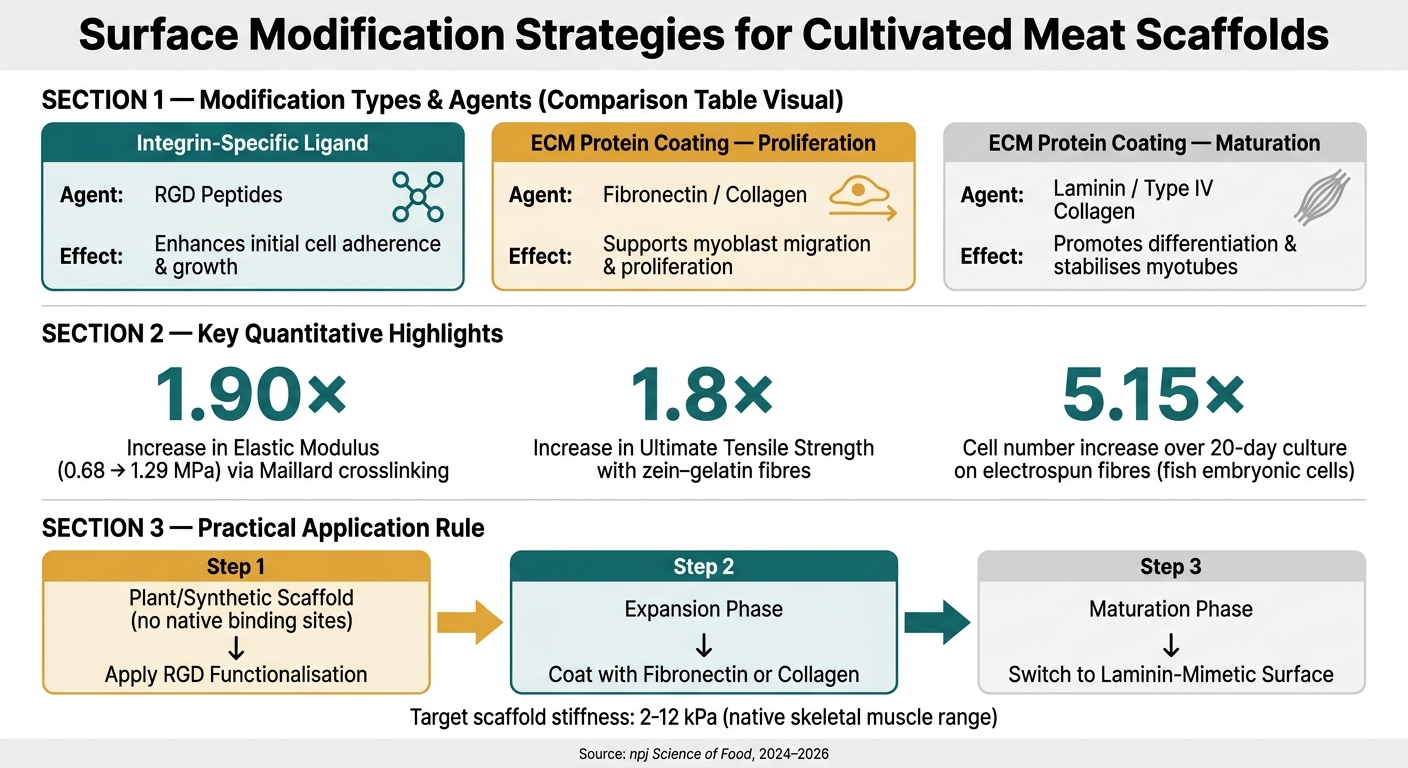
Building on the role of surface charge and functional groups, newer strategies now focus on integrin-targeted and ECM-mimetic surface modifications to guide cell behaviour. Many plant-derived and synthetic scaffold materials, such as cellulose, alginate, and soy protein, lack the natural cell-binding domains found in animal tissues. Without modifications, cells struggle to adhere to these surfaces. A widely used solution is the integration of RGD (arginyl-glycyl-aspartic acid) motifs, which can be grafted onto scaffold surfaces or incorporated into the material itself.
"Integrating biomaterials with RGD motifs or other integrin‐recognised sequences can enhance cell adherence and initial growth." - npj Science of Food [2]
RGD sequences bind directly to integrins on the cell membrane, forming critical mechanochemical connections that allow cells to sense their surroundings and commit to specific lineages. For example, research [4] has demonstrated that combining short-stranded zein fibres with RGD-functionalised alginate improves alignment in bovine muscle precursor cells. This highlights how integrin-specific ligands actively influence cell behaviour rather than merely supporting passive attachment.
These integrin-focused techniques naturally extend to broader ECM-mimetic strategies, which aim to further refine scaffold–cell interactions.
ECM Protein Coatings and Their Effects
ECM-mimetic strategies often incorporate full-length proteins such as collagen, fibronectin, and laminin, which are essential for myogenesis. Each of these proteins plays a specific role depending on the stage of cell development.
Fibronectin and collagen are key during the proliferation and migration stages, while laminin and type IV collagen promote differentiation and stabilise myotubes. Achieving the high level of cellular organisation seen in mature muscle fibres, which can contain up to 100 nuclei, depends on delivering the right biochemical cues at the right time [2].
Table: Surface Modification Strategies for Myogenesis
| Modification Type | Specific Agent | Primary Effect |
|---|---|---|
| Integrin‐specific ligand | RGD peptides | Enhances initial cell adherence and growth [2] |
| ECM protein coating | Fibronectin / Collagen | Supports myoblast migration and proliferation [2] |
| ECM protein coating | Laminin / Type IV Collagen | Promotes differentiation and stabilises myotubes [2] |
However, using animal-derived ECM proteins raises concerns about consistency and food safety. A promising alternative is recombinant bacterial collagen, produced by organisms like Streptococcus. This material can be manufactured at scale via microbial fermentation, requires no coexpression of hydroxylation enzymes, and eliminates the risk of disease transmission associated with animal-derived products [2].
Applying These Modifications to Cultivated Meat Scaffolds
Scaling these surface modifications for food-grade scaffolds requires careful material selection and processing. Research published in npj Science of Food (2025–2026) demonstrated the effectiveness of electrospun zein–gelatin fibres crosslinked via the Maillard reaction - a food-safe thermal process using protein–sugar mixtures. These fibres showed a 1.90-fold increase in elastic modulus (from 0.68 MPa to 1.29 MPa) and a 1.8-fold increase in ultimate tensile strength [4]. Importantly, this process avoids toxic crosslinkers, ensuring compliance with food-grade safety standards. In a 20-day culture, fish embryonic cells (Dicentrarchus labrax) grown on these fibres exhibited a 5.15-fold increase in cell number compared to day zero [4].
The practical takeaway is clear: match the coating to the production stage. Use fibronectin or collagen coatings during the expansion phase to maximise cell proliferation, then switch to laminin-mimetic surfaces during maturation to promote myotube formation. For plant-based scaffolds lacking native cell-binding sites, RGD functionalisation is an essential first step before applying any protein coatings. Additionally, scaffolds must meet the 2–12 kPa stiffness range characteristic of native skeletal muscle, as mechanical and biochemical signals work together to guide stem cell fate [2].
Surface Chemistry Within 3D Scaffold Design
Combined Effects of Chemistry and Topology
Surface chemistry in 3D scaffolds doesn't act alone. It works hand-in-hand with the scaffold's physical architecture - features like porosity, fibre alignment, and surface texture - to influence how cells adhere, organise, and differentiate. Unlike 2D cultures, where cells interact primarily with the basal surface, cells in 3D environments engage with the matrix across their entire membrane. This multidirectional interaction allows biochemical signals from surface modifications to reach cells more effectively, amplifying differentiation cues [3].
The scaffold's topology also plays a role in modulating chemical signals. For example, aligned fibres provide contact guidance, helping myoblasts orient correctly, while porous scaffold walls shield cells from shear stress in dynamic cultures. Together, these physical and chemical interactions contribute to the formation of structured, fibrous muscle tissue [3].
Protein adsorption is the mechanism through which 3D topology enhances chemical cues. Factors like the scaffold's charge, hydrophilicity, and functional groups determine how proteins adhere to the scaffold, which in turn influences cell behaviour [2]. This interplay between chemical and physical cues makes the choice of scaffold material a critical decision.
3D Scaffold Materials for Cultivated Meat
Different material types bring unique strengths and trade-offs when it comes to balancing mechanical properties and biological compatibility:
| Material Type | Examples | Key Advantages |
|---|---|---|
| Synthetic Polymers | PCL, PLA, PLGA | High mechanical strength, adjustable degradation, and scalability [2] |
| Plant Proteins | Soy, Zein, Wheat Gluten | Affordable, consumer-friendly, and edible [2] |
| Polysaccharides | Alginate, Cellulose, Gellan Gum | Biocompatible, safe, and structurally adaptable [2] |
| Fungal Materials | Aspergillus oryzae mycelium | Edible, naturally 3D, and supports myoblast growth [1] |
A particularly interesting example comes from research at the University of California, Davis, in October 2022. Researchers Minami Ogawa and Jaime Moreno García demonstrated that heat-inactivated Aspergillus oryzae pellets (0.9 mm in diameter) could serve as edible 3D scaffolds. These fungal surfaces supported nearly double the cell activity within 48 hours compared to untreated surfaces [1]. This highlights how a material's natural topology can promote cell proliferation without extensive chemical modification.
Synthetic polymers like PCL and PLA are often used for their ability to provide the 2–12 kPa stiffness range required for skeletal muscle. However, these materials need surface functionalisation to enhance cell attachment [2]. Hybrid scaffolds, which combine the structural strength of synthetic polymers with the biological functionality of natural biopolymers, are gaining popularity as they meet both mechanical and biological needs [2].
Optimising Surface Chemistry for Bioreactor Scaffolds
Scaffold surface chemistry in bioreactor conditions faces unique challenges. Factors like fluid flow, agitation, and prolonged culture periods can compromise scaffold stability. Therefore, surface chemistry must prioritise durability alongside biological performance.
"Exposure to high shear stress from the flowing cell culture media can have a negative effect on cell viability. Scaffolding of 3D cultures can reduce or regulate shear stress by a protective soft and elastic surrounding gel or by the porous scaffold wall architecture." - Claire Bomkamp et al. [3]
While porous scaffold architecture helps protect cells from shear stress, surface chemistry ensures cells stay anchored under dynamic conditions. For plant-based or polysaccharide scaffolds that lack native adhesion sites, RGD functionalisation becomes essential in bioreactor settings. It provides the necessary anchorage for cells to remain viable during agitation [2]. Peptide-based scaffolds, though biologically effective, lack the durability needed for long-term bioreactor use. Crosslinked polymers or hybrid materials offer more practical solutions [2].
Hydrophilicity is another critical factor. Scaffolds must allow culture media to penetrate their 3D structure to supply oxygen and nutrients while removing waste. Overly hydrophobic surfaces can block this perfusion, leading to necrotic regions inside the scaffold. Matching surface wettability to the bioreactor's flow dynamics is crucial for maintaining cell viability and promoting differentiation during scale-up for cultivated meat production. Use a production scale planner to manage these technical requirements during expansion.
Design Principles and Future Directions
Surface Chemistry Design Rules for Scaffold Development
Advances in understanding surface chemistry's role in cell differentiation have led to key principles for scaffold development:
First, biomimetic functionalisation is essential for scaffolds made from non-animal materials. Plant proteins, polysaccharides, and fungal substrates lack inherent cell-binding domains. To ensure reliable cell adhesion and subsequent differentiation, integrating RGD motifs or other integrin-recognised sequences is a fundamental requirement [2].
Second, staged mechanical signalling is critical. Myoblast expansion thrives in a stiffness range of 2–12 kPa, but forming mature myofibres demands higher stiffness. Scaffold designs that allow progressive stiffness changes - through controlled crosslinking or material degradation - better mimic the dynamic extracellular matrix environment [2].
Third, edibility must guide scaffold design. Using materials like fungal mycelium or plant proteins eliminates the need for costly cell dissociation steps during final product formulation. However, when using plant-derived proteins such as soy or wheat gluten, early consideration of allergen labelling is vital to meet food safety standards [2].
Research Gaps and Emerging Technologies
Despite these design principles, several challenges remain in scaffold development. For example, many surface modifications used in regenerative medicine lack food-grade certification, creating regulatory hurdles for cultivated meat production. Research into edible crosslinkers and food-safe functional groups is urgently needed to address this limitation [2].
Another gap lies in the lack of high-throughput screening for scaffold surface chemistries. At present, there is no standardised platform to quickly evaluate how different surface modifications influence cell differentiation across species-specific lines, such as bovine, porcine, or poultry. This slows down material selection significantly [2]. Advances in deep learning now offer tools for rapid in silico optimisation of protein mechanical strength and thermal stability, which could accelerate this process [5].
Scalability also remains a pressing issue. Techniques like electrospinning and bioprinting are effective at the laboratory scale but struggle to replicate the structural complexity of whole-cut meat at commercial production levels. Overcoming this bottleneck is essential for scaling cultivated meat production [2] [1].
Using Cellbase to Source Scaffold Materials

Reliable sourcing of scaffold materials is a crucial step for the cultivated meat industry. Until now, sourcing food-grade, surface-modified scaffolds has been a fragmented process. Cellbase, the first specialised B2B marketplace for the cultivated meat sector, directly addresses this challenge. The platform connects R&D teams, production managers, and procurement specialists with verified suppliers of scaffolds and surface-modified substrates. Each listing includes detailed use-case specifications tailored to cultivated meat production. For teams refining surface chemistry or scaling from bench to bioreactor, this curated supplier network helps minimise procurement challenges and technical risks.
FAQs
How do I choose the right surface functional groups for muscle vs fat differentiation?
When choosing surface functional groups, the target cell type plays a critical role in the decision-making process. For example, in muscle differentiation, the surface should facilitate cell attachment, alignment, and maturation. This is often achieved by incorporating biofunctional groups such as carboxyl or amine onto the surface.
In contrast, fat differentiation requires surfaces that encourage lipid accumulation and adipocyte maturation. Tailoring these surfaces might involve introducing specific cues that align with the needs of fat cells.
Techniques like plasma treatment can be employed to fine-tune surface properties, ensuring optimal interaction between the cells and the surface. This level of precision is particularly valuable in cultivated meat production, where both muscle and fat cell differentiation are essential.
What’s the simplest food-safe way to add RGD to an edible scaffold?
The easiest way to make an edible scaffold more cell-friendly is by using surface functionalisation methods like plasma treatment or peptide grafting. These techniques add bioactive groups, such as RGD peptides, to the scaffold's surface, which enhances cell attachment and adhesion.
How can I keep cells attached under bioreactor shear without harming edibility?
To ensure cells remain attached under shear forces in bioreactors while keeping the final product suitable for consumption, altering the scaffold's surface chemistry plays a key role. Methods such as plasma treatment can add bioactive groups like carboxyl, amine, or RGD peptides. These groups imitate natural extracellular matrix (ECM) signals, improving cell adhesion. Additionally, fine-tuning scaffold stiffness - such as targeting 11–12 kPa for muscle cells - and crafting hydrophilic, biofunctional surfaces further promote robust cell adhesion and differentiation, even in dynamic conditions.


