

Scaffold wettability directly impacts cell attachment, growth, and tissue formation in cultivated meat production. For anchorage-dependent cells like myoblasts, the scaffold's surface must support protein adsorption, which in turn facilitates cell adhesion and development. Wettability, measured by contact angle, determines how well a scaffold interacts with liquids like culture media.
- Hydrophilic surfaces (contact angle < 90°): Promote liquid spreading and protein adsorption, aiding cell attachment.
- Hydrophobic surfaces (contact angle > 90°): Resist liquid spread, potentially hindering cell adhesion.
Key factors influencing wettability:
- Surface chemistry: Functional groups like hydroxyl (-OH) enhance hydrophilicity.
- Physical properties: Roughness and porosity affect liquid interaction and nutrient flow.
- Material selection: Top biomaterials for scaffolds (e.g., bacterial cellulose, plant proteins) must be edible and food-grade for cultivated meat.
Challenges:
- Non-animal scaffolds often lack natural cell-binding sites, requiring chemical or structural modifications.
- Scaffolds must balance wettability with mechanical properties, porosity, and food safety.
For bioprocess engineers and R&D professionals, optimising scaffold wettability ensures effective cell-scaffold interactions, enabling scalable production of high-quality cultivated meat.
The Science of Scaffold Wettability
What is Wettability and Why Does it Matter?
Wettability refers to how easily a liquid spreads across a solid surface, measured by the contact angle - the angle formed where a liquid droplet meets the surface. A contact angle below 90° signals a hydrophilic surface that encourages liquid spreading, while a contact angle above 90° indicates a hydrophobic surface that resists liquid spread.
For cultivated meat scaffolds, wettability plays a key role in protein adsorption - the process by which proteins from the culture media adhere to the scaffold's surface. These proteins act as a bridge between the material and cells, influencing cell adhesion, migration, proliferation, and differentiation [1]. Without proper wettability, cells cannot attach effectively.
The next section delves into how surface characteristics influence wettability.
How Surface Properties Affect Wettability
Wettability is shaped by more than just surface chemistry; physical properties like roughness and porosity also play a part. A rougher surface increases the contact area between the material and the liquid, enhancing the surface's natural hydrophilic or hydrophobic tendencies. High porosity, on the other hand, allows cells to penetrate the scaffold and facilitates the flow of nutrients and removal of waste, both critical for maintaining dense, healthy cell populations [1][3].
Surface chemistry is just as crucial. For example, hydroxyl (-OH) groups contribute to the hydrophilicity and water-retention properties of bacterial cellulose (BC), making it ideal for cell culture environments [3]. Scaffolds with a high surface-to-volume ratio - often seen in porous or fibrous designs - offer more area for protein adsorption, which directly supports cell attachment [1].
However, many non-animal biomaterials lack natural cell-binding sites, necessitating chemical or structural modifications. Techniques like integrating RGD motifs are commonly used to enhance cell adhesion where these natural cues are absent.
These considerations are especially important when designing edible scaffolds for cultivated meat.
Edible Scaffold Constraints for Cultivated Meat
When designing scaffolds for cultivated meat, wettability must be optimised with a unique constraint in mind: the scaffold itself will be consumed. Unlike biomedical applications, where scaffolds can be removed, cultivated meat scaffolds must be edible. This limits the range of materials and treatments to food-grade options. Many synthetic polymers used in biomedical research, such as PCL and PLA, are not edible and require expensive removal processes before the final product can be consumed [1].
In addition to being food-safe, scaffolds must align with consumer expectations for texture, taste, and appearance. Plant-based proteins like soy, wheat, and zein are affordable and widely accepted, but they carry allergen risks that necessitate clear labelling. Thermal stability is another challenge; for example, scaffolds for fish products need to replicate the low thermal stability of fish collagen to ensure the product flakes properly when cooked [2].
Finally, scalability is a key hurdle. Materials that perform well in small-scale experiments must also be cost-effective and maintain consistent wettability when produced at commercial volumes. This balance between functionality and practicality is essential for cultivated meat to succeed as a viable product.
sbb-itb-ffee270
How Wettability Affects Cell–Scaffold Interactions
Wettability and Protein Adsorption
When a scaffold comes into contact with culture media, proteins immediately bind to its surface. The scaffold's wettability plays a crucial role in determining which proteins adhere, how much binds, and their conformations. Michele Ferrari, a researcher at CNR-ICMATE, explains:
"The first event after the biomaterial is implanted into an organism is the protein adsorption to its surface, which mediates the cell adhesion and offers signals to the cell through the cell adhesion receptors." - Michele Ferrari, Researcher, CNR-ICMATE [5]
These adsorbed proteins interact with integrin receptors, initiating processes like adhesion, migration, proliferation, and differentiation [1]. However, if the wettability isn't optimised, proteins may adopt unsuitable conformations, disrupting cellular signalling - even when the scaffold material itself is biocompatible. For instance, highly hydrophilic materials like alginate, despite their compatibility with cells, often need modifications to enable effective cell attachment [1].
This dynamic between wettability and protein adsorption is key to understanding the varying responses of cultivated meat cell types to different scaffold materials.
Wettability Ranges for Cultivated Meat Cell Types
The impact of wettability on protein adsorption creates distinct scaffold requirements for various cultivated meat cells.
- Myoblasts, the precursor cells of muscle tissue, depend on extracellular matrix (ECM) proteins like fibronectin and collagen during migration and proliferation. As these cells fuse into multinucleated myotubes, laminin and type IV collagen provide further structural support [1]. Scaffolds with moderately hydrophilic surfaces are ideal, promoting initial protein adsorption while supporting later differentiation. For example, pectin–pea protein composite scaffolds have shown myoblast proliferation rates comparable to standard tissue culture plates [4].
- Adipocytes, or fat cells, require scaffolds that accommodate lipid accumulation. Purely hydrophilic scaffolds can hinder this process, but integrating lipids into the scaffold, such as with bigel systems, enhances adipocyte maturation and contributes to better flavour profiles [4].
- Fibroblasts, which synthesise collagen and remodel the ECM, thrive in polysaccharide-rich environments, such as those incorporating fungal fractions [1].
The table below summarises the scaffold characteristics suited to each cell type:
| Cell Type | Preferred Scaffold Characteristics | Performance Impact |
|---|---|---|
| Myoblasts | Moderately hydrophilic; protein-enriched (e.g., pectin + pea protein) | Supports proliferation comparable to standard culture plates [4] |
| Adipocytes | Lipophilic integration via bigels or oleogels | Enhances lipid accumulation and improves flavour and mouthfeel [4] |
| Fibroblasts | Polysaccharide-rich (e.g., fungal fractions) | Stimulates collagen synthesis and ECM remodelling [1] |
| Satellite cells | Stiffness of 2–12 kPa | Mimics natural ECM stiffness for expansion and differentiation [1][2] |
Applying 2D Surface Data to 3D Scaffolds
Most wettability studies focus on flat 2D surfaces, but translating this data to porous 3D scaffolds used in cultivated meat presents unique challenges. On 2D surfaces, integrins bind primarily on the basal side of the cell. In contrast, 3D scaffolds allow cell–matrix interactions across the entire cell surface.
"In 3D culture, cell–cell and cell–matrix interactions can occur on the entire surface of the cell membrane." - Claire Bomkamp, Senior Scientist, The Good Food Institute [2]
This difference has major implications for wettability assessment. While 2D surfaces are evaluated using the Young model, which assumes smooth and homogeneous surfaces, 3D scaffolds require models like Wenzel or Cassie–Baxter, which consider surface roughness and the potential for air entrapment within pores [5]. Trapped air, or a plastron, can block media infiltration and prevent cells from colonising the scaffold's interior, even if the material is chemically suitable [5]. A scaffold that performs well in 2D contact angle tests may behave entirely differently when fabricated into a porous 3D structure.
Beyond adhesion geometry, 3D scaffolds also maintain chemical and signalling gradients that 2D systems cannot replicate. In 2D culture, media mixing creates a uniform environment, erasing localised concentration gradients that guide cell behaviour. A well-designed 3D scaffold preserves these gradients, better mimicking the in vivo environment [2]. These differences highlight the importance of adapting 2D wettability data to 3D scaffold design, directly influencing material choices and scaffold modifications for cultivated meat applications.
Measuring and Adjusting Scaffold Wettability
Methods for Measuring Wettability
Accurately assessing wettability is essential for improving cell–scaffold interactions and ensuring high-quality cultivated meat. For porous scaffolds, indirect measurement techniques provide valuable insights. Attenuated Total Reflectance Fourier-Transform Infrared (ATR-FTIR) spectroscopy detects -OH groups, confirming hydrophilic properties[3]. Scanning Electron Microscopy (SEM) reveals pore size and fibre network density, which help determine whether liquids can penetrate the scaffold's interior[3]. Differential Scanning Calorimetry (DSC) evaluates endothermic transitions linked to water loss, offering a measure of the scaffold's water-holding capacity[3]. By combining these methods, researchers can comprehensively assess scaffold wettability.
Optimising Wettability via Material Selection and Treatment
After measuring wettability, several approaches can improve cell–scaffold interactions. Coating scaffolds with extracellular matrix (ECM) proteins like fibronectin, laminin, or collagen IV introduces integrin-binding sites, promoting better cell adhesion[2]. For food-grade scaffolds, composite blending offers another solution. For instance, blending bacterial cellulose with carrageenan and locust bean gum has been shown to enhance fibroblast attachment while also mimicking the texture of meat[3].
Surface purification is another crucial step. Washing bacterial cellulose scaffolds with 0.3 M NaOH at 80°C effectively removes bacterial residues and cytotoxic contaminants, neutralising the pH to 7.0 before cell seeding[3]. Skipping this step can severely impede cell growth, even if wettability has been optimised.
How Scaffold Processing Affects Wettability
Processing methods play a significant role in determining scaffold wettability. Freeze-drying is commonly used to maintain the porous architecture of hydrogel-based scaffolds, which supports media infiltration and cell migration. However, the wettability measured on a freeze-dried scaffold may not match that of the rehydrated, culture-ready version[3]. For reliable results, it is crucial to evaluate wettability on the final scaffold in its intended state.
Below is a summary of key techniques and their relevance to scaffold wettability:
| Technique | Property Assessed | Relevance to Wettability |
|---|---|---|
| ATR-FTIR | Chemical functional groups (e.g., -OH) | Confirms hydrophilicity at the molecular level[3] |
| SEM | Surface porosity and fibre network density | Indicates liquid ingress capability in porous scaffolds[3] |
| DSC | Thermal transitions and water loss | Assesses water-holding capacity in the scaffold[3] |
Dr. David Kaplan: Using tissue engineering to grow cultivated meat
Choosing Scaffold Materials for Cultivated Meat
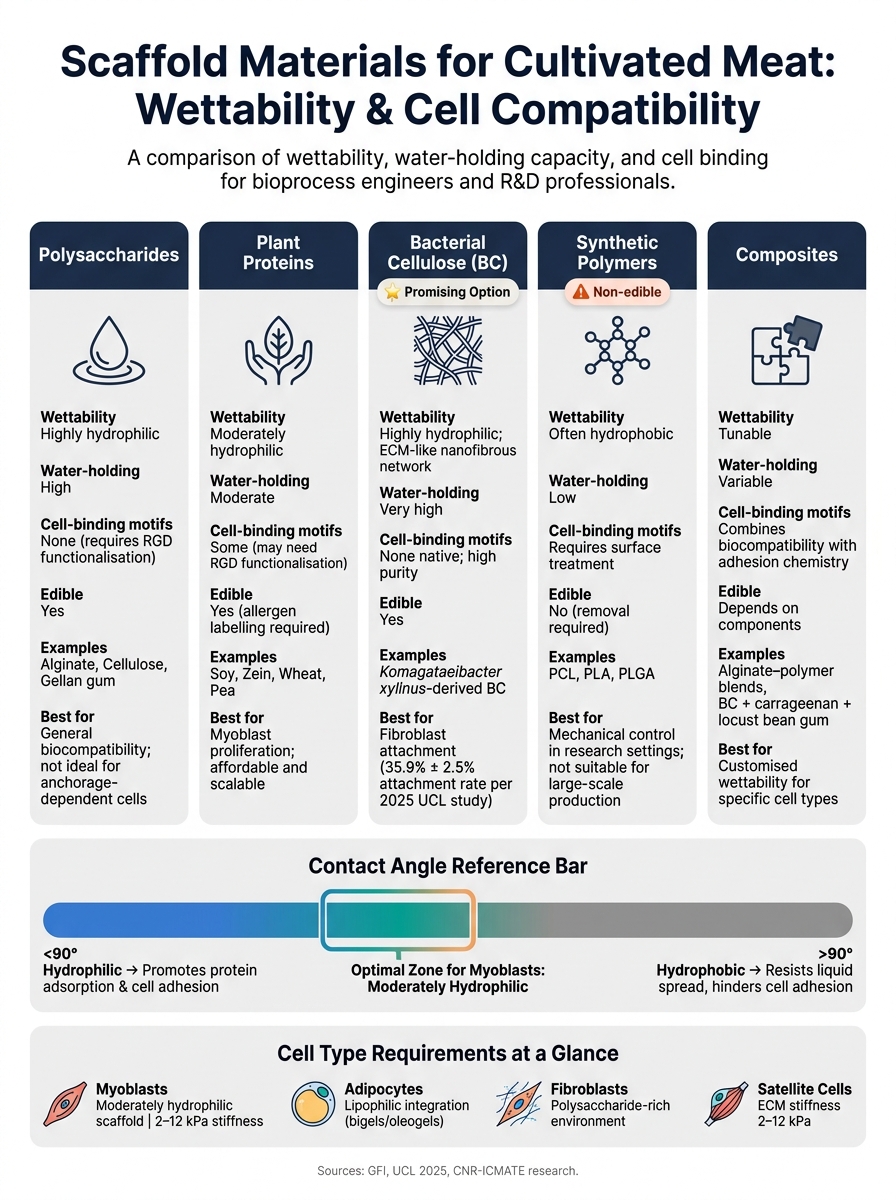
Scaffold Materials for Cultivated Meat: Wettability & Cell Compatibility Guide
Matching Wettability to Cell Types and Product Formats
Selecting the right wettability target for scaffold materials is heavily influenced by the type of cells being cultivated and the intended product format. For example, skeletal muscle cells require scaffolds that closely replicate the stiffness of natural muscle tissue - typically in the range of 2 to 12 kPa. These scaffolds should also provide structural cues to guide the cells into forming multinucleated myofibres [1][2]. If the scaffold surface is too hydrophobic, it can block the protein adsorption needed for integrin binding. On the other hand, excessively hydrophilic surfaces may fail to retain enough proteins for effective cell adhesion.
Adipocytes, or fat cells, have their own set of requirements. They can be cultured on edible microcarriers or integrated into 3D scaffolds alongside muscle fibres to mimic the typical 90% muscle to 10% fat composition of conventional meat [2].
The product format also plays a significant role. For structured whole-cut products, scaffolds must support nutrient and oxygen transport throughout a thick 3D structure while protecting cells from shear stress. In contrast, minced products like burgers or sausages allow for more flexibility. Here, muscle and fat cells can be grown separately on different scaffolds or microcarriers and then combined during post-harvest processing [1][2].
In the case of cultivated fish, thermal properties become critical. Fish muscle collagen has lower thermal stability compared to mammalian collagen, which contributes to the flaky texture when cooked:
"Scaffolds for cultivated fish will need to recapitulate this lower thermal stability either by having a lower melting temperature themselves or by providing an environment conducive to the secretion of appropriate collagens." [2]
These varied demands underscore the importance of carefully matching scaffold materials to both biological and product-specific needs.
Comparing Scaffold Material Classes
Understanding how wettability affects cell adhesion is key to evaluating different scaffold material classes.
| Scaffold Class | Wettability Profile | Common Examples |
|---|---|---|
| Polysaccharides | Highly hydrophilic; high water-holding capacity; lacks cell-binding motifs | Alginate, cellulose, gellan gum [1][3] |
| Plant proteins | Moderate hydrophilicity; contains some cell-binding sites; may need RGD functionalisation | Soy, zein, wheat, pea [1] |
| Bacterial cellulose (BC) | High purity; ECM-like nanofibrous network; strong water retention; free from lignin or hemicellulose | Komagataeibacter xylinus-derived [3] |
| Synthetic polymers | Often hydrophobic; allows precise mechanical control; typically non-edible; requires surface treatment | PCL, PLA, PLGA [1] |
| Composites | Tunable wettability; combines biocompatibility with adhesion-supporting chemistry | Alginate–polymer blends [1] |
Polysaccharides like alginate are safe and biocompatible but lack the RGD motifs needed for anchorage-dependent cells like muscle cells to adhere [1]. Protein-based scaffolds - derived from soy, zein, or pea - offer some inherent cell-binding sites. However, these materials may require allergen labelling, which could complicate consumer-facing applications. Bacterial cellulose stands out as a promising option. Its high purity and ECM-like structure have shown impressive results, such as a 35.9% ± 2.5% fibroblast attachment rate on BC scaffolds derived from brewer's spent yeast, according to a 2025 UCL study [3]. Synthetic polymers provide excellent mechanical control, but their non-edible nature and the need for removal steps make them less practical for large-scale production.
Using Cellbase to Source Scaffold Materials
Turning material properties into actionable sourcing strategies is often easier said than done. Scaffold material suppliers frequently provide fragmented or incomplete information, making it difficult to find detailed data such as contact angle measurements, ATR-FTIR profiles, or water-holding capacity values tailored to cultivated meat applications.
Cellbase simplifies this process by offering a specialised B2B marketplace for the cultivated meat industry. Materials listed on Cellbase are tagged with specific use-case details, enabling procurement teams to filter options by criteria like edibility, compatibility, or GMP compliance. Whether you're evaluating bacterial cellulose, composite hydrogels, or plant-protein scaffolds, this streamlined approach saves time and ensures access to verified product information, helping you make informed decisions with confidence.
Key Takeaways on Scaffold Wettability
Wettability plays a pivotal role in scaffold performance. If the scaffold is too hydrophobic, it struggles to adsorb proteins effectively. On the other hand, excessive hydrophilicity can make it difficult to retain proteins. Striking the right balance is essential to support cell attachment, proliferation, and differentiation within three-dimensional scaffolds.
Surface chemistry is a key factor in achieving this balance. Functional groups, such as hydroxyl (-OH) groups, influence a material's hydrophilicity and its ability to support cell adherence. Scaffolds with high water-holding capacity can mimic the extracellular matrix's natural network structure, while appropriate porosity ensures efficient nutrient diffusion and waste removal. These properties are interconnected, so focusing solely on wettability without considering porosity or mechanical compatibility won't produce an effective scaffold [3].
Material choice is just as important, especially for scalable cultivated meat production. Sustainable feedstocks have shown strong cell attachment capabilities without requiring expensive purification processes often linked to certain plant-based materials. This highlights the potential of environmentally conscious sourcing strategies [3].
Different scaffold materials bring unique advantages and challenges. Polysaccharides are safe but lack cell-binding motifs, protein-based materials naturally provide adhesion sites, and synthetic polymers require thorough evaluation for food safety. These factors are crucial in guiding material selection and optimisation for cultivated meat production [3].
FAQs
What contact angle should I target for my scaffold?
A moderately hydrophilic scaffold surface - with a water contact angle between 20° and 40° - is ideal for promoting cell attachment. This balance supports effective interactions between the surface and cells.
Surfaces with lower contact angles exhibit greater hydrophilicity, which improves protein adsorption and enhances cell adhesion. However, if the surface becomes too hydrophobic (with a contact angle exceeding 90°), it can hinder these processes. In such cases, treatments like plasma processing or the addition of hydrophilic functional groups can help adjust the surface properties.
For further insights and potential solutions, consider exploring scaffold and surface modification techniques available through Cellbase.
How is wettability measured on porous 3D scaffolds?
Measuring wettability on porous 3D scaffolds for cultivated meat presents some unique challenges. Liquids tend to seep into the pores during standard optical contact angle measurements, which can lead to inaccurate results. To address this, researchers might use a 3D-printed platform to elevate the scaffold, helping to minimise false-positive readings. Another approach is applying the Cassie-Baxter contact angle correction method, which is specifically suited for porous materials. For those in need of specialised scaffolds, Cellbase offers a network of trusted suppliers to streamline procurement.
Which food-safe treatments improve cell attachment on non-animal scaffolds?
To improve cell attachment on non-animal scaffolds used in cultivated meat production, researchers are adopting a range of food-safe techniques:
- Incorporating plant-based additives: Bioactive compounds like annatto extract are employed to adjust surface wettability, enhancing cell adherence.
- Using peptides with specific motifs: Peptides containing RGD sequences or integrin-recognised patterns are integrated to strengthen cell adhesion.
- Advanced scaffold fabrication: Techniques such as electrospinning and 3D bioprinting are utilised to design scaffolds that mimic the extracellular matrix, providing an optimal environment for cell growth.
Cellbase facilitates connections between professionals and tailored scaffolds designed for these applications.


