

Texture analysis is critical for making cultivated meat feel like conventional meat. Techniques such as Texture Profile Analysis (TPA), Warner-Bratzler shear testing, and tensile testing help measure qualities like hardness, chewiness, and stiffness. These methods ensure products meet consumer expectations for mouthfeel and bite while maintaining consistency during production.
Key points include:
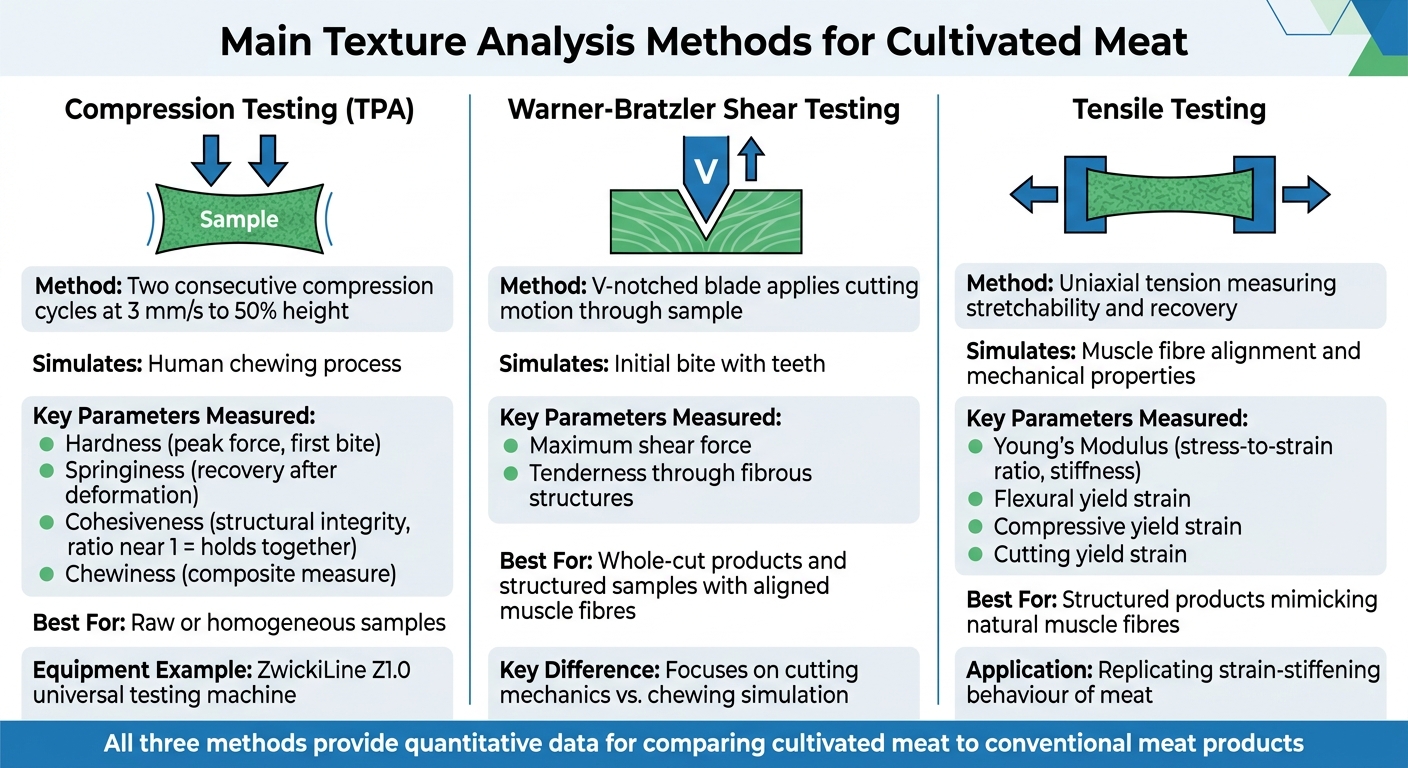
- Texture Profile Analysis (TPA): Simulates chewing by compressing samples twice. Measures hardness, springiness, and chewiness.
- Warner-Bratzler Testing: Focuses on tenderness by cutting through fibres, ideal for structured products.
- Tensile Testing: Assesses stretchability and stiffness, important for replicating muscle fibre alignment.
Challenges include sample preparation inconsistencies and difficulty mimicking complex meat scaffold biomaterials. New developments like multi-point indentation and integrating real-time rheological testing into production aim to improve accuracy and efficiency.
For researchers, platforms like Cellbase simplify equipment procurement and link bioprocessing decisions to texture outcomes. Mastering these methods is key to ensuring cultivated meat matches the sensory experience of its conventional counterpart.
Texture Analysis Workshop with Texture Technologies, BlueNalu, and Optimized Foods - CMS22
sbb-itb-ffee270
Main Texture Analysis Methods
Three Main Texture Analysis Methods for Cultivated Meat Comparison
Compression Testing
Compression testing, or Texture Profile Analysis (TPA), involves applying two consecutive cycles of uniaxial compression to a sample, separated by a short rest period. This method mimics the mechanical process of human chewing, providing insights into how a product behaves during consumption. During the test, a probe compresses the sample to 50% of its original height at a speed of 3 mm/s, simulating the force of a human bite.
Several key parameters are derived from this test:
- Hardness: The peak force during the first compression, representing the "first bite" sensation.
- Springiness: The extent and speed of recovery after deformation.
- Cohesiveness: The ratio of the work done in the second compression compared to the first, reflecting the internal structural integrity.
- Chewiness: A composite measure derived from hardness, cohesiveness, and springiness.
For example, a cohesiveness value close to 1 indicates that the product holds together well during chewing, while values near 0 suggest it disintegrates easily.
In March 2022, researchers Jacobo Paredes-Puente, Diego Cortizo-Lacalle, and Ane Miren Imaz examined a Frankfurt-style sausage made from cultivated meat provided by Biotech Foods S.L. (San Sebastián, Spain). Using a ZwickiLine Z1.0 universal testing machine, they discovered that while the cultivated sausage demonstrated hardness and chewiness comparable to conventional products, it exhibited a notably higher Young's Modulus (stiffness) than traditional Frankfurt sausages [1].
Shear and Warner-Bratzler Testing
Shear testing offers a complementary perspective to compression testing by focusing on the mechanics of the initial bite. Using a V-notched blade, this method applies a cutting motion through the sample, replicating the action of teeth during the first contact with meat.
Unlike TPA, which simulates the chewing process, the Warner-Bratzler method specifically measures the force required to shear through fibrous structures, making it particularly useful for assessing tenderness. This approach excels when evaluating whole-cut products and structured samples with aligned muscle fibres. The results - particularly the maximum shear force - are closely linked to consumer perceptions of tenderness.
While TPA is better suited for raw or homogeneous samples, the Warner-Bratzler method is ideal for structured products, helping researchers assess the bite mechanics of alternatives to traditional meat [1].
Tensile Testing
Tensile testing goes beyond compression and shear by measuring a material's stretchability and recovery under uniaxial tension. This method is especially relevant for structured products designed to mimic the alignment and mechanical properties of natural muscle fibres.
Key metrics include:
- Young's Modulus: The ratio of mechanical stress to strain, indicating the material's resistance to deformation and its ability to recover its shape.
In January 2025, a research group led by Jean-Baptiste R.G. Souppez and Eirini Theodosiou from Aston University conducted single-cycle uniaxial tests - encompassing tension, compression, and cutting - on seven types of burgers. Their findings helped establish target values for cultivated meat products to replicate the mechanical characteristics of traditional beef. They identified that flexural, compressive, and cutting yield strains are critical for distinguishing beef from its alternatives [3].
Tensile testing provides valuable data on whether cultivated meat scaffolds and aligned fibres can achieve the mechanical performance of natural meat, particularly in replicating the strain-stiffening behaviour seen in filament and fibrous networks [2].
Applications and Limitations
Benefits of Texture Analysis Methods
Texture analysis provides a reliable and efficient alternative to human sensory panels for evaluating cultivated meat. With a single Texture Profile Analysis test, researchers can measure multiple parameters - such as hardness, cohesiveness, springiness, and chewiness - in just one double compression cycle. This process delivers a complete mechanical profile in less than a second, offering rapid and consistent metrics that are crucial for continuous quality improvement. Such speed and reproducibility are especially valuable in production environments where quick quality control checks are essential[1].
These instrumental methods also enable direct comparisons with commercial meat products. By plotting stress against strain, researchers can classify textures (e.g., mushy, tough, rubbery, or brittle), helping production teams align their products with consumer expectations[2]. Additionally, rheological characterisation plays a key role in controlling processes like extrusion, offering insights into flow behaviour and viscous properties that influence the final mouthfeel of the product[1].
Quantitative comparisons like these are instrumental in validating the development of cultivated meat, ensuring its textural properties closely match those of traditional meat products. However, despite these advantages, there are still technical hurdles to address.
Challenges and Limitations
Despite its strengths, texture analysis comes with its own set of challenges. One persistent issue is sample preparation. Variations in fibre orientation and moisture content make it difficult to achieve consistent sample thickness, leading to variability in results[1]. To address this, researchers at Biotech Foods developed a method using a methacrylate plate template and a microtome blade, ensuring a standardised 3 mm thickness across samples and reducing data inconsistencies[1].
Rheological testing also presents unique difficulties. For instance, slippage often occurs at high deformations - typically beyond 10% - when samples lose adhesion to the testing plates. This issue compromises the accuracy of data related to the transition between solid and liquid states[1][2]. Furthermore, standard texture analysis methods often fail to capture the intricate hierarchical structures of meat, such as sarcomeres, muscle fibres, and connective tissues, which developers aim to replicate using edible scaffolds. These are critical elements that cultivated meat developers must replicate to achieve a realistic texture[2].
As Floor K. G. Schreuders from Wageningen University pointed out:
Future developments should therefore focus on routes to create more elasticity and possibly allow heating effects on texture to mimic meat characteristics even better[2].
Another challenge is the lack of established benchmarks for cultivated meat. Until recently, there was little experimental data available on the mechanical properties of these products, making it difficult to set clear production targets. However, recent studies have begun identifying target values from high-beef-content products (over 95% beef), providing a more defined framework for development goals[3].
Overcoming these challenges will be critical for cultivated meat to consistently replicate the textural experience of conventional meat.
New Developments in Texture Analysis
The field of texture analysis is evolving, moving past older techniques to improve precision and enable real-time assessments.
Multi-point Indentation Techniques
Traditional Texture Profile Analysis (TPA), which relies on single-point compression, often fails to account for localised mechanical differences in cultivated meat. This shortcoming becomes apparent in heterogeneous samples, where factors like fibre orientation and moisture distribution can lead to inconsistent results [1]. Multi-point indentation techniques address this issue by providing spatially resolved data across the tissue surface. For cultivated meat, where replicating the complex structure of traditional meat is a priority, this approach ensures a higher level of accuracy. Unlike traditional tests, which can suffer from sample slippage at deformations beyond 10%, multi-point indentation effectively identifies such inconsistencies [1]. The ability to map texture with such detail makes this method a strong candidate for integration into automated production systems.
Integration with Bioprocessing Systems
The trend in the industry is shifting towards embedding texture analysis into production processes for real-time quality control. Incorporating rheological characterisation into bioprocessing workflows enables manufacturers to adjust parameters dynamically. For example, during extrusion or flow-based forming, understanding the viscous and flow properties of the cultivated meat matrix is crucial for achieving textures similar to conventional meat. Monitoring key parameters like storage modulus (G') and cohesiveness allows real-time adjustments to maintain the desired mechanical properties within commercial standards [1][4]. Instrumental methods offer greater reproducibility and efficiency compared to organoleptic testing and sensory panel evaluations. However, challenges persist, such as automating sample preparation for fibrous or heterogeneous materials without introducing artefacts. Additionally, continuous monitoring of critical factors like pH and temperature remains essential to replicate the muscle-to-meat transition seen in traditional meat products [1].
How Cellbase Supports Texture Analysis
Connecting Researchers with Verified Suppliers
Producing cultivated meat demands specialised tools for analysing texture in heterogeneous samples. Cellbase simplifies this challenge by linking researchers to trusted suppliers of essential equipment. This includes universal uniaxial testing machines like the ZwickiLine Z1.0, equipped with high-precision 50 N Xforce P load cells, and advanced rheometers such as the Anton Paar MCR 301, which uses parallel plate geometries to measure storage modulus and viscous properties [1].
The platform streamlines the often-complicated procurement process that can hinder R&D timelines. By standardising technical specifications, Cellbase allows researchers to efficiently compare equipment using structured data filters. David Bell of Cultigen Group highlights this approach:
We've parsed and standardised that data into structured fields so buyers can actually compare products apples-to-apples [6].
This level of transparency also encompasses upstream production factors that significantly influence the mechanical properties of the final product [5].
Industry-specific Expertise
Beyond simplifying equipment procurement, Cellbase provides valuable industry insights. The platform bridges the gap between upstream bioprocessing decisions and downstream texture outcomes. For instance, it connects factors like scaffold stiffness and media composition to the mechanical properties of the end product. By doing so, it helps researchers align their quality control processes with the mechanical standards required for cultivated meat production.
Conclusion and Future Directions
Texture analysis plays a crucial role in ensuring the quality of cultivated meat, helping researchers replicate the sensory experience of conventional meat. By targeting mechanical properties like Young's modulus and shear strain, producers can fine-tune bioprocessing strategies to align with consumer preferences. However, to advance further, several research gaps must be addressed.
One critical area is post-cultivation maturation. Understanding how factors such as time, temperature, and pH impact tissue transformation is key to mimicking the post-mortem changes seen in traditional livestock meat [1]. Additionally, the industry needs to move beyond basic compression tests. Implementing multi-modal mechanical testing - such as standardised flexion, tension, and cutting protocols - will provide a more comprehensive understanding of complex whole-cut structures [3]. Recent studies highlight how properties like hardness and chewiness can effectively differentiate high-meat-content products (over 95%) from alternatives. These findings offer valuable benchmarks as the industry works towards achieving a projected 35% market share by 2040 [1][3].
To support this evolution, platforms like Cellbase connect researchers with verified suppliers of texture analysis equipment and provide expertise that links upstream bioprocessing with downstream texture outcomes.
Another promising direction is incorporating real-time rheological characterisation into production workflows. This approach ensures product consistency while enhancing the sensory experience for consumers. As the cultivated meat sector progresses, the relationship between engineering parameters and consumer perception will become increasingly precise, allowing producers to create products that are virtually indistinguishable from traditional meat.
FAQs
How do I choose between TPA, shear, and tensile testing for my product?
When deciding on the best method to evaluate the texture of your cultivated meat product, it’s essential to align the testing approach with the specific texture attributes you aim to measure:
- Texture Profile Analysis (TPA): This method is ideal for assessing hardness, elasticity, and chewiness, making it a go-to choice for a comprehensive texture profile.
- Shear Testing: Use this technique to measure tenderness and fibrousness, which are critical factors in determining ease of chewing.
- Tensile Testing: Perfect for analysing stretchability and the fibrous structure, particularly when creating steak-like products.
Choose the testing method that aligns with your product's sensory and structural goals.
What sample-prep steps reduce variability in cultivated meat texture results?
To reduce variability in the texture results of cultivated meat, it's crucial to maintain consistent timing and handling during preparation. Cook samples in batches, ensuring all are prepared under the same conditions. Coordinate the timing so that every sample reaches evaluation at the same temperature and state. Adhering to uniform preparation methods is key to achieving reliable texture analysis and sensory evaluations, ensuring consistency and precision throughout the process.
Which texture metrics best predict consumer bite and mouthfeel?
Texture metrics, such as Texture Profile Analysis (TPA) and Warner-Bratzler Shear Force (WBSF), play a crucial role in assessing the sensory qualities of cultivated meat. These techniques are particularly useful for predicting how consumers will perceive bite and mouthfeel, enabling a better alignment of texture characteristics with their preferences.


