

For cultivated meat production, storing primary or immortalised cell lines correctly is non-negotiable. Improper storage can lead to reduced cell viability, contamination, and costly setbacks. Here’s what you need to know:
- Short-term storage (-80°C): Suitable for working cell banks accessed frequently. Use mechanical freezers but note the risk of temperature fluctuations and limited viability (6–12 months max).
- Long-term storage (< -130°C): Liquid nitrogen vapour-phase tanks are the gold standard for master cell banks, halting metabolic activity and preserving cells indefinitely.
- Freezing method: Controlled-rate freezing (-1°C/min) prevents ice crystal damage. Use cryoprotectants like DMSO or glycerol and pre-chill freezing media (2–8°C).
- Equipment choice: Mechanical freezers are energy-intensive and vulnerable to power failures. LN2 tanks are more reliable for critical, long-term storage.
- Regulatory compliance: Follow GMP standards, maintain detailed records, and ensure monitoring systems are in place for temperature and inventory tracking.
Proper planning and equipment selection ensure cell viability, scalability, and compliance with safety standards. Let’s dive deeper into each step.
How to Freeze Cells: Cell Culture Basics Training
sbb-itb-ffee270
Step 1: Determine the Required Storage Temperature
The temperature you choose for cell storage depends on how long you need to preserve the material. For short-term use, -80°C is sufficient, but for long-term preservation, temperatures below -130°C are necessary to prevent degradation over time.
Short-Term Storage at -80°C
Mechanical freezers set to -80°C are suitable for short-term use, especially when regular access to cell lines is needed. This setup works well for active research or production tasks. However, it’s not designed for extended storage, as prolonged use at this temperature can lead to ice recrystallisation, which compromises cell integrity. If you're planning to establish a master cell bank, -80°C storage isn’t a viable option.
Long-Term Storage Below -130°C
For long-term preservation, liquid nitrogen vapour-phase storage systems are the industry standard. These systems maintain temperatures between -130°C and -196°C, effectively halting metabolic activity and preventing the formation of damaging ice crystals. Vapour-phase storage also reduces the risk of contamination compared to direct immersion in liquid nitrogen. This method is particularly important for cultivated meat producers who need to scale production processes and maintain traceable, GMP-compliant master cell banks. While offering reliable and contamination-resistant storage, these systems require more complex management and a consistent supply of liquid nitrogen. [1]
Step 2: Select the Appropriate Freezing Method
Choosing the right freezing method is critical, as the process can cause cellular damage if not carefully managed. Rapid cooling risks forming large ice crystals that can puncture membranes, while overly slow cooling may subject cells to prolonged osmotic stress. The optimal approach is controlled-rate freezing, typically at a rate of approximately -1°C per minute [2]. This method ensures controlled ice formation, helping to preserve cell integrity.
Controlled-Rate Freezing at -1°C per Minute
Cooling cells gradually at -1°C per minute is a standard practice for maintaining cell viability during cryopreservation. This rate allows extracellular ice to form first, which creates a stable osmotic environment when combined with cryoprotective agents like dimethyl sulfoxide (DMSO) or glycerol. Once the temperature drops below –130°C, molecular activity within the cells slows significantly, reducing biological ageing [2].
For the best results, ensure the following:
- Cells should be in the log-growth phase with at least 90% viability.
- Pre-chill the cryopreservation medium (containing 7.5–10% DMSO or 10% glycerol) to a temperature of 2–8°C before use.
Freezing Container Options
Achieving the -1°C per minute cooling rate can be done using either programmable controlled-rate freezers or passive isopropanol-based systems. A common passive option is the Nalgene Mr. Frosty, which uses 100% isopropanol to regulate the cooling rate in a -80°C freezer [3]. Here’s how to use it:
- Start with a room-temperature container filled with isopropanol.
- Load the cryovials into the container.
- Place the unit in a -80°C freezer overnight.
- Transfer the vials to long-term storage in liquid nitrogen, which is a key consideration when scaling cell lines for production.
To maintain the system's effectiveness, replace the isopropanol after every five uses. Many professional freezing containers are designed to hold 12–18 tubes (1.0 mL to 5.0 mL) and feature screw-top lids, which secure the samples and prevent direct contact with the alcohol [3].
This careful approach to freezing ensures optimal cell preservation and long-term viability.
Step 3: Choose Between Mechanical Freezers and Liquid Nitrogen Tanks
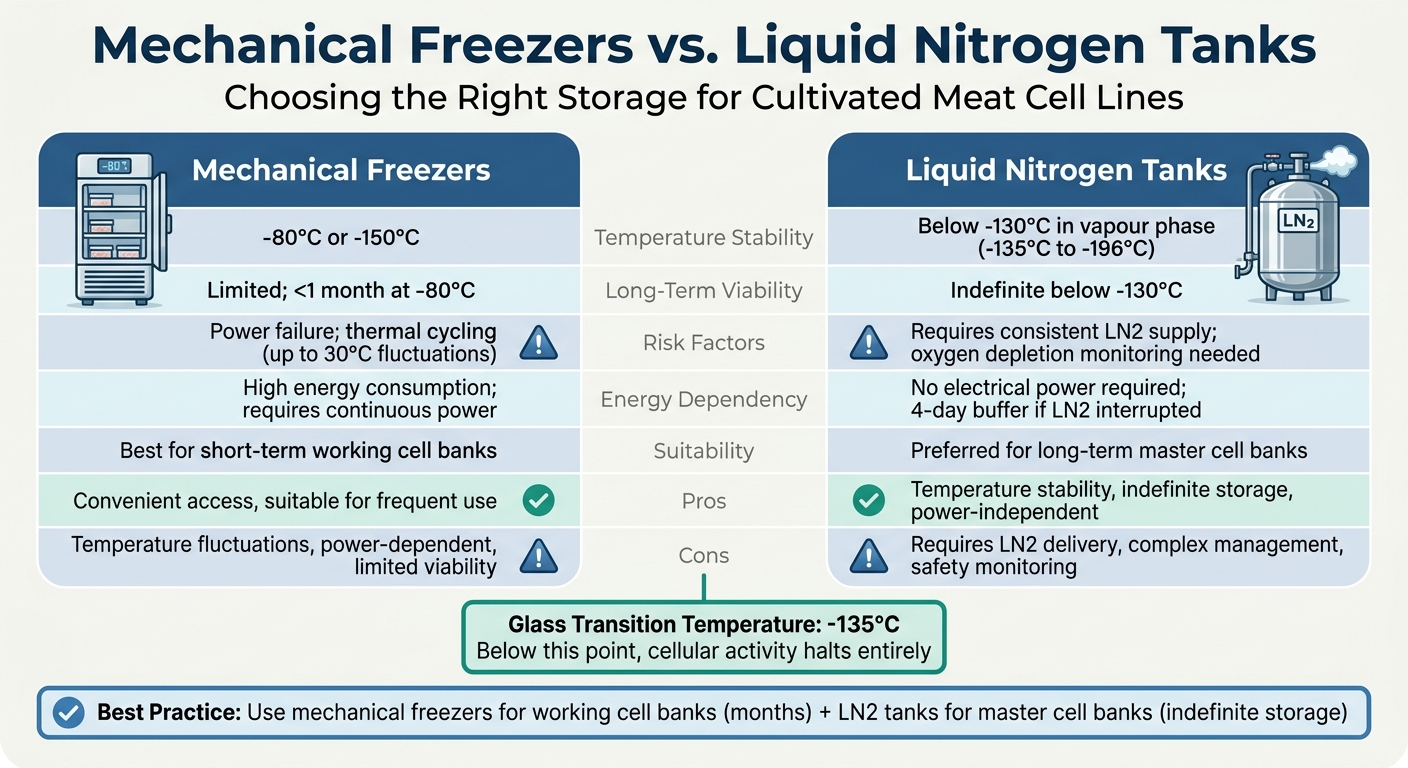
Mechanical Freezers vs Liquid Nitrogen Tanks for Cell Line Storage Comparison
After selecting a controlled-rate freezing method, the next step is choosing the right storage equipment. Your decision between mechanical freezers and liquid nitrogen (LN2) tanks will depend on how long you plan to store cells and the level of temperature stability required.
The main consideration here is the glass transition temperature of water, approximately -135°C. Below this temperature, cellular activity halts entirely. Mechanical freezers typically operate at -80°C, which is above this threshold. While this temperature slows chemical reactions, some still occur over time, potentially reducing cell viability. On the other hand, LN2 tanks maintain temperatures between -135°C and -196°C, effectively halting biological degradation and preserving cells for much longer periods [4][5].
Mechanical Freezers: Pros and Cons
Mechanical freezers are ideal for short-term storage or working cell banks that need frequent access over weeks or months. These compressor-driven units are convenient but come with limitations. They consume large amounts of energy, require strong HVAC systems, and depend entirely on continuous power. Additionally, temperature fluctuations inside these freezers can reach up to 30°C, which poses a risk to cell viability [5].
A notable example of the risks associated with mechanical freezers occurred in 2012 at the Harvard Brain Tissue Resource Centre. A freezer failure led to the loss of one-third of the world's largest collection of autism brain samples. Despite the thermostat reading -80°C, the internal temperature rose to refrigerator levels. This incident, described by Professor Carlos Pardo of Johns Hopkins University, significantly delayed autism research by nearly a decade [5].
Liquid Nitrogen Tanks: The Industry Standard for Long-Term Storage
For long-term storage, especially for master cell banks, vapour-phase LN2 tanks are the go-to choice. These tanks maintain cryogenic temperatures without relying on electricity, offering a fail-safe buffer in case of power outages. High-performance LN2 tanks can take up to four days to warm from -80°C to -60°C if the LN2 supply is interrupted [5]. However, maintaining these systems requires a consistent LN2 delivery schedule, automated level sensors, and oxygen depletion monitors to ensure safety.
Equipment Comparison Table
| Feature | Mechanical Freezers | Liquid Nitrogen Tanks |
|---|---|---|
| Temperature Stability | -80°C or -150°C | Below -130°C in vapour phase |
| Long-Term Viability | Limited; <1 month at -80°C | Indefinite below -130°C |
| Risk Factors | Power failure; thermal cycling | Risk if relying on liquid-phase storage |
| Suitability for Cultivated Meat Cell Lines | Best for short-term working cell banks | Preferred for long-term master cell banks |
This table highlights the strengths and limitations of each option. Mechanical freezers are better suited for short-term use, while LN2 tanks are essential for preserving master cell banks over extended periods.
Practical Recommendations for Cultivated Meat Storage
For cultivated meat production, a balanced approach works best. Use mechanical freezers for working cell banks intended for bioreactor seeding within a few months. Meanwhile, store master cell banks in vapour-phase LN2 tanks for long-term preservation. To minimise risks, it’s wise to divide cell batches across multiple storage units, ensuring redundancy in case of equipment failure.
For a range of reliable storage solutions tailored to cultivated meat production, visit Cellbase for verified listings.
Step 4: Assess Capacity and Regulatory Requirements
Once you’ve chosen the right storage equipment, the next step is to focus on capacity planning and ensuring compliance with regulatory standards. This ensures your storage system aligns with both operational needs and legal requirements.
Vial Capacity Planning
For cultivated meat cell lines, storage typically involves two key tiers: the Master Cell Bank (MCB) for long-term preservation and the Working Cell Bank (WCB) for routine production use [7]. These cell banks often need to accommodate hundreds or even thousands of cryovials [7]. When planning capacity, consider the production scale - industry projections estimate cultivated meat production could reach 125,000 tonnes by the end of 2026 [6]. This requires careful alignment with bioreactor yields and sizes.
Operational success hinges on maintaining enough vials to support the "thaw-to-production" process without exhausting the MCB. Redundancy is critical to account for potential contamination risks, which might necessitate additional vials to restart production. Furthermore, keeping detailed records of the cells' origins - such as the animal source and supplier - is essential for regulatory compliance and overall transparency [7].
According to FSA Research and Evidence, "there are no standardised rules and procedures yet for how to set up and manage cell banks for cultivated meat production" [7].
Ensure your facility’s processes are designed to meet strict GMP and safety standards.
GMP and Safety Compliance
In the United States, the FDA regulates cell collection and banking for cultivated meat. Facilities must adhere to CGMP (Current Good Manufacturing Practice) regulations, which include creating a written food safety plan. This plan should address biological, chemical, and physical hazards while implementing preventive controls for sanitation and supply chain management [8]. During the premarket consultation process, the FDA evaluates the establishment of cell lines and cell banks, followed by routine inspections to ensure biological materials remain safe and unadulterated [8][9]. Detailed record-keeping is mandatory for these inspections, as cultivated meat must meet the same rigorous safety standards as other FDA-regulated foods [8].
In the UK, regulations are still developing, but high expectations are in place since banked cells form the foundation of the final product [7]. Early registration of storage and manufacturing facilities is recommended. Engage with relevant regulatory bodies during development and establish strong bioprocess monitoring and verification systems for temperature-controlled environments to meet preventive control standards [8][9].
Step 5: Verify Monitoring and Record-Keeping Capabilities
Maintaining the integrity of cultivated meat cell lines requires dependable monitoring and documentation systems. These systems not only safeguard your specimens but also help ensure compliance with regulatory requirements. Even the most advanced storage equipment can fall short without proper oversight.
Temperature Monitoring Systems
Start by conducting temperature mapping to identify any inconsistencies in thermal distribution within the storage unit. This process ensures the unit can maintain uniform conditions. Once the unit is operational, continuous monitoring becomes essential. For mechanical freezers, tracking ambient temperature and humidity is particularly important, as it helps prolong the equipment's lifespan. Monitoring systems should be equipped with an uninterruptible power supply (UPS) to ensure functionality during power outages. Test these systems annually to confirm their readiness. Additionally, train staff to respond quickly to alarm events and document their resolutions.
For facilities using liquid nitrogen storage, install oxygen and/or CO₂ monitors with both auditory and visual alarms to detect and alert personnel to hazardous gas build-up. This precaution is critical for maintaining a safe working environment [10].
Beyond environmental controls, effective labelling and inventory management practices are key to ensuring traceability and compliance.
Labelling and Inventory Tracking
Choose cryogenic-resistant labels and containers that remain intact and legible under extreme conditions. These should feature built-in traceability to facilitate accurate inventory management and meet regulatory requirements. Containers should also have leak-proof designs with secure closures to avoid contamination during handling and long-term storage [1].
To mitigate risks, duplicate your specimen collections and store them in separate freezer units to guard against catastrophic losses. Standardise inventory management procedures across your biobank by using Laboratory Information Management Systems (LIMS). These systems streamline the tracking of samples and enhance operational efficiency. Finally, align your labelling and inventory practices with established standards from organisations such as the International Organization for Standardization (ISO), the Clinical & Laboratory Standards Institute (CLSI), and the International Society for Biological and Environmental Repositories (ISBER) [10].
Conclusion
Choosing the right temperature-controlled storage for cultivated meat cell lines involves careful consideration of several factors. First, determine the required storage temperature: –80°C is suitable for short-term research, while temperatures below –130°C are essential for long-term storage of Master and Working Cell Banks. Equally important is the freezing process - controlled-rate freezing at –1°C per minute is critical for preserving cell viability and maintaining cell integrity.
The scale of your operations and associated risks will guide your equipment choices. Mechanical freezers work well for short-term storage, but liquid nitrogen tanks provide superior stability for long-term needs. These decisions directly influence your storage capacity and regulatory strategy. It’s important to plan for sufficient capacity to accommodate both Master Cell Bank (MCB) and Working Cell Bank (WCB) vials, ensuring smooth scalability from lab research to industrial production.
Compliance with regulatory standards is non-negotiable. Storage facilities must meet the requirements of evolving frameworks, whether under FDA–USDA regulations in the United States or the EU Novel Foods Regulation. As the UK Food Standards Agency highlights:
"Because the banked cells are the starting material for the final product, high standards might be required by regulators in the future to ensure a safe meat product of high quality" [7].
This underscores the need for storage solutions that support meticulous record-keeping and traceability from the very beginning.
Beyond selecting the right equipment, robust monitoring systems are vital. Temperature monitoring and inventory management play a critical role in protecting your cell banks. With growth media accounting for 55% to 95% of production costs [1], losing cell banks due to equipment failure can result in significant financial setbacks. Automated systems with temperature alerts and Laboratory Information Management Systems (LIMS) for inventory tracking help ensure compliance and operational stability.
Making informed decisions about temperature-controlled storage is a cornerstone of successful cultivated meat production. For tailored advice and to explore a selection of storage solutions designed for cultivated meat cell lines, visit Cellbase.
FAQs
When should I use a master cell bank vs a working cell bank?
A master cell bank (MCB) is the cornerstone for long-term storage in cultivated meat production, acting as the definitive source of cells. Its primary role is to ensure genetic stability and uniformity over time. From this, a working cell bank (WCB) is created, which is used for routine production processes. The WCB provides the cells needed for cultivation, while the MCB stays securely stored as a backup. This separation ensures traceability and supports compliance with regulatory standards.
How do I choose between a mechanical freezer and a vapour-phase LN2 tank?
The right option hinges on the specific requirements of your cultivated meat project. Mechanical freezers (operating between -80°C and -86°C) work well for short- to medium-term storage and are straightforward to implement in most standard lab environments. On the other hand, vapour-phase liquid nitrogen (LN2) tanks (maintaining temperatures below -130°C) are better suited for long-term cryopreservation, offering minimal loss in cell viability. However, these systems demand specialised infrastructure and adherence to strict safety protocols. Your decision should align with your storage timeline, cell viability priorities, and available operational resources.
What monitoring and records are required for GMP compliance?
To meet GMP compliance in cultivated meat production, it's essential to closely monitor and document critical parameters such as temperature, pH, humidity, and pressure. Employ tools like IoT sensors and data loggers for real-time tracking throughout processes like cell culture, bioreactor operations, and storage.
Additionally, keep detailed records of equipment calibration, maintenance logs, and validation protocols. These documents are crucial for passing audits and meeting regulatory inspection requirements.


