

Ribosome engineering is reshaping cultivated meat production by improving protein synthesis at the cellular level. Ribosomes, the cell's protein factories, are critical for producing the actin, myosin, and other proteins that define meat's texture and nutritional value. Standard cell lines, however, aren't optimised for the high productivity needed for large-scale meat cultivation.
Key advancements include:
- Optimised ribosomal RNA variants: Screening libraries with 1.7 × 10⁷ variants has shown potential for increased translational activity.
- Orthogonal ribosomes: These engineered ribosomes specialise in producing specific proteins, such as myosin, without disrupting normal cell functions.
- Codon optimisation: Tailoring mRNA sequences to ribosomal preferences has yielded up to 72-fold higher protein expression.
- Myokine signalling: Proteins like IL-15 and myonectin enhance ribosome biogenesis and protein synthesis during muscle differentiation.
Challenges remain in balancing energy demands, maintaining cell stability, and scaling production to industrial levels. For instance, ribosome overactivity can lead to misfolded proteins or metabolic strain, while nutrient diffusion limits in bioreactors restrict tissue growth beyond 200 μm. Addressing these issues requires integrating ribosome engineering with advanced bioprocessing strategies.
This article explores how these methods are shaping the future of cultivated meat and the hurdles that must be overcome to achieve commercial viability.
Ribosomes and Protein Biosynthesis: A Primer
Ribosome Structure and Function in Mammalian Cells
Ribosomes are at the heart of protein synthesis, translating mRNA sequences into functional proteins. In mammalian cells, ribosomes are classified as 80S particles, made up of two subunits: the 40S small subunit, which decodes mRNA, and the 60S large subunit, responsible for catalysing peptide bond formation. The translation process involves three main steps: initiation, where the start codon is recognised; elongation, where amino acids are sequentially added to the growing polypeptide chain; and termination, which occurs when a stop codon is reached.
Two specific regions of the large subunit are particularly important for engineering applications: the peptidyl transferase centre (PTC), which facilitates peptide bond formation, and the exit tunnel, through which the newly synthesised polypeptide exits [3].
Grasping these core mechanisms is essential for exploring how ribosome performance can be optimised to improve cultivated meat production.
Why Protein Biosynthesis Matters for Cultivated Meat
The efficiency of protein synthesis is a critical factor in the development of cultivated meat, particularly during in vitro myogenesis. This process transforms muscle satellite cells (MSCs) into multinucleated myofibres that are rich in contractile proteins like actin and myosin. Ribosomes play a central role in this transformation [4].
"roughly eight trillion muscle cells are required to produce 1 kg of protein from a traditional bioreactor possessing a capacity of 5,000 L" [5]
This staggering requirement highlights how even small improvements in ribosome efficiency can significantly boost production yields, directly impacting the commercial feasibility of cultivated meat.
As cells mature, their ribosomal activity undergoes a shift. During the proliferation phase, MSCs prioritise rapid division. However, three to five days into differentiation, the focus moves towards synthesising adult isoforms of contractile proteins and enabling the fusion of cells into myotubes [4]. This transition is regulated by specific signalling molecules, or myokines.
For instance, Interleukin‑15 (IL‑15) promotes the accumulation of Myosin Heavy Chain (MyHC) protein while reducing protein degradation, acting as a key anabolic factor during muscle development [4]. Similarly, Myonectin supports muscle growth by enhancing protein synthesis through the PI3K/Akt/mTOR signalling pathway [4]. Understanding how these signalling pathways influence ribosome activity is vital for designing scalable cell lines that meet production demands. These insights lay the groundwork for the engineering strategies discussed in subsequent sections.
Current Research on Ribosome Engineering
Natural vs. Orthogonal Ribosomes in Cultivated Meat Production
Ribosome Biogenesis and Translation Control
Ribosome biogenesis, the process through which cells construct new ribosomes, is a highly regulated and energy-intensive activity. In mammalian cells, it represents a large portion of the cell's metabolic output. Translation alone can consume as much as 75% of a cell's total energy budget [8], making it one of the most resource-demanding cellular processes.
When ribosome allocation is inefficient - for instance, when ribosomes stall in early coding regions - it creates bottlenecks that reduce the availability of free ribosomes, ultimately limiting protein production. Computational models have shown that addressing these bottlenecks by engineering just 100 genes could improve ribosome allocation by 35% in yeast (Saccharomyces cerevisiae) and 57% in Escherichia coli [8]. These findings have direct implications for optimising ribosome dynamics in mammalian cells, particularly in the cultivated meat industry, where energy efficiency and protein output are critical.
Ribosome Engineering in Cultivated Meat Contexts
Advances in ribosome engineering are now being applied to cultivated meat production, building upon foundational knowledge of ribosome biogenesis. Even research not directly conducted in muscle cells is yielding insights relevant to cultivated meat cell lines.
In December 2020, Hadas Zur and Tamir Tuller from Tel Aviv University demonstrated the potential of Ribosome Traffic Engineering (RTE) to enhance growth rates and protein output. Using CRISPR-Cas9, they introduced synonymous mutations in the ramp region (codons 11–50) of RPO21 and CYS4 in S. cerevisiae. The resulting double mutant exhibited improved log-phase growth and cell density. However, the researchers cautioned that the relationship between translation optimisation and growth rate diminishes during the diauxic shift and stationary phases, where factors beyond translation become rate-limiting [8]. This insight is particularly relevant for designing differentiation protocols in cultivated meat production.
In February 2020, Michael Jewett's team at Northwestern University validated the RISE (Ribosome In vitro Synthesis and Evolution) method. This technique involves screening a library of approximately 1.7 × 10⁷ ribosomal RNA variants [2]. By operating entirely outside living cells, RISE bypasses the constraints imposed by lethal ribosome mutations, which cannot be studied in vivo.
"The in vitro approach overcomes cell viability constraints, enabling exploration of lethal ribosome mutations." - Michael Jewett et al. [2]
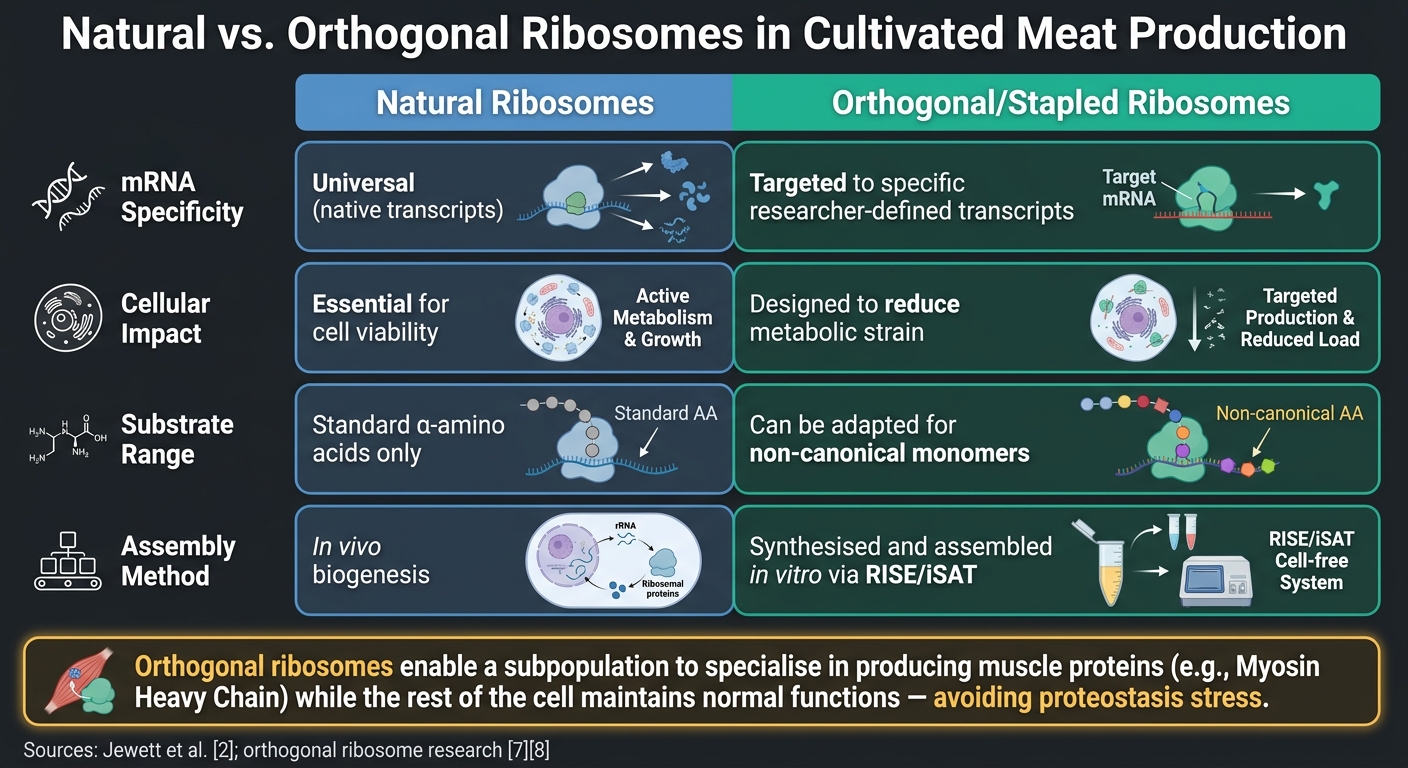
Another promising innovation for cultivated meat is the use of orthogonal ribosomes. These engineered ribosome–mRNA pairs function independently of the cell's native translation machinery. This allows researchers to focus ribosomal activity on specific targets, such as Myosin Heavy Chain (MyHC) isoforms critical for muscle texture, without interfering with essential cellular processes [6]. Comparative studies highlight the advantages of orthogonal ribosomes over natural ones:
| Feature | Natural Ribosomes | Orthogonal/Stapled Ribosomes |
|---|---|---|
| mRNA Specificity | Universal (native transcripts) | Targeted to specific researcher-defined transcripts [6] |
| Cellular Impact | Essential for viability | Designed to reduce metabolic strain [7] |
| Substrate Range | Standard α-amino acids | Can be adapted for non-canonical monomers [7] |
| Assembly | In vivo biogenesis | Synthesised and assembled in vitro via RISE/iSAT [2] |
The key takeaway here is that orthogonal ribosomes enable a subpopulation of ribosomes to specialise in producing muscle proteins, such as MyHC, while the rest of the cell maintains normal functions. This avoids the risk of proteostasis stress, which can arise when the entire translation system is pushed to overproduce specific proteins.
Strategies for Improving Ribosome Performance
Increasing Ribosome Biogenesis
Boosting ribosome numbers is a direct way to enhance protein production, and two main methods have gained attention. The first involves modifying the epigenetic state of ribosomal RNA (rRNA) genes to increase their translation capacity.
"Epigenetic engineering of ribosomal RNA genes enhances protein production." - Santoro R., Lienemann P., Fussenegger M. [1]
The second approach leverages the PI3K/Akt/mTOR signalling pathway. Myokines like IL-15, myonectin, and irisin activate this pathway, driving ribosome biogenesis during myotube maturation, as previously discussed.
However, this increase in ribosome production must be carefully balanced with the cell's metabolic capacity, as ribosome synthesis is one of the most energy-demanding processes in living cells [1].
Once ribosome numbers are increased, the focus shifts to ensuring they are fully engaged in translation.
Improving Translation Initiation and Elongation
Maximising the activity of all ribosomes is essential, as even in growth-optimised cells, 15–20% of ribosomes remain inactive [9]. This represents a significant reserve of untapped capacity in cultivated meat cell lines.
The rate of translation elongation depends on two factors: the inherent speed of the ribosome and the proportion of ribosomes actively engaged in translation [9]. To optimise these, maintaining high amino acid levels in the culture medium is critical. Additionally, engineering cell lines to stabilise ribosomal proteins helps protect rRNA from misfolding and degradation, reducing the typical 10% loss of rRNA during peak growth conditions [9].
Once ribosome activity is maximised, refining mRNA sequences becomes the next step to accelerate protein synthesis further.
mRNA Optimisation and Codon Usage
The performance of ribosomes is highly dependent on the quality of the mRNA they process. Codon optimisation tailors the coding sequences of target proteins to align with the tRNA pool specific to the host species - such as bovine, porcine, or fish. This alignment prevents ribosome stalling during elongation and increases throughput for critical myogenic proteins like MyoD and Myf5.
In addition to codon optimisation, transcriptional tuning ensures a proper balance between rRNA and mRNA levels within the cell. Any mismatch between these components can create bottlenecks, reducing overall efficiency [1].
For practical application, Integrated Synthesis, Assembly, and Translation (iSAT) systems offer a valuable tool. These systems use cell-free extracts and fluorescence-based assays to prototype optimised mRNAs in vitro before integrating them into stable cell lines. This iterative approach allows researchers to compare codon-optimised variants quickly, improving the yield of essential myogenic proteins and strengthening the scalability of cultivated meat production [1].
Trade-offs: Growth, Differentiation, and Product Quality
Optimising ribosome performance involves a delicate balance between boosting protein synthesis and managing impacts on cell growth and differentiation, as previously outlined.
Metabolic Burden and Proteostasis Stress
Engineering ribosomes to enhance protein production comes with increased energy demands, as it diverts ATP and amino acids away from other vital cellular functions. Ribosome synthesis is already one of the most energy-intensive processes within a cell, and further amplification can exacerbate these energy challenges.
This intensified activity can also affect protein quality. Overactive ribosomes may overwhelm cellular chaperones, resulting in misfolded proteins and activation of the unfolded protein response (UPR). Such stress can inhibit growth or even lead to cell death. For primary adult stem cells from livestock species like cattle or sheep, which naturally have limited proliferative capacity, these additional stresses could significantly reduce the number of viable cell divisions before senescence sets in [5].
In cultivated meat production, tissue thickness rarely exceeds 200 μm due to constraints on nutrient diffusion, which can lead to cell death in the core of larger tissue aggregates [5]. Strategies that increase energy consumption risk accelerating nutrient depletion in these critical regions, where consistent protein synthesis is essential. Additionally, heightened metabolic strain can interfere with the fine-tuned signalling pathways required for muscle differentiation.
Effects on Muscle Differentiation and Protein Composition
The stresses introduced by ribosome engineering can extend beyond metabolism, potentially disrupting muscle development. Myogenesis, the process of muscle formation, relies on a tightly regulated sequence of transcription factors: Pax7 ensures stem cells remain quiescent, Myf5 promotes proliferation of myoblasts, and MyoD triggers differentiation [5]. Altering protein synthesis could disrupt this sequence, stalling differentiation or producing atypical muscle fibre compositions. This might result in fewer intramuscular fat deposits, which are key to achieving desirable texture and flavour in cultivated meat [5].
As a result, maintaining rigorous quality control by monitoring the expression of myogenic markers throughout the engineering process is essential to ensure proper muscle development and product quality.
sbb-itb-ffee270
Research Gaps and Future Directions
Advances in ribosome engineering show promise, but their application to commercial cultivated meat production still faces significant hurdles. To bridge these gaps, researchers need to focus on advanced molecular profiling techniques and scalable bioprocess strategies that can withstand the demands of long-term production.
Multi-Omics and Long-Term Stability Studies
A major challenge lies in the lack of long-term stability data for engineered cell lines. Over time, these cells can accumulate spontaneous mutations, potentially altering their phenotype. Ivana Pajčin from the University of Novi Sad highlights this concern: immortalised cells "are not always representative of the primary culture due to potential spontaneous mutations during long-term cultivation" [13]. For ribosome-engineered lines, the stakes are even higher - mutations in ribosomal components could undermine translation efficiency without immediate detection.
Multi-omics approaches offer a way to address these issues. By integrating transcriptomics, proteomics, and metabolomics, researchers can monitor critical myogenic markers like Pax7, MyoD, and Myogenin, as well as shifts in MyHC isoforms. Genome-scale metabolic models can then translate these insights into actionable changes in media composition to meet the unique demands of engineered ribosomes [5][11]. For cultivated meat, ensuring consistent protein production over extended cycles is essential. Without such longitudinal monitoring, it's difficult to separate sustainable improvements from short-lived effects.
In addition to genetic and metabolic stability, scaling these innovations to industrial levels presents its own set of challenges.
Bioprocess Integration and Scale-Up
Scaling ribosome-engineered cells from small flasks to industrial bioreactors is no small feat. Producing just 1 kg of protein in a 5,000 L stirred-tank bioreactor requires approximately eight trillion muscle cells [5]. At these densities, nutrient gradients become a critical issue. The 200 μm diffusion limit for oxygen and other nutrients means that cells in the core of 3D tissue structures may face starvation, particularly when their demand for resources is at its peak due to high protein synthesis.
Shear stress from bioreactor agitation adds another layer of complexity. While unmodified cells may tolerate this turbulence, engineered cells with modified translation machinery could be more vulnerable. The stress could not only disrupt cellular pathways but also physically damage cells already under metabolic strain [13]. Addressing these issues will require integrating real-time data with digital biomanufacturing models, including computational fluid dynamics simulations, to better understand and predict the diverse microenvironments within large-scale vessels [10]. Downstream processes like harvesting also need attention - enzymatic methods involving trypsin can alter the surface proteome of engineered cells [14], potentially negating the benefits of ribosome engineering.
| Scale-Up Factor | Key Bottleneck | Relevance to Ribosome Engineering |
|---|---|---|
| Nutrient diffusion | 200 μm penetration limit [5] | May starve cells with high protein synthesis demands in 3D tissues |
| Genetic stability | Spontaneous mutations [13] | Could compromise engineered translation efficiency over time |
| Shear stress | Stirred-tank turbulence [13] | Risks disrupting engineered cellular pathways |
| Harvesting method | Proteolytic damage from trypsin [14] | May alter proteome and mask improvements in protein quality |
Resolving these scale-up challenges is essential for translating ribosome engineering from the lab to commercial production. Each strategy must be rigorously tested to ensure reliable protein yields, stability, and safety under industrial conditions.
Conclusion: The Case for Ribosome Engineering in Cultivated Meat
Producing 1 kg of protein in a 5,000 L bioreactor requires an astonishing 8 trillion muscle cells [5]. This highlights the immense challenge of scaling cultivated meat production. Ribosome engineering offers a solution by improving the protein output of individual cells, rather than simply increasing cell numbers.
Timing is critical when applying ribosome engineering. Enhancing translation at the wrong stage can disrupt myogenesis, potentially affecting the production of key contractile proteins like MyHC [5]. Achieving the right balance between translation and myogenesis is just as important as the engineering itself.
"In order to achieve high-quality CBM and its production with high yield, the molecular aspect needs a thorough inspection to achieve good laboratory practices for commercial production." - Asim Azhar et al., Frontiers in Food Science and Technology [5]
Several techniques have already shown promise in increasing recombinant protein output, such as overexpressing translation initiation factors (eIF3i and eIF3c), codon optimisation, and targeting mRNA modifications [15]. However, these methods must be applied with care to avoid issues like metabolic burden, proteostasis stress, and long-term genetic instability. While molecular optimisation is essential, it cannot fully address challenges like nutrient diffusion limits, shear stress sensitivity, and proteome disruption during harvesting. These hurdles require simultaneous advances in bioprocess design.
The potential environmental benefits of cultivated meat are immense. It could cut greenhouse gas emissions by 78%–96%, reduce land use by 99%, and lower water use by 82%–96% compared to traditional livestock farming [12]. Achieving these benefits at scale depends on bridging the gap between current cell culture productivity and economic feasibility. Ribosome engineering is a powerful tool to help close this gap, but it must be part of a broader, integrated approach that includes molecular biology, bioprocess innovations, and comprehensive multi-omics monitoring. Only by combining these efforts can the full promise of cultivated meat be realised.
How Cellbase Supports Cultivated Meat Research
Advancing from molecular optimisation to large-scale production in cultivated meat requires precise tools and materials at every stage. Cellbase steps in as the first dedicated B2B marketplace tailored for the cultivated meat sector, linking researchers with trusted suppliers of critical resources.
For teams working on cell-line optimisation, Cellbase simplifies the process of sourcing primary stem cells - such as satellite cells, MSCs, and iPSCs - from species like bovine, porcine, avian, and fish. It also provides access to chemically defined, xeno-free media and recombinant growth factors like IGF-1, FGF-2, and TGF-β, which are pivotal in enhancing ribosome biogenesis and translational activity. For example, media supplemented with IGF-1 at a concentration of 100 ng/mL has been shown to boost myoblast numbers by 66% [5][16][17]. This highlights how targeted growth factor selection can significantly influence protein biosynthesis.
Cellbase also supports researchers in ensuring proper differentiation and quality control. The platform offers lineage-specific antibodies (e.g., Pax7, MyoD, CD56, Desmin) and fluorescent dyes like phalloidin and BODIPY, which help confirm whether engineered cell lines are differentiating as intended and producing the desired contractile proteins [5][17]. Additionally, sourcing animal-component-free (ACF) dissociation enzymes such as recombinant trypsin and collagenase through Cellbase minimises batch variability and aligns with regulatory guidelines [17].
When it comes to scaling up production, Cellbase provides access to stirred-tank bioreactors, microcarriers, hydrogels, and advanced process sensors. These tools are essential for transforming molecular-level improvements into commercial-scale protein yields. Challenges like nutrient diffusion limits and sensitivity to shear stress often arise during scale-up, but Cellbase connects researchers with the bioprocessing hardware needed to overcome these hurdles [10][17].
FAQs
Which ribosome engineering approach is most promising for cultivated meat cell lines?
Research in ribosome engineering for cultivated meat aims to enhance protein biosynthesis and influence cell fate decisions. One promising approach is ribosome pool engineering, which modifies ribosomal RNA operons to improve translation efficiency. Tools like iSAT and RISE provide platforms for in vitro ribosome evolution, enabling the development of ribosomes with improved functionality. Additionally, platforms such as Cellbase play a crucial role by linking experts with the specialised equipment and materials needed to scale up cultivated meat production effectively.
How can higher translation rates be increased without causing misfolded proteins or cell stress?
To improve translation rates without triggering protein misfolding or cellular stress, researchers focus on fine-tuning the translation process rather than accelerating it across the board. Some key approaches include:
- Using slow-translating codons: These help align the pace of translation with the natural process of protein folding, ensuring proper structure formation.
- Reducing free folding energy in the 5' coding region: This adjustment can enhance protein production efficiency while maintaining cellular health.
Other techniques involve low-induction regimes, temperature downshifts, and advanced synthetic tools like SINEUP RNAs. These strategies enable higher protein yields without overburdening the cell.
For those working with specialised materials, resources like Cellbase may provide further insights.
What changes are needed in bioreactors to support ribosome-engineered muscle tissue beyond 200 µm?
To grow muscle tissue thicker than 200 µm, bioreactors must overcome challenges related to nutrient, oxygen, and pH diffusion - factors crucial for cell survival in three-dimensional structures. Stirred-tank bioreactors demand precise adjustments to maintain uniform conditions while reducing shear stress that could harm cells. In many cases, perfusion-based systems play a key role in creating stable environments, especially in densely packed tissues. For those working with specialised bioreactors and materials, Cellbase offers a platform to connect professionals with the essential tools for advancing cultivated meat production.


