

If you tune trace elements by label dose alone, you can miss what muscle cells actually see. In muscle-derived cultivated meat media, the gap between nominal and delivered concentration can shift growth, viability, redox state, and differentiation from one run to the next.
If I were setting this up, I’d do four things first:
- Map every input source of iron, zinc, selenium, copper, and manganese
- Check delivered levels, not just formulation targets
- Screen by cell state, because proliferation and differentiation do not want the same mineral window, a factor that varies between primary vs immortalised cell lines
- Lock the final window with analytics, using prepared medium after mixing, sterilisation, and storage using a serum-free media optimisation kit
The article’s core point is simple: trace element control is a bioavailability problem first, and a dosing problem second. Iron depends on carrier choice and oxidation state. Zinc often has a tight working range. Selenium should be set against GPx, ROS, and viability rather than dose on paper. Copper and manganese then help test redox and mitochondrial stability once the first three are in range.
For bioprocess engineers and cell culture teams, the workflow is clear: start with baseline mapping, screen Fe/Zn/Se first, then test Cu/Mn, and verify lot-to-lot recovery with ICP-MS or ICP-OES on incoming materials and prepared medium. That is how I’d turn a variable formulation into a controlled one.
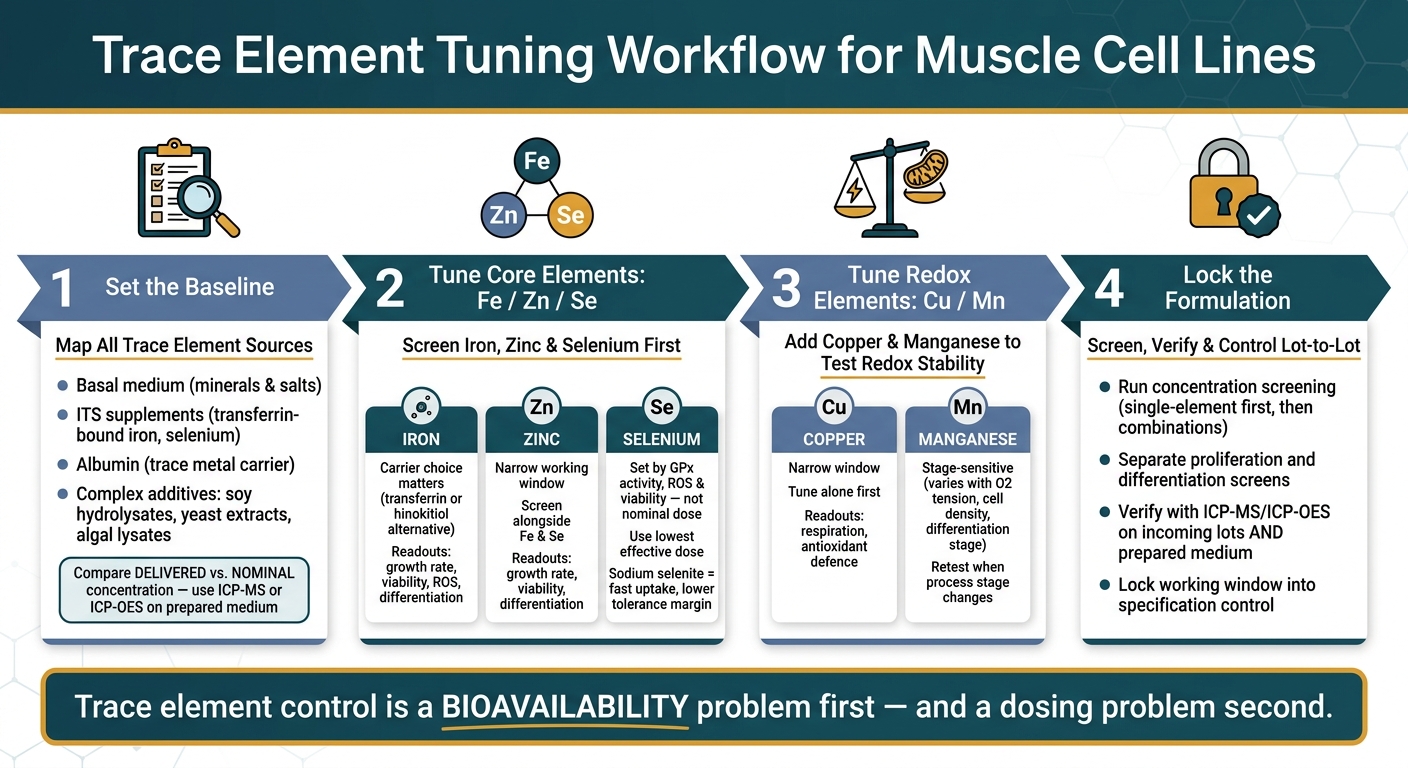
Trace Element Optimization Workflow for Muscle Cell Lines
Leading the Way in Cell Culture Media Control: The Future of Testing with CCM Fingerprinting
sbb-itb-ffee270
Set the Baseline Before Changing Concentrations
Begin with a full inventory of every trace-element input. Before you change any trace element, you need to know what is already getting into the culture from each part of the formulation.
Map Trace Elements Already in the Formulation
Before tuning one element at a time, map every trace-element source already in the medium. In most muscle cell line media, trace elements come from several places. The basal medium supplies minerals and salts. Insulin–transferrin–selenium (ITS) supplements add iron through transferrin and selenium in a defined salt or complex form. Albumin, if used, can also bring in trace metals. Complex ingredients such as soy hydrolysates, yeast extracts, and algal lysates may add minerals that are not fully quantified, and their trace metal content is often not fully characterised [5][3].
| Source Category | Common Trace Element or Carrier | Role |
|---|---|---|
| Protein carriers | Transferrin (iron), albumin | Iron transport [1] |
| Serum-free supplements | Selenium (in ITS) | Antioxidant defence, selenoproteins [5] |
| Complex additives | Algal, soy and yeast hydrolysates | Amino acids, minerals, partial serum replacement [5][3] |
Record each source in molar units before screening.
What matters is not only what is present, but how much of it makes it through processing and reaches the cells. Complex additives can shift trace-element input in a material way, so treat them as active ingredients, not background noise.
Check Delivered Versus Nominal Concentration
After you inventory the sources, compare delivered concentration with nominal dose. Those two numbers often do not match. Iron can precipitate at physiological pH. Trace metals can bind to proteins, amino acids, and phosphates. Some may also adsorb to vessel surfaces. As a result, free-ion availability is often lower than the nominal dose.
Transferrin is the standard iron carrier in ITS-supplemented media, but batch-to-batch variation can affect its quality [1]. Ajinomoto's hinokitiol-based alternative is chemically stable and binds iron for delivery into cells [1].
Complex ingredients add still more uncertainty. When cyanobacteria or algal biomass is sterilised and hydrolysed for use as a media supplement, some models assume that only 50% of the initial biomass is available to cells after processing losses [5].
If the cell response does not line up with the formulation on paper, the next step is analytical confirmation. Use published values as a starting point, then verify the actual trace-element profile before locking the formulation. Once the baseline is clear, tune iron, zinc, and selenium first.
Tune Iron, Zinc and Selenium as the Core Optimisation Set
Once the baseline is locked in, screen iron, zinc and selenium first. Start with the window in the table below.
| Element | Principal Function | Deficiency Signal | Excess Risk | Delivery / Transport Note | Recommended Readouts |
|---|---|---|---|---|---|
| Iron | Supports growth, viability and differentiation | Reduced proliferation and lower viability | Oxidative stress from free iron chemistry | Transferrin-bound delivery or a low-molecular-weight alternative such as hinokitiol | Growth rate, viability, ROS markers, differentiation capacity |
| Zinc | Supports growth in a narrow working window | Reduced growth or weaker differentiation performance | Cytotoxicity at higher concentrations | Screen alongside iron and selenium to capture interactions | Growth rate, viability, differentiation capacity |
| Selenium | Supports antioxidant defence and selenoprotein activity | Elevated ROS and reduced viability, especially at high density | Toxicity above the working window | Sodium selenite is rapidly taken up but carries a higher toxicity risk than organic forms | GPx activity, ROS levels, viability, differentiation capacity |
Transferrin quality can vary between batches, and that can shift iron availability. Hinokitiol, a low-molecular-weight iron carrier, is chemically stable and gives you a more consistent option that is worth screening early [1].
Treat zinc as a narrow-window variable. Don’t test it in isolation. Screen it with iron and selenium so you can see interaction effects instead of missing them.
For selenium, set the range by GPx activity, ROS and viability, not by nominal dose alone. Sodium selenite is taken up fast, but it is less forgiving than organic selenium, so use the lowest effective dose.
Once these three sit in range, move to copper and manganese to test redox and mitochondrial sensitivity. This systematic approach is essential when navigating the broader challenges of scaling cultivated meat production.
Tune Copper and Manganese Without Destabilising Redox Balance
Once iron, zinc and selenium are fixed, use copper and manganese to check whether redox stability still holds. These two trace elements do not behave the same way, so it helps to tune them one at a time before putting them together in a screen.
Copper: Respiration, Antioxidant Defence and Metal Interactions
Copper needs a narrow window. Too little can limit growth. Too much can destabilise the formulation and muddy the readout.
In a mixed trace-element screen, keep the copper range tight and use a controlled design. That way, if cell behaviour changes, you can link the shift to copper with more confidence instead of guessing whether another factor caused it.
Manganese: Mitochondrial Resilience and ZIP8-Linked Uptake
Manganese is stage-sensitive in a different way. Its effect can shift with oxygen tension, cell density and differentiation stage, so it should be retested whenever the process stage changes.
If results move around between runs, check oxygen tension, cell density and differentiation stage before changing the dose. In practice, that saves time. What looks like a manganese problem can just as easily be a process-state problem.
For monitoring, use the same growth, differentiation and redox readouts across both elements. That gives you a cleaner comparison and makes it easier to spot whether the issue sits with respiration, oxidative stress, or lineage progression.
Build a Screening and Control Plan That Holds Up Across Lots
Once copper and manganese are tuned, the next step is to check whether that window still works when raw material lots change. In practice, that means treating concentration screening and lot control as two separate jobs.
Design the Concentration-Screening Workflow
Keep optimisation separate from release testing. Use high-throughput, automated screening to map concentration ranges and to split single-metal effects from the main interaction effects [2]. Run proliferation and differentiation as separate screens.
Start with each element on its own. That gives you the usable range without interaction noise. Then test the combinations most likely to interact. After you identify the best window, confirm it in a verification run before you lock it into the formulation specification.
Control Lot-to-Lot Variation and Verify Trace-Metal Recovery
Once the working range is set, check that new lots still deliver it. Use ICP-MS or ICP-OES on incoming materials and on prepared medium to confirm that delivered levels still match the target after mixing, sterilisation, and storage. Check each lot in the prepared medium, not just against the supplier label.
This matters because high-molecular-weight components such as transferrin can vary between batches [1]. The label may look fine, but the prepared medium is what the cells actually see. That makes analytical verification the dependable check. Where structured supplier specifications are available, Cellbase organises them into structured fields that make comparison easier [4].
If iron delivery is still the main source of lot-to-lot drift, a chemically stable alternative can help. Ajinomoto's hinokitiol-based transferrin replacement is one example [1].
Conclusion: Define a Usable Concentration Window, Then Lock It Down
Define the working window with screening, confirm it analytically, and lock it into specification control.
FAQs
Why do nominal and delivered trace element levels differ?
Because the level listed in a formulation doesn’t always match what cells are exposed to in practice. In the complete culture medium, trace elements can shift because of batch-to-batch variation, interactions with other medium components, and losses through precipitation or adsorption.
This tends to happen more often in media that contain complex or variable ingredients. The same issue can show up when replacements such as iron carriers vary between batches in stability or quality.
How should I screen Fe, Zn and Se for muscle cell lines?
Use high-throughput automation with machine learning models to test concentration ranges for iron, zinc and selenium. That makes it easier to measure how each window affects cell proliferation, differentiation and redox balance.
When designing media, factor in transporter biology and lot-to-lot variability in raw materials as well. Cellbase can help you source suitable media components and analytical tools for cultivated meat workflows.
When should I recheck trace elements across lots and process stages?
Recheck trace elements across all production lots and process stages to keep performance steady and cut batch-to-batch variation.
Run the check again when moving from proliferation to differentiation, and whenever you switch media suppliers or change raw material batches. Those shifts can affect cell viability, growth, and differentiation. Cellbase can help you identify relevant media components and analytical tools.


