

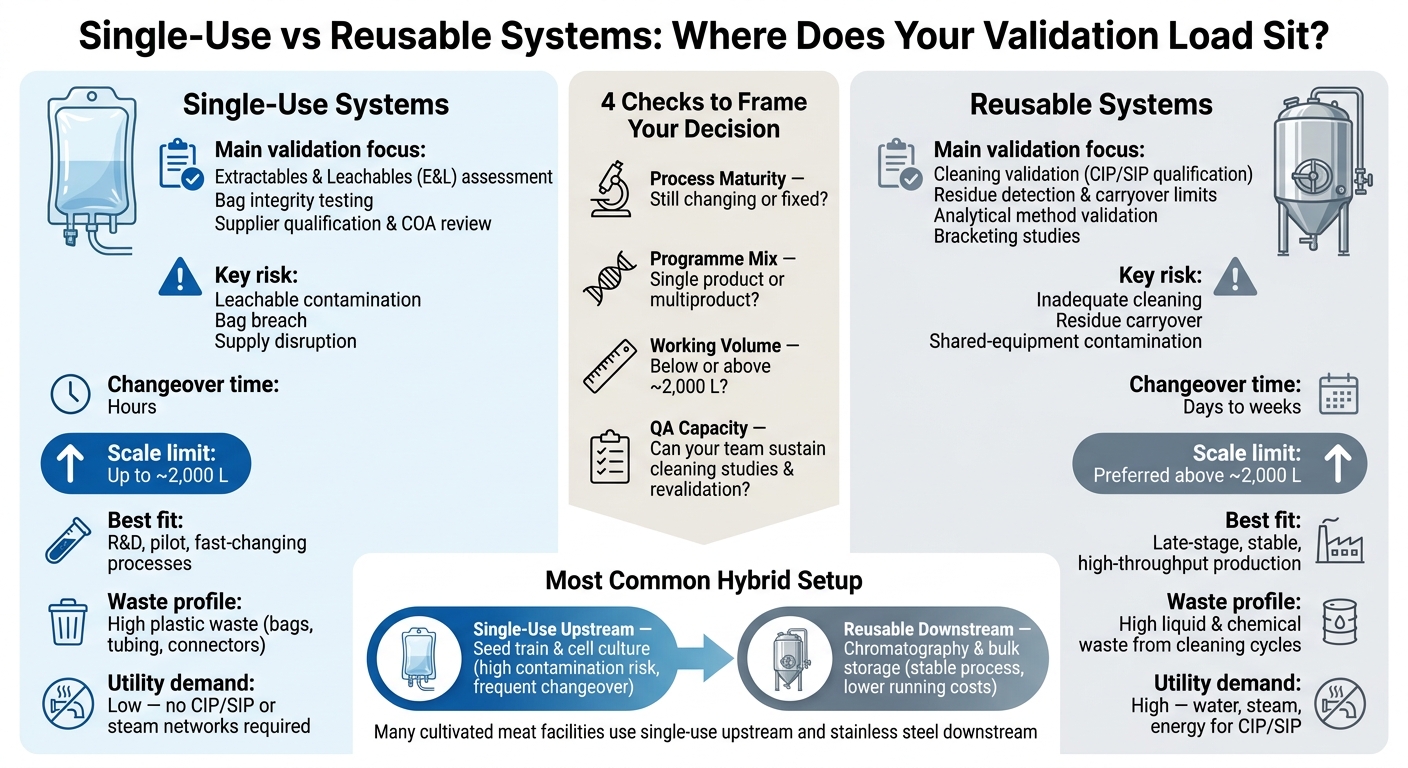
If I have to reduce the choice to one line, it is this: single-use cuts cleaning work, while reusable shifts the burden to cleaning, sterilisation, and residue control.
For bioprocess engineers and cell culture teams, the decision is usually not about preference. It is about where you want the validation load to sit:
- Single-use systems push work towards supplier control, extractables and leachables (E&L) review, bag integrity, and sterility assurance
- Reusable systems push work towards CIP/SIP qualification, residue limits, analytical method validation, and batch-to-batch carryover control
- In cultivated meat, this matters most in upstream media prep and inoculum expansion, where contamination risk is highest and changeovers are frequent
- Single-use platforms usually top out at around 2,000 L, so scale and bioreactor selection can rule out one option early
- Many sites end up with a hybrid model: single-use upstream, stainless steel downstream
If I were framing the decision fast, I would check four things first:
- Process maturity: Is the process still moving, or is it fixed?
- Programme mix: Single product, or shared equipment across cell lines and formats?
- Working volume: Are you still below roughly 2,000 L?
- QA capacity: Can your team support repeated cleaning studies, reviews, and revalidation?
Single-Use vs Reusable Bioprocessing Systems: Validation Decision Guide
Single-use bioprocessing solutions for media operations
sbb-itb-ffee270
Quick Comparison
| Factor | Single-use | Reusable |
|---|---|---|
| Main validation focus | E&L, supplier files, integrity testing | Cleaning validation, CIP/SIP, residue detection (see media sterility best practices) |
| Main risk | Leachables, bag failure, supplier change | Incomplete cleaning, carryover, shared-equipment risk |
| Changeover time | Often hours | Often days to weeks |
| Best fit | R&D, pilot, fast process changes | Late-stage production, stable process, high throughput |
| Utility demand | Lower | Higher |
| Waste profile | More plastic waste | More liquid and chemical waste |
| Scale limit | Usually up to about 2,000 L | Preferred above that range |
So the short answer is simple: if your process is still changing, single-use often makes validation simpler at the plant level. If your process is fixed and scale is climbing, reusable production systems usually make more sense, even though the cleaning workload is heavier.
Single-use systems: lower cleaning burden, higher material-risk control
Validation advantages of disposable contact surfaces
Single-use systems remove the need to validate CIP and SIP for product-contact surfaces, because those surfaces are disposable polymer bags, tubing, and manifolds [2]. That cuts changeover time and makes these systems a good fit for R&D and pilot work, where process changes happen often [2].
What changes is the focus of validation. Instead of cleaning validation, teams spend more time on material compatibility and component integrity.
Validation limits: extractables, leachables and bag integrity
With single-use setups, supplier qualification and material-risk control become the main validation tasks. A big part of that is extractables and leachables (E&L) from polymer components [2]. During process development, extractables and leachables should be characterised to confirm that they do not affect cell health or product quality [2].
Operational validation also covers pre-use bag integrity testing and sterility assurance for pre-sterilised components [1]. Single-use formats can also hit control limits in mixing efficiency, oxygen transfer, and heat transfer [1]. At larger volumes, mixing and mass transfer are harder to control [1].
How Cellbase supports sourcing for single-use validation workflows
Supplier qualification sits inside the validation workflow, not beside it. Cellbase helps procurement and technical teams source verified single-use bioreactors and related components for cultivated meat validation workflows.
Reusable systems: stronger long-run control, heavier cleaning validation
Why reusable equipment is well established in validated bioprocessing
Reusable systems shift the validation focus. Instead of putting most of the burden on disposable materials, they put it on cleaning and sterilisation control.
That’s why stainless steel is so common in validated bioprocessing. Once the system is qualified, it can deliver repeatable process control and a clear validation path. But there’s a catch: qualification may be stable, while validation work continues through cleaning and sterilisation activities.
Validation burdens: cleaning, sterilisation and segregation
The trade-off is straightforward. Reusable systems come with a heavier validation load because cleaning, sterilisation and segregation all have to be validated to control carryover.
The main job is proving that residues are removed and that product carryover is prevented. Under ICH Q7, cleaning validation requires operators to show that residues from previous batches are reduced below predefined acceptance limits. In practice, that means writing specific cleaning procedures, validating analytical methods for residue detection, and running worst-case bracketing studies [1]. And this is not a one-off task. Cleaning validation is an ongoing programme with annual reviews, defined revalidation triggers, and continuous documentation [1].
Sterilisation adds another layer. Reusable systems need fixed utility infrastructure such as CIP skids, SIP distribution networks, and floor drains for run-off [1]. Those systems need to be built into the facility from the start, because retrofitting them later is expensive and disruptive. In multiproduct cultivated meat facilities, where different cell lines or product formats may share the same infrastructure, the validation load increases with that shared use [1].
Where reusable systems fit in cultivated meat scale-up
Reusable systems make the most sense in later-stage cultivated meat production, when process conditions are stable and throughput is higher. At larger working volumes, stainless steel becomes the practical option for production bioreactors, and the heavier validation burden stops being optional overhead. It becomes part of routine operation at scale [1].
That trade-off leads directly into a comparison of single-use vs reusable bioreactors below.
Single-use vs reusable systems: direct comparison for validation decisions
Validation scope and quality risk profile
For cultivated meat teams, the decision comes down to this: do you validate materials through the supplier, or do you control residues inside your own plant? That’s the practical split. It’s not about which setup looks easier on paper. It’s about where the validation load sits.
Single-use systems bring extractables and leachables (E&L) risk, bag integrity concerns, and a direct reliance on supplier quality [1]. Reusable systems need ongoing cleaning validation, including analytical method validation for residue detection and defined residue carryover limits for each process change or product family [1]. Put simply, single-use pushes risk towards materials, while reusable pushes risk towards cleaning control.
The table below shows how that burden moves between supplier control and facility control.
| Validation factor | Single-use systems | Reusable systems |
|---|---|---|
| Primary validation focus | E&L assessment, bag integrity, supplier quality | Cleaning procedures, residue detection, residue carryover limits |
| Typical studies required | E&L profiling, integrity testing, COA review | Analytical method validation, bracketing studies, CIP/SIP qualification |
| Main failure mode | Leachable contamination, bag breach, supply disruption | Inadequate cleaning, residue carryover between batches |
| Detection methods | Supplier documentation, integrity testing | Validated analytical methods |
Documentation needs split in the same way. Single-use programmes are mostly supplier-led, with the focus on Certificates of Analysis and change notifications from vendors. Reusable systems create facility-led records: maintenance logs, annual reviews, and clear revalidation triggers that stay in place for the full service life of the equipment [1].
Operational fit: flexible development versus standardised production
Once that validation split is clear, the next step is to ask whether the process is stable enough for fixed infrastructure. In practice, process maturity tells you where the validation effort should sit: with supplier control or with facility control.
Single-use systems fit development and pilot programmes, where process specifications are still moving. Changeover is measured in hours rather than days or weeks [1]. That matters when teams are tuning cell culture conditions or moving between cell lines. Reusable systems make more sense once the process is locked and throughput is steady, with tighter process control in stable, high-volume production. There’s also a practical scale limit to keep in mind: single-use bioreactor platforms usually top out at about 2,000 L [1]. Above that working volume, reusable systems are generally preferred.
| Operational factor | Single-use systems | Reusable systems |
|---|---|---|
| Development stage fit | Development and pilot programmes | Late-stage, single-product, commercial manufacturing |
| Changeover demands | Hours | Days to weeks |
| Process control depth | Moderate; dependent on supplier consistency | High; infrastructure calibrated to specific process |
| Documentation complexity | Supplier-led (COAs, change notices) | Facility-led (logs, revalidation programmes) |
Waste, utilities and hybrid configurations
Validation isn’t the only trade-off. Waste streams and utility system design also shape the decision.
Single-use systems create a lot of plastic waste - bags, tubing, and connectors - that is discarded after every batch [1]. Reusable systems create high volumes of liquid waste and chemical runoff from CIP and SIP operations, along with heavy water, steam, and energy use [1].
That’s why many cultivated meat facilities end up with a hybrid setup. The most common model uses single-use upstream - seed train and cell culture, where contamination risk and changeover frequency are highest - and reusable stainless steel downstream for chromatography and bulk storage, where lower running costs and fixed processes are useful [1]. Some facilities flip that arrangement to cut cleaning validation in existing downstream lines.
| Factor | Single-use systems | Reusable systems |
|---|---|---|
| Material waste | High (plastic bags, tubing, connectors per batch) | Low (equipment retained across batches) |
| Utility consumption | Low (no CIP/SIP or steam networks required) | High (water, steam, and energy for cleaning cycles) |
| Cleaning burden | None for fluid path | Ongoing; validated procedures required |
| Typical hybrid setup | Single-use upstream (cell culture, seed train) | Reusable downstream (chromatography, bulk storage) |
Conclusion: choosing the right validation model for cultivated meat
There’s no single correct answer here. The validation burden sits in one of two places: with the supplier through material control, or with the plant through cleaning control. Single-use systems can cut changeover to hours [1], but that speed comes with more material-related risk to manage. Reusable systems give you long-life infrastructure, but they also bring a continuous cleaning-validation burden under ICH Q7 [1].
That puts process maturity at the centre of the decision. When specifications are still moving, single-use usually makes more sense. When the process is stable and throughput is sustained, reusable systems are often the better fit. Scale matters too. Above roughly 2,000 L, single-use is much harder to justify [1].
If the choice isn’t clear-cut, a hybrid setup is often the practical middle ground. In many cultivated meat facilities, that means single-use upstream and stainless steel downstream [1].
These decisions affect compliance workload, day-to-day flexibility, and facility design across the full life of the process.
Key takeaways for technical, QA and procurement teams
Use four checks to frame the decision:
- Development stage: this tells you whether flexibility or tighter process control matters more right now.
- Programme mix: single-product versus multiproduct has a direct effect on how much cleaning validation work needs repeating.
- Scale: above roughly 2,000 L, reusable systems are generally the only viable path [1].
- QA maturity: this determines whether your team can handle the steady analytical and documentation load that reusable equipment brings.
For procurement teams, supplier documentation quality matters most in single-use workflows. QA teams should focus on extractables and leachables characterisation, qualify backup suppliers, and add supply assurance clauses to vendor contracts early to lower the risk of production halts [1]. Cellbase can help teams source single-use components with E&L documentation and reusable systems suited to cleaning validation.
FAQs
How do I choose between single-use and reusable systems?
Choose based on your production scale, budget and resource priorities. Single-use systems usually mean lower upfront cost and faster turnaround, which makes them a good fit for early-stage research and smaller operations.
Reusable stainless steel systems tend to fit large-scale production above 10,000 litres. They can deliver better long-term efficiency, but they also come with higher initial spend and more demanding cleaning requirements. Many facilities use a hybrid approach.
When does a hybrid setup make the most sense?
A hybrid setup often makes the most sense when a facility needs to balance early-stage flexibility with commercial-scale efficiency.
Many cultivated meat producers use single-use systems for seed trains and early process development, where fast turnaround matters. They then rely on reusable stainless steel bioreactors for large-scale continuous production, where economies of scale matter more and recurring consumable use needs to be kept in check.
What validation evidence should QA review first?
It depends on the system type.
For single-use equipment, QA should start with material characterisation and the supplier’s sterility testing. That matters because more of the validation work sits with the manufacturer.
For reusable stainless steel systems, the first stop should be the cleaning validation protocol. Pay close attention to hard-to-clean product contact areas, such as valve seats and impeller blades. QA should also check the documented SOPs for CIP/SIP, along with residue limits and sampling methods.


