

In cultivated meat production, scaffolds act as the framework for cell growth. Conductive scaffolds are crucial for muscle cells, which rely on electrical signals to develop properly. However, achieving the right balance between electrical conductivity and structural strength is challenging. Key issues include:
- Insufficient conductivity: Limits muscle cell alignment and maturation.
- Material challenges: Biocompatibility and toxicity risks with conductive polymers like PEDOT:PSS.
- Structural trade-offs: Conductive materials can block pores, hindering nutrient flow and cell migration.
Solutions involve using materials like PEDOT and polypyrrole (PPy), optimising pore size (165–202 μm), and advanced fabrication techniques like freeze-drying and sulphuric acid treatment. Platforms like Cellbase simplify sourcing of verified scaffold materials, ensuring researchers can access the right tools for cultivated meat development.
Common Problems with Scaffold Conductivity
Insufficient Conductivity Limits Muscle Cell Development
Muscle cells are electroactive, meaning they depend on electrical signals to align and differentiate effectively. When scaffolds lack adequate conductivity, they fail to replicate the necessary electrical microenvironment. This shortfall disrupts myogenesis, the process by which muscle cells align and mature into functional fibres.
Without these electrical cues, muscle cells may attach to the scaffold but remain disorganised. They won't develop the alignment or structure typical of mature muscle tissue. The result? Tissue that lacks the structural and functional qualities needed for cultivated meat production.
This issue highlights the importance of designing scaffolds that achieve the right balance - providing sufficient electrical performance without sacrificing structural integrity.
Balancing Conductivity with Scaffold Structure
While electrical signalling is crucial, adding conductive materials to scaffolds introduces its own set of problems. One key challenge is maintaining high porosity. Pores are essential for several reasons: they allow cells to migrate, support nutrient exchange, and provide surfaces for cell attachment. But integrating conductive polymers can block these pores, weakening the scaffold's microstructure.
Manufacturing methods, such as freeze-thaw cycles, need to be carefully calibrated. Too much conductive filler can clog the pores and collapse the structure, while too little diminishes the scaffold's ability to conduct electrical signals effectively.
Material Compatibility Issues
Finding materials that are biocompatible, mechanically stable, and electrically conductive is no easy feat. For example, PEDOT:PSS, a widely used conductive polymer, illustrates the challenge. A study from the University of Crete in December 2025 found that a concentration of 0.15% w/v struck the right balance between conductivity and cell compatibility. However, higher concentrations caused problems. Maria Chatzinikolaidou from the Department of Materials Science and Engineering explained:
Higher concentrations, such as 0.3%, have been reported to impair cell viability and spreading due to the excess anionic PSS component [1].
Beyond concentration, crosslinkers like glutaraldehyde or GOPS can leave behind toxic residues if not properly removed. Additionally, scaffolds must endure mechanical stresses while retaining their electrical properties - an especially tough requirement for muscle tissue engineering.
These challenges underscore how critical precise material selection is when designing scaffolds for cultivated meat production. Every component must work together to ensure both functionality and compatibility.
Electrically Conductive Scaffold To Modulate & Deliver Stem Cells l Protocol Preview
Materials That Improve Scaffold Conductivity
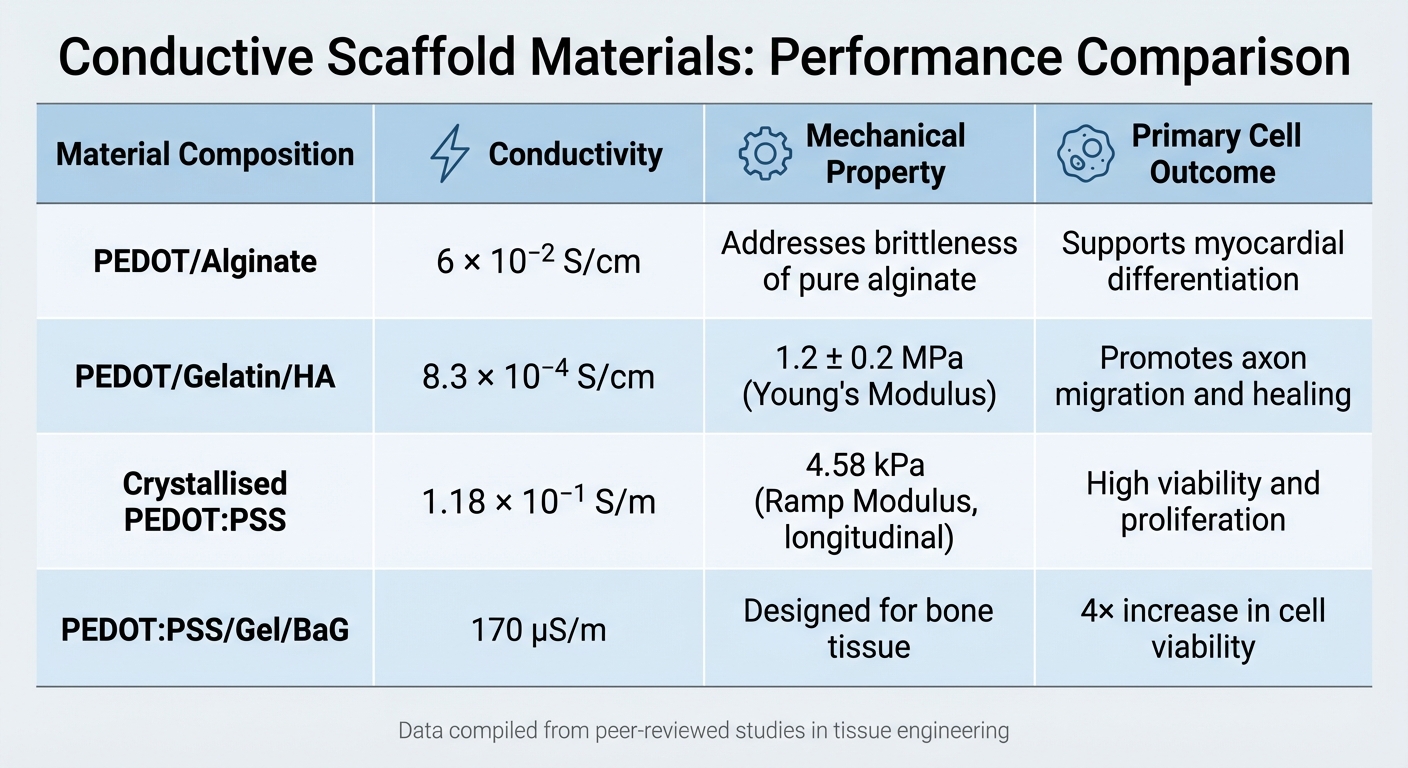
Conductive Scaffold Materials Comparison for Cultivated Meat Production
Using PEDOT and PEDOT:PSS
PEDOT (poly(3,4-ethylenedioxythiophene)) and its derivative PEDOT:PSS stand out for their excellent chemical stability and high conductivity. These conductive polymers provide the electrical stimulation necessary for muscle cells to differentiate effectively. PEDOT scaffolds can achieve conductivity levels as high as 6 × 10⁻² S/cm [4], while still maintaining the structural integrity needed for cell attachment.
Creating PEDOT:PSS scaffolds with aligned microarchitectures significantly boosts their conductivity. This alignment encourages organised cell growth and improves cytoskeletal orientation [3]. Treating these scaffolds with sulfuric acid enhances conductivity by a factor of 1,000 [3]. Despite this treatment, the scaffolds retain extremely high porosity - up to 98.5% [3] - which is essential for cell migration and nutrient access.
Producing PEDOT as nanoparticles eliminates the insulating PSS, enhancing biocompatibility. This approach also allows for fine-tuning mechanical properties, such as achieving a Young's Modulus of 1.2 ± 0.2 MPa [2]. These modifications pave the way for incorporating additional conductive materials like polypyrrole (PPy).
Adding Polypyrrole (PPy) for Muscle Cell Growth
Polypyrrole (PPy) serves as another effective means to improve scaffold conductivity. When incorporated into scaffold matrices, PPy supports electrical stimulation, which is crucial for muscle cell development. The conductive particles can be synthesised directly within the scaffold, enabling precise control over the ratio of conductive material to the base matrix. This flexibility influences both the mechanical properties of the scaffold and its ability to support cell growth.
Comparison of Conductive Materials
The table below provides a comparison of various conductive scaffold formulations, showcasing their unique properties and applications:
| Material Composition | Conductivity | Mechanical Property | Primary Cell Outcome |
|---|---|---|---|
| PEDOT/Alginate | 6 × 10⁻² S/cm [4] | Addresses brittleness of pure alginate | Supports myocardial differentiation |
| PEDOT/Gelatin/HA | 8.3 × 10⁻⁴ S/cm [2] | 1.2 ± 0.2 MPa (Young's Modulus) | Promotes axon migration and healing |
| Crystallised PEDOT:PSS | 1.18 × 10⁻¹ S/m [3] | 4.58 kPa (Ramp Modulus, longitudinal) | High viability and proliferation |
| PEDOT:PSS/Gel/BaG | 170 μS/m [5] | Designed for bone tissue | 4× increase in cell viability |
This comparison underscores how different material compositions can be tailored to meet specific requirements for cultivated meat tissue development.
sbb-itb-ffee270
Designing Scaffolds for Both Conductivity and Cell Growth
Choosing the Right Pore Size and Surface Area
The size of pores in scaffolds plays a critical role in cell attachment, migration, and electrical signalling. Studies have shown that pore sizes between 165–202 μm provide a good balance, ensuring enough surface area for cell adhesion while allowing nutrients to diffuse effectively [3]. High porosity - reaching up to 98.5% - can improve water absorption and conductivity. However, overly thin scaffold struts due to excessive porosity may hinder cell bridging [3].
Beyond size, the shape and arrangement of pores are equally important. Aligned, lamellar pore structures, achieved through directional freezing, significantly enhance longitudinal conductivity, increasing it by 6.3–8.4 times [3]. This anisotropic design mirrors the natural alignment found in tissues like muscle and nerve, where cells grow along specific axes.
Fabrication Techniques for Conductive Scaffolds
Once the ideal pore architecture is determined, advanced fabrication methods help optimise scaffold conductivity and strength. Freeze-drying is a key technique for creating porous, aligned PEDOT:PSS scaffolds. By carefully controlling the freezing direction, manufacturers can produce structures with highly precise pore dimensions. In 2021, researchers Matteo Solazzo and Michael G. Monaghan from Trinity College Dublin developed GOPS-crosslinked PEDOT:PSS scaffolds using directional lyophilisation. Their method resulted in parallel lamellae that maintained water stability for over three months while supporting the growth of C3H10 cells [3].
To further boost conductivity, sulphuric acid crystallisation is employed. This process removes excess PSS, forming PEDOT nanofibrils. When combined with directional lyophilisation, this treatment can enhance conductivity by up to 5,000 times [3]. Additionally, the acid treatment causes approximately 100% volumetric expansion and increases water absorption to as much as 85 times the scaffold's dry weight [3].
Another approach involves freeze–thaw cycling, which improves the mechanical durability of scaffolds. By subjecting hydrogels to four 24-hour freeze–thaw cycles, their microstructure, mechanical strength, and electrochemical properties are enhanced [1]. This method is particularly useful in applications like cultivated meat production, where scaffold strength is crucial [1].
Sourcing Scaffold Materials Through Cellbase
Once you've fine-tuned your scaffold design, the next challenge is securing reliable materials to bring it to life.
Finding Verified Scaffold Suppliers
Traditionally, sourcing conductive scaffolds has been a frustrating process, often requiring researchers to sift through catalogues packed with irrelevant pharmaceutical products. David Bell, Founder of Cultigen Group, describes the struggle:
Finding suppliers for bioreactors, growth media, scaffolds, or cell lines meant... navigating catalogues with 300,000 products where 299,950 were irrelevant [6].
Enter Cellbase, the first B2B marketplace dedicated to cultivated meat. This platform connects researchers with verified suppliers of materials like PEDOT:PSS-coated scaffolds, polypyrrole-infused structures, and other conductive components rigorously tested for performance.
Cellbase’s "Scaffolds & Biomaterials" collection is a game-changer. It offers 3D structures, edible materials, and hydrogels, all subjected to stringent quality checks to ensure they meet the demands of cell culture applications. Each product listing provides critical technical details, including conductivity levels (in S/cm), pore sizes (measured in micrometres), and biocompatibility data. This transparency eliminates guesswork when selecting materials for muscle or fat cell growth. Researchers can also filter products based on validation status, scalability (from lab to commercial production), and regulatory compliance, ensuring materials align with food-grade standards. This thorough verification process makes procurement more straightforward and reliable.
Simplified Procurement Process
Cellbase takes the hassle out of procurement with features like transparent pricing and catalogues tailored specifically for cultivated meat. Advanced filters allow procurement teams to search for scaffolds by material type (e.g., PPy or PEDOT), pore size (50–200 µm for muscle cells), and conductivity levels. Once a suitable option is found, users can directly message suppliers for custom quotes. As Bell puts it:
We're building the procurement layer the industry needs. One curated supplier at a time [6].
With Cellbase, everything happens in one place. The platform handles technical documentation, Material Transfer Agreements, purchase orders, and bank transfers digitally. For UK-based teams, prices are displayed in pounds sterling, with metric measurements, while global shipping options include cold chain logistics for sensitive materials. This streamlined approach drastically cuts down procurement times, providing faster access to PEDOT scaffolds that support consistent cell differentiation.
Summary
Achieving the right level of scaffold conductivity is a key factor in producing high-quality cultivated meat. Conductive scaffolds play a vital role by delivering the electrical signals that muscle cells need to grow and mature properly. Without this electrical environment, muscle cells struggle to develop, which directly impacts the quality of cultivated meat.
The main challenge lies in finding a balance between conductivity and structural strength. This involves fine-tuning materials like PEDOT:PSS to achieve the necessary electrical properties [1]. Additionally, the scaffolds need to work seamlessly with biocompatible materials such as gelatin or PVA, ensuring they support cell growth without compromising cell health.
To overcome these challenges, careful material selection and mechanical stimulation are essential. For example, combining PEDOT:PSS scaffolds with cyclic compression at a frequency of 1 Hz has been shown to improve differentiation markers, including increased collagen secretion and calcium deposition [1].
As the cultivated meat industry expands - projected to grow from £7.2 billion in 2024 to £8.5 billion in 2025 - efficient procurement becomes increasingly important [6]. This is where Cellbase steps in, connecting researchers with suppliers who specialise in food-grade materials rather than pharmaceutical-grade ones. By offering detailed technical resources and simplifying processes like obtaining quotes and managing Material Transfer Agreements, Cellbase helps streamline development.
For UK research teams moving from small-scale experiments to commercial production, having access to verified conductive scaffolds through Cellbase accelerates progress and lowers technical risks - key elements for successfully bringing cultivated meat to market.
FAQs
What conductivity should a muscle scaffold target?
Conductivity is a critical factor for muscle scaffolds, as it supports electrical excitability and aids in the maturation of myotubes. Conductive polymers such as polypyrrole (PPy) and PEDOT have demonstrated their ability to boost conductivity significantly. While studies don't specify exact target values, improving conductivity remains a key element in refining scaffold performance for cultivated meat production.
How can you raise conductivity without blocking pores?
To boost scaffold conductivity while keeping pores open, consider using highly porous electronic scaffolds tailored to promote ideal cell activity during electrical stimulation. Materials such as crosslinked 3D PEDOT:PSS improve conductivity without compromising the pore structure. This allows essential nutrients to flow freely, supporting cell growth and differentiation - an approach especially useful in cultivated meat production.
How can you check if PEDOT:PSS is safe for cells?
To assess whether PEDOT:PSS is safe for cells, biocompatibility testing is essential. This process examines how the material affects cell growth and viability through specific assays. These tests help confirm that the material promotes healthy cell behaviour without causing adverse effects.


