

For bioprocess engineers and cultivated meat R&D teams, partial media replacement works only when you match exchange fraction, timing, cell density, and waste load to the culture stage and vessel.
I’d boil the article down to this: 30–50% daily exchange can be a useful starting point in high-density expansion, but it is not a rule. Once cultures move towards 80–130+ million cells/mL, the schedule usually has to follow glucose drawdown, lactate, ammonia, viability, mixing time, and oxygen transfer, not just the clock.
If I were screening whether partial replacement fits a process, I’d focus on five questions first:
- How much medium am I exchanging each cycle?
- What is triggering the exchange: time, glucose, or viable cell density?
- At what density does the current schedule stop holding lactate and ammonia in range?
- Can the vessel mix the incoming medium fast enough without adding too much shear?
- Is partial replacement still the right mode, or am I close to fed-batch limits or perfusion territory?
Partial replacement sits between fed-batch and perfusion:
- Batch: no exchange
- Fed-batch: nutrients added, waste stays
- Partial replacement: part of the spent medium removed and replaced at intervals
- Perfusion: medium exchanged continuously with cell retention
Quick comparison
| Mode | Nutrient control | Waste removal | Hardware load | Typical use case |
|---|---|---|---|---|
| Batch | Low | Low | Low | Early culture work |
| Fed-batch | Medium | Low | Low | Simple expansion runs |
| Partial replacement | Medium to high | Medium to high | Medium | Higher-density expansion without full perfusion set-up |
| Perfusion | High | High | High | Very high-density or steady-state production |
The core point is simple: partial replacement is not just a media schedule; it is a control problem plus a vessel problem. The article maps the variables that decide whether it extends a run in a stable way or just delays the same limit by a day or two.
sbb-itb-ffee270
Core Variables That Determine Partial Replacement Performance
Partial replacement performance comes down to how exchange fraction, timing, cell density, and metabolite load work together. In practice, those variables don’t act on their own. Change one, and the rest shift with it. The real process question is simple: which variable should drive the schedule?
Exchange Fraction and Replacement Timing
The fraction of medium removed at each exchange and the interval between exchanges are linked. You can’t set one sensibly without the other. A larger exchange done less often gives byproducts more time to build up. A smaller exchange done too infrequently can do the same. So the aim is to remove enough spent medium to keep lactate and ammonia under control, while still retaining enough carry-over nutrients and growth factors to justify partial replacement in the first place.
| Exchange Pattern | Typical Effect |
|---|---|
| Low, infrequent exchange | More nutrients and growth factors are retained, but inhibitory byproducts can build up |
| Low, frequent exchange | More stable conditions, but higher media use |
| Moderate daily exchange (30–50%) [3] | A practical compromise in expansion runs |
| High-frequency exchange | Strong byproduct removal, but media efficiency decreases |
Media use still matters. If you exchange large fractions too often, you chip away at the efficiency gains that make partial replacement worth doing. Once exchange size is fixed, cell density usually becomes the main factor that sets how often the process has to run.
Cell Density, Growth Phase and Stage-Specific Needs
As viable cell density rises, nutrient demand rises with it. That means a schedule that works well at low density can fall apart once the culture enters a high-density regime. At lower densities, a time-based schedule is often enough. As the culture tightens up, that same schedule usually has to become more frequent.
| Density Regime | Indicative Density or Stage | Exchange Logic | Main Limiting Factors |
|---|---|---|---|
| Low | <10–20 million cells/mL | Batch or infrequent partial replacement | Nutrient availability |
| High-density expansion | 80–130+ million cells/mL [3][2] | Daily exchange [3] or media rejuvenation [1][2] | Metabolite build-up; oxygen transfer |
| Differentiation phase | Stage-based rather than density-based | Specific media shifts such as serum starvation, the deliberate reduction of serum [5][6] | Physical space; scaffold integration |
Low-density expansion, high-density expansion, and differentiation are not the same operating problem. Early in expansion, cells are still adapting and overall consumption is lower. In the high-growth phase, metabolic demand peaks, so exchange frequency should track that change. Differentiation follows a different logic again. At that point, density on its own is not enough. What matters is what density is telling you about nutrient depletion and waste accumulation.
Nutrient Depletion, Metabolite Thresholds and Trigger Strategy
The control problem is straightforward: keep nutrients above limiting levels while preventing metabolites from slowing growth. In practice, three trigger strategies are common.
- Time-based triggers use a fixed schedule, regardless of current culture state.
- Nutrient-threshold triggers start exchange when a measured analyte, usually glucose, drops below a set point.
- Cell-density-based triggers use viable cell density as a proxy for metabolic load, starting exchange once density passes a defined value.
Each trigger turns a measurement into an action. The best choice depends on what the process can measure reliably at that stage.
Start with the simplest trigger that matches the process state.
Bioreactor Operation, Mixing and Scale-Up Constraints
Once the trigger is set, the vessel has to carry out each medium exchange the same way, cycle after cycle. That’s where things get harder. Moving from shake flasks or bench-scale systems into controlled bioreactors shifts the problem. At that point, media strategy matters, but fluid dynamics, mass transfer and vessel design start to matter just as much.
Mixing and Shear During Exchange Events
Fresh medium has to spread through the vessel fast after each exchange. In larger reactors, that takes longer. If mixing is poor, local pockets of different pH, nutrients and metabolites can form, and those gradients can change cell behaviour. The catch is simple: better mixing often comes with more shear, and cultivated meat cells are often sensitive to mechanical stress [7][4].
In STRs, impeller speed and aeration need to be tuned together to keep oxygen transfer in range and maintain nutrient uniformity [4]. Stirred-tank reactors are still the most common format for both proliferation and differentiation, but they also bring clear shear risk for fragile animal cells [7][4]. Low-shear separation systems can cut handling stress, though they add more process complexity.
That’s why vessel selection isn’t just about what equipment is available. It directly affects how the process behaves.
Vessel Format and Automation Readiness
The vessel format sets the practical limits for repeated partial replacement. Each option comes with its own trade-off between mixing, shear and how easy it is to automate.
| Vessel Format | Mixing Profile | Shear Profile | Ease of Automation | Fit for Partial Replacement |
|---|---|---|---|---|
| Stirred-tank (STR) | High; gradients can form at scale [7][4] | High at impeller; requires speed optimisation [7] | High; industry standard for pump and sensor integration [4] | Strong for high-density suspension and microcarrier cultures [4] |
| Wave-style bags | Moderate | Low | High; single-use | Common for seed trains and smaller production volumes |
| Airlift reactor | Moderate; gas-driven [7] | Low to moderate; no mechanical impeller [7] | High; simplified vessel design | Suitable for shear-sensitive cell lines [7] |
| Hollow fibre | Low; diffusion-based exchange [7] | Very low; cells protected within fibres [7] | Moderate; complex manifold design [4] | Good for dense differentiation phases; harder to scale [7] |
Those differences set the operating limits when partial replacement is compared with batch, fed-batch and perfusion.
Scale-Up Risks to Plan For
Two of the main scale-up risks are inconsistent exchange fractions and longer withdrawal and refill times [4]. Small errors may not look serious in one cycle, but across repeated exchanges they can stack up. Longer exchange windows also leave cells for more time in conditions with lower nutrient availability and drifting pH. So the process has to be checked for viability response across several back-to-back cycles, not just one.
Mixing also changes with vessel geometry. An impeller setting that works in a small STR may not behave the same way in a larger unit. That’s one reason teams are looking closely at perfusion systems and media rejuvenation. These systems are being developed to hold high cell densities while cutting byproduct build-up at production scale [1][2].
These constraints set the limits on which vessel formats still make sense at scale. The next step is to ask whether partial replacement still holds up as the best middle ground under those limits.
Comparing Batch, Fed-Batch, Partial Replacement and Perfusion
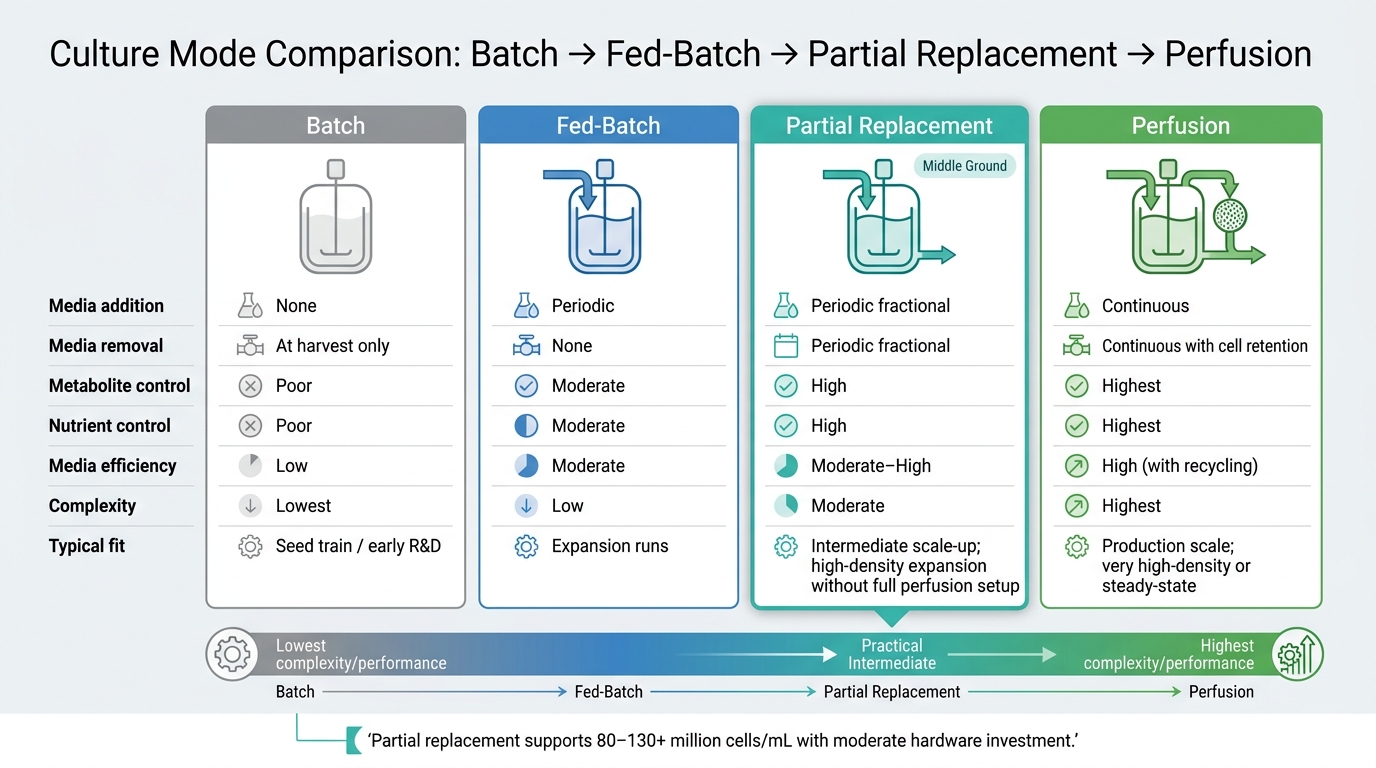
Batch vs Fed-Batch vs Partial Replacement vs Perfusion: Cultivated Meat Culture Modes Compared
Once exchange timing is set, the next question is which culture mode best matches the target density and waste load.
How the Four Culture Modes Differ in Practice
The main difference comes down to nutrient supply, waste removal, and whether cells stay in the vessel.
| Feature | Batch | Fed-Batch | Partial Replacement | Perfusion |
|---|---|---|---|---|
| Media addition | None | Periodic | Periodic fractional | Continuous |
| Media removal | At harvest only | None | Periodic fractional | Continuous with cell retention |
| Metabolite control | Poor | Moderate | High | Highest |
| Nutrient control | Poor | Moderate | High | Highest |
| Media efficiency | Low | Moderate | Moderate–high | High (with recycling) |
| Complexity | Lowest | Low | Moderate | Highest |
| Typical fit | Seed train / early R&D | Expansion | Intermediate scale-up | Production scale |
That side-by-side view makes the role of partial replacement pretty clear. It often sits between fed-batch and perfusion as a workable middle ground.
When Partial Replacement Is the Right Intermediate Step
Partial replacement tends to make sense when a team needs tighter metabolite control than fed-batch can provide, but isn't yet set up for dependable perfusion. That includes cases where it serves as a stepping stone towards a more continuous process later on.
It can also be a good fit when primary vs immortalised cell lines are sensitive to the higher shear or failure risks linked to continuous cell-retention systems. In that situation, partial replacement gives teams a lower-complexity way to keep cultures productive while process development moves forward.
Decision Criteria for Process Development and Facility Planning
The right choice depends on a few concrete process and facility variables, and it's worth working through them directly rather than by habit.
Target viable cell density is one of the first filters. Partial replacement can support fairly high densities, but perfusion is still the route to the highest steady-state densities. Acceptable metabolite exposure matters just as much. If lactate or ammonia limits are tight, whether because of the cell line or the needs of a specific differentiation stage, partial replacement may not clear waste fast enough between exchanges.
Media usage rate and waste handling also shape the decision. Partial replacement creates spent medium in discrete, predictable volumes. That is usually easier to schedule and handle than a continuous waste stream. Sensor coverage and automation capability set another practical limit. Partial replacement can run with more modest monitoring, while perfusion needs tighter closed-loop control to hold steady conditions.
Mode choice ties together three things: density target, waste burden, and automation level. Those same factors also affect how much waste the facility must manage and how much process control the operation needs.
The next decision is how to monitor and handle the spent medium that partial replacement creates.
Integrating Partial Replacement with Media Management
Spent Media Recycling and Monitoring Strategy
Partial replacement works best when spent medium handling sits inside the same control loop as exchange timing. In practice, that means recycled or discarded medium is part of the bioprocess design, not a separate facilities job.
The right recycling route depends on how tightly the process already controls cells, flow and metabolite build-up.
| Recycling Approach | Compatibility with Partial Replacement | Removal of Residual Metabolites | Monitoring Needs |
|---|---|---|---|
| Membrane-based (TFF) | High; supports continuous and semi-continuous exchange flows | Excellent removal of small-molecule inhibitors | Transmembrane pressure, flow rates, permeate flux |
| Centrifuge-based perfusion | High; allows for discrete harvests and media reuse | Good separation of cells from spent medium | Cell density, rotation speed, biomass discharge |
| Algal detoxification | Moderate; requires a secondary cultivation vessel | High; algae absorbs leftover nutrients and supplies oxygen | pH, dissolved oxygen, algal biomass density |
| Chemical stripping | Moderate; suited to specific metabolite removal | Targeted; highly specific to ammonia or lactate | Ion-specific concentrations (e.g. NH₄⁺) |
Membrane-based and centrifuge-based routes pair well with partial replacement because they support semi-continuous exchange or discrete harvests with media reuse. They also give teams a cleaner way to separate cell retention from metabolite removal, which matters once cell density climbs.
Algal detoxification can also work in a circular loop. In one example, microalgae (Chlorella BDH-1) grown on spent cultivated meat medium could substitute for 50% of required serum and amino acids whilst improving muscle cell growth by 40% [9]. That kind of setup turns a waste stream into a process input, which is attractive if the extra vessel and control burden make sense for the platform.
Chemical stripping is more selective. It suits cases where one metabolite, such as ammonia or lactate, is the main problem and broad media reconditioning is not the goal.
Whatever route a team uses, real-time monitoring needs to cover metabolite concentration, nutrient depletion, cell density and viability so the team can decide whether spent medium can be rejuvenated or should be discarded [8]. Without that analytical layer, recycling decisions drift into a fixed schedule. And once that happens, partial replacement loses much of its control value.
Where Cellbase Fits for Cultivated Meat Teams
Once the handling route is set, teams need hardware and monitoring tools that can run the workflow the same way, batch after batch. Cellbase helps cultivated meat teams source bioreactors, sensors, filtration systems, growth media and related infrastructure for partial-replacement workflows.
Conclusion: The Variables That Matter Most
Partial replacement works when exchange timing, metabolite control, cell density and vessel design match the stage of the culture.
FAQs
When should partial replacement replace fed-batch?
Partial media replacement is often the better fit when the main job is to keep the culture environment stable. For cell culture teams dealing with ammonia and lactate build-up, that matters a lot. By removing part of the spent medium and adding fresh medium back in, you can lower waste levels while keeping amino acids, glucose, and other key nutrients at useful concentrations for steady cell growth.
Fed-batch is still common, especially when teams scale the proliferation phase and want a simple way to extend culture duration without a full medium exchange. But it doesn’t remove spent metabolites. So while fed additions help delay nutrient depletion, they can’t deal with toxic by-products in the same direct way.
Compared with static batch culture, partial media replacement can support a healthier culture state. It helps reduce the nutrient starvation and waste accumulation that often push cells off their growth trajectory.
Which trigger works best for exchange timing?
The best trigger is usually real-time metabolic and physiological indicators, not fixed time intervals.
In practice, teams usually watch for nutrient depletion, metabolite build-up, and cell density thresholds. Taken together, these signals help you time partial media replacement so nutrients stay available and waste does not stack up.
What shows partial replacement is no longer enough?
Partial media replacement stops being enough once metabolic byproducts start to accumulate and key nutrients run low. At that point, cell performance can slip, growth density can plateau, and the process can get more expensive than it needs to be.
At higher yields, basic replacement may no longer hold the tight culture conditions needed for high-density proliferation or tissue differentiation. Teams often then shift to more advanced continuous approaches to keep the culture environment stable over longer runs.


