

For cultivated meat R&D teams, more passages do not prove bovine cell immortalisation. I would assess cumulative population doublings, chromosome stability and retained differentiation before selecting a line for scale-up.
I compare six routes across three criteria: lifespan and growth consistency; genomic stability and checkpoint function; and lineage retention and scale-up suitability. TERT plus CDK4 is the reference pairing, not a proven winner: the supplied material contains no validated population-doubling totals for any route.
Quick comparison
| Route | Target or mechanism | Main limit in the supplied data |
|---|---|---|
| TERT plus CDK4 | Telomere maintenance plus CDK4-driven cell-cycle progression | Long-term stability, differentiation and suspension performance remain unestablished |
| CDK4 R24C plus cyclin D1 plus TERT | Telomere maintenance plus p16-resistant CDK4 signalling | No direct bovine comparison with TERT plus wild-type CDK4 |
| p16 suppression or knockout | Relief of p16-dependent arrest | Does not itself maintain telomeres; combined-edit results cannot establish its effect alone |
| p21 suppression or knockout | Reduced p53-linked cell-cycle arrest | Sustained expansion and lineage retention remain unestablished |
| p53 disruption or viral pathway inactivation | Loss or suppression of checkpoint control | Reported bovine gains involve combined edits; edit verification does not establish genomic stability |
| Spontaneous immortalisation | Culture selection of cells that escape proliferative limits | Selected changes and long-term stability remain uncharacterised |
My selection rule is simple: <u>test growth, genome and tissue function together</u>. At your intended production endpoint, faster division or retained markers alone are not enough - myoblasts must still form myotubes, and adipose-derived stem cells must still undergo adipogenic differentiation. Neither outcome can be inferred from fibroblast data.
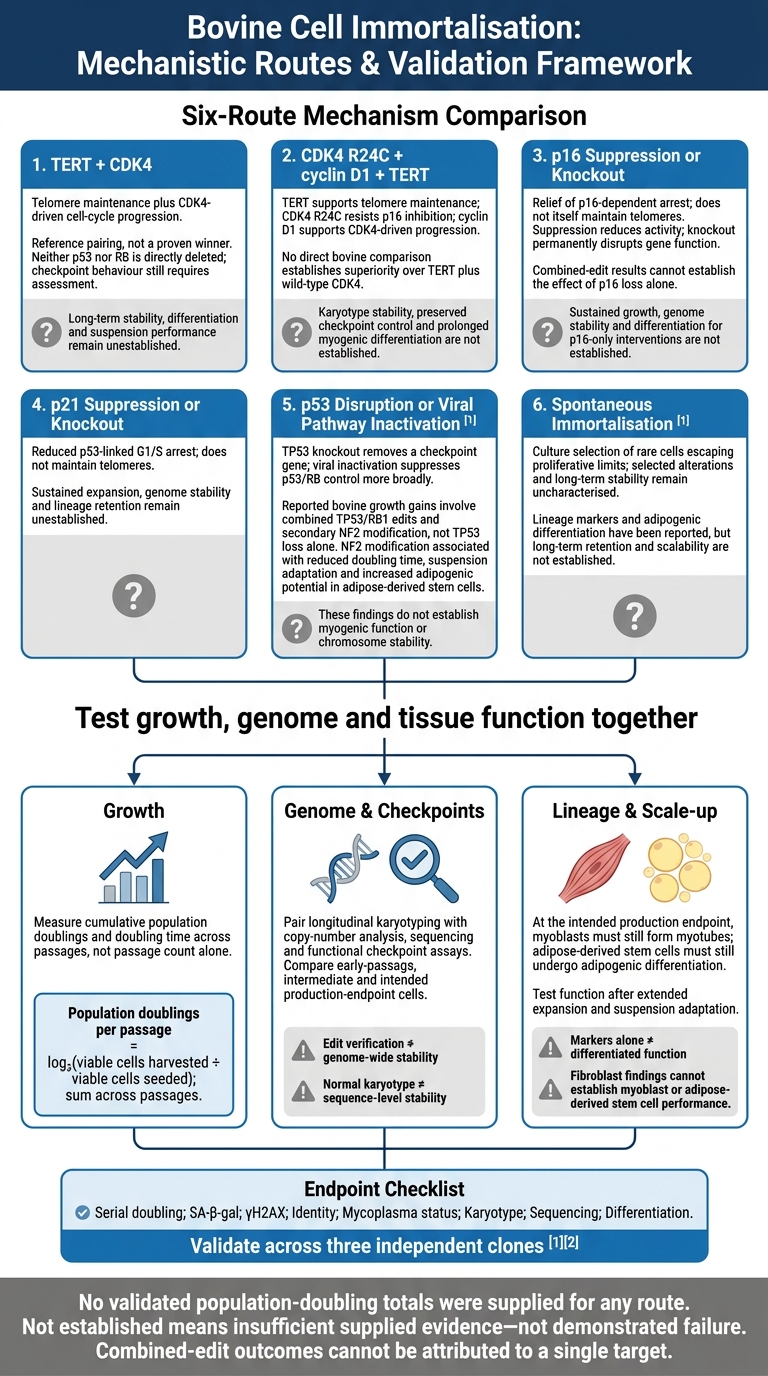
Bovine Cell Immortalisation: Six Routes and Three Validation Tests
1. TERT plus CDK4
TERT plus CDK4 is a reference pairing for bovine satellite cells, combining telomere maintenance with cell-cycle control. TERT maintains telomeres, while CDK4 promotes cell-cycle entry. Neither p53 nor RB is directly deleted, so checkpoint behaviour still requires direct assessment.
Use this pairing as the reference for judging single-checkpoint edits.
Proliferative lifespan and growth consistency
Compare cumulative population doublings and doubling time across passages, rather than relying on passage count alone.
Genomic stability and checkpoint integrity
Target-site PCR, Sanger sequencing and ICE analysis confirm the presence of an edit. They do not establish genome-wide stability or stable long-term expansion. Longitudinal karyotyping and functional checkpoint assays are still required.
Lineage retention and scale-up suitability
Before claiming a scale-up gain, compare sustained myogenic differentiation and fusion capacity after extended expansion with those of unmodified cells at the same expansion stage.
The next comparison adds a p16-resistant CDK4 variant and cyclin D1.
sbb-itb-ffee270
2. CDK4 R24C plus cyclin D1 plus TERT
Compared with TERT plus wild-type CDK4, K4DT adds p16-resistant CDK4 signalling without changing the telomere-maintenance component. CDK4 R24C resists p16 inhibition, cyclin D1 supports CDK4-driven cell-cycle progression, and TERT supports telomere maintenance.
Proliferative lifespan and growth consistency
The supplied evidence contains no direct bovine comparison showing that K4DT extends proliferative lifespan—a key metric when evaluating primary vs immortalised cell lines— or produces more stable doubling times than TERT plus wild-type CDK4.
Genomic stability and checkpoint integrity
The supplied evidence does not establish karyotype stability or preserved checkpoint control in bovine K4DT cells.
Lineage retention and scale-up suitability
No supplied bovine data show that K4DT preserves myogenic differentiation after prolonged expansion.
The next comparison tests whether removing individual checkpoints can match this effect with fewer edits.
3. p16 Suppression or Knockout
Targeting p16 removes a senescence brake but does not address telomere attrition. Unlike the telomere-supported CDK4 sets above, p16 loss provides checkpoint relief only. Suppression reduces p16 activity through methods such as RNAi or CRISPRi; knockout permanently disrupts gene function. Both target p16-dependent RB arrest.[1]
Proliferative lifespan and growth consistency
The supplied bovine data do not directly compare p16 suppression with knockout for cumulative population doublings or doubling-time consistency. Pairing p16 loss with TERT addresses the telomere barrier.[1]
Genomic stability and checkpoint integrity
The supplied bovine p16-only data do not show karyotype stability or preserved checkpoint control. Outcomes from multi-gene edits cannot be attributed to p16 loss alone.[1]
Lineage retention and scale-up suitability
The supplied p16-only data do not show preserved differentiation after extended expansion. Findings that also involve RB1, TP53 and NF2 modifications do not establish that p16 suppression or knockout alone supports suspension expansion and bioreactor scaling.[1]
The next section examines whether p21 suppression produces a similar effect through a different checkpoint target.
4. p21 Suppression or Knockout
p21 loss weakens G1/S arrest downstream of p53, but it does not maintain telomeres.[1] Whether this checkpoint relief alone is enough to extend expansion remains unresolved.
Proliferative lifespan and growth consistency
The available bovine evidence does not establish whether p21 suppression or knockout alone sustains cumulative population doublings or stabilises doubling time.
Genomic stability and checkpoint integrity
Bypassing the checkpoint does not address the underlying cause of senescence. If telomere attrition still limits expansion, cells may continue dividing with unstable genomes.
Lineage retention and scale-up suitability is a critical factor when using a cultivated meat production scale planner to forecast output.
Select lines only when extended expansion is accompanied by preserved differentiation, stable doubling time and a normal karyotype. The supplied evidence does not establish these outcomes for p21 suppression or knockout alone.
5. p53 Disruption or Viral Pathway Inactivation
By contrast, p53-pathway disruption targets p21’s upstream regulator. TP53 knockout removes a single checkpoint gene, while viral inactivation suppresses p53/RB control more broadly.[1]
Proliferative lifespan and growth consistency
WO2024141754A1 reports bovine myoblasts and adipose-derived stem cells with TP53/RB1 knockouts. NF2 knockout shortened doubling times and supported suspension adaptation. These results reflect combined edits, not TP53 loss alone, and do not list exogenous TERT.[1]
Genomic stability and checkpoint integrity
TP53/RB1 knockout removes two major controls. Viral inactivation acts more broadly, but the supplied evidence does not compare the long-term stability of these approaches. The patent’s Sanger sequencing and ICE analysis verify edits, not chromosome stability.[1]
Lineage retention and scale-up suitability
The patent reports increased adipogenic potential in the adipose-derived stem cell background after NF2 modification.[1] This does not establish myogenic retention in myoblasts. Lineage-specific function must be confirmed after suspension adaptation. This is a critical step for cultivated meat production systems aiming for industrial scale.
The next comparison considers whether similar expansion can occur without deliberate editing.
6. Spontaneous Immortalisation
Spontaneous immortalisation is an unengineered route: prolonged culture selects rare cells that bypass normal proliferative limits. It is less predictable than targeted editing.[1] Whether this selected escape preserves the lifespan, stability and lineage traits achieved through editing requires testing.
Proliferative lifespan and growth consistency
Assess escape from proliferative limits through sustained, reproducible growth, not passage number alone. Shorter doubling times and improved adaptation to suspension culture are the clearest signs.[1]
Genomic stability and checkpoint integrity
Selection can enrich mutations affecting growth control. Checkpoint function and chromosome stability therefore need direct testing.[1]
Lineage retention and scale-up suitability
In bovine myoblasts, spontaneously immortalised cells can retain CD56 expression after suspension adaptation, whereas unmodified cells may lose this marker. In bovine adipose-derived stem cells, spontaneous NF2 pathway disruption has been associated with retained CD29 and CD90 expression and stronger adipogenic differentiation, including more lipid accumulation and mature unilocular adipocytes.[1]
As with edited lines, lineage markers and differentiated function must persist through expansion. Bioprocess control software and suspension adaptation tests assess scale-up suitability: only lines that maintain stable growth and lineage markers are suitable.[1] The comparison below assesses these lines against the same three criteria: lifespan, genomic stability and lineage retention.
Lifespan and Growth Consistency
| Route | Bovine lineage | Validated population doublings | Doubling time | Growth consistency | Senescence bypass |
|---|---|---|---|---|---|
| TERT plus CDK4 | Angus | - | - | - | - |
| CDK4 R24C plus cyclin D1 plus TERT | - | - | - | - | - |
| p16 suppression or knockout | Angus, Wagyu; evidence reflects p16/RB1 KO, not p16 alone[1] | - | Reduced (5–100% improvement)[1] | High; phenotype preserved[1] | Validated for combined edits[1] |
| p21 suppression or knockout | - | - | - | - | - |
| p53 disruption or viral pathway inactivation | Angus, Wagyu; myoblasts and ADSCs reported[1] | - | Reduced[1] | Consistent over at least four suspension passages[1] | Engineered lines reported with combined TP53/RB1 disruption[1] |
| Spontaneous immortalisation | - | - | - | - | - |
No validated lifespan data were supplied. Dashes mark information that has not been established. Growth improvements in the p53 row involved secondary NF2 modification, which reduced doubling time and improved suspension adaptation.[1]
Calculate population doublings for each passage as log₂(viable cells harvested ÷ viable cells seeded), then sum across passages. Record elapsed days, including selection and adaptation. Compare independent clones and donors using matched medium, seeding density and culture format. Optimizing surface functionalization can further enhance these growth metrics by improving cell attachment. Pair growth measurements with senescence markers: PCR, Sanger sequencing and ICE analysis confirm editing status, not growth performance.[1]
Growth consistency alone does not establish a useful line. The next section examines whether these routes also preserve karyotype and checkpoint control.
Genomic Stability and Checkpoint Function
A normal karyotype does not prove sequence-level stability. Chromosome analysis and sequencing answer different questions.
The key issue is whether each edit supports sustained growth without weakening checkpoint control. Checkpoint loss poses a greater risk when p53 is disrupted, because upstream DNA-damage arrest is already weakened.
| Route | Karyotype and sequencing evidence | Growth benefit versus stability risk |
|---|---|---|
| TERT plus CDK4 | Integration confirmed by targeted sequencing; genome-wide stability not established. | Combines telomere support with CDK4-driven growth; retention of DNA-damage checkpoints requires confirmation. |
| CDK4 R24C plus cyclin D1 plus TERT | Karyotype stability and sequencing data not established. | Adds p16-resistant G1/S progression; the stability cost relative to wild-type CDK4 remains unresolved. |
| p16 suppression or knockout | Locus integrity confirmed by PCR/Sanger; genome-wide stability not established.[1] | Relieves p16-dependent G1 arrest but does not resolve telomere attrition. |
| p21 suppression or knockout | Karyotype and sequence stability not established. | Weakens p53-mediated arrest downstream; sustained growth may mask unresolved damage. |
| p53 disruption or viral pathway inactivation | Edit verification does not establish genome-wide stability.[1] | p53 disruption can eliminate DNA-damage-induced arrest; viral effects depend on the construct. Combined-edit outcomes cannot establish the effect of TP53 loss alone. |
| Spontaneous immortalisation | Selected genomic changes and their stability not established. | Unlike defined edits, culture-selected escape may carry uncharacterised alterations into the expanded line. |
These comparisons distinguish telomere support from checkpoint bypass and whole-genome risk. Do not attribute genomic effects to TP53 loss alone when TP53/RB1 disruption and HRASG12V expression are combined.[1]
Compare banked early-passage cells with intermediate cultures and cells at the intended production endpoint. Pair karyotyping with copy-number analysis and sequencing.
These stability signals only matter if lineage traits also persist.
Lineage Retention, Scale-up and Conclusions
After extended culture, check myotube formation, fusion index and myogenic markers, including after suspension adaptation. These assess function, not growth.[1]
TERT plus CDK4 remains the reference point for stable bovine expansion. However, this does not establish suspension readiness or suitability for every process.[1][2]
The matrix below summarises the best-supported evidence already discussed for each route. Treat it as a line-level summary of validated evidence, with unsupported cells marked “Not established”.
| Route | Doubling time | Validated population doublings | Karyotype stability | Genomic monitoring | Differentiation | Lineage marker and function support | Scalability |
|---|---|---|---|---|---|---|---|
| TERT plus CDK4 | Not established | Not established | Not established | Targeted verification only | Not established | Not established | Not established |
| CDK4 R24C plus cyclin D1 plus TERT | Not established | Not established | Not established | Not established | Not established | Not established | Not established |
| p16 suppression or knockout | Not established | Not established | Not established | Targeted verification only[1] | Not established | Not established | Not established |
| p21 suppression or knockout | Not established | Not established | Not established | Not established | Not established | Not established | Not established |
| p53 disruption or viral pathway inactivation | Reduced with combined edits and NF2 modification[1] | Not established | Not established | Edit verification only[1] | Increased adipogenesis reported with NF2 modification[1] | Myogenic function not established | Limited suspension evidence for combined edits[1] |
| Spontaneous immortalisation | Not established | Not established | Not established | Not established | Adipogenic differentiation reported[1] | Lineage markers reported; long-term retention not established[1] | Not established |
Apply the same endpoint criteria to every line and clone. At the intended production endpoint, validate serial doubling, SA-β-gal, γH2AX, identity, mycoplasma status, karyotype, sequencing and differentiation across three independent clones.[1][2]
For sourcing after qualification, Cellbase supports cultivated meat R&D; it does not validate or manufacture lines.[3][4]
FAQs
What evidence would confirm my bovine cells are immortalised?
Confirming immortalisation means showing that your bovine cells have exceeded the usual proliferative limit of primary cells, which often slow after approximately 10 passages. Look for consistent growth and a stable phenotype over dozens of cell divisions, while retaining differentiation potential.
Verification typically checks genetic and karyotypic stability, alongside retention of lineage-specific markers. Methods include genomic sequencing, karyotyping and epigenetic profiling.
How should I choose targets for my bovine cell type?
Balance proliferative capacity, lineage potential and genetic stability. Modulating NF2 can shorten doubling times in bovine myoblasts and adipose-derived stem cells, while targeting p16, p21, p53, CDK4 and TERT can extend cell lifespan. Use karyotyping and genomic sequencing to monitor for unintended genetic changes, and confirm that cells retain their capacity to differentiate.
For validated cell lines or research materials, browse Cellbase’s curated listings for the cultivated meat industry.
Can my cells lose differentiation potential during scale-up?
Yes. Over many population doublings, cells may accumulate mutations or undergo phenotypic changes that reduce their ability to differentiate into muscle, fat or connective tissue. Maintaining genetic and phenotypic stability is a key challenge when scaling up cultivated meat production.
Researchers use karyotyping, genomic sequencing and epigenetic profiling to monitor cell integrity. Cellbase offers a curated marketplace for sourcing the equipment and materials needed to maintain stable conditions.


