

For cultivated meat bioprocess engineers, I compare equipment impacts per 1 kg of usable finished product - not by rated power. I first compare bioreactor systems for process fit, food safety and reliability, then compare options using the same LCA boundary and output assumptions.
My procurement checklist covers:
- Equipment and disposables: allocate manufacture, replacement and disposal impacts across expected usable output.
- Utilities and cleaning: include electricity, heat, cooling, water, chemicals and waste treatment.
- Production performance: account for utilisation, yield, downtime and failed batches.
- Data quality: separate measured inputs from estimates, then test whether uncertain assumptions change the ranking.
The electricity supply matters. In the article’s cited 2026 industrial-scale model, a 30% solar electricity share reduced estimated total emissions by about 12% - a scenario result, not a saving guaranteed for every facility.
I use Cellbase to shortlist equipment and request supplier data. My rule is simple: <u>LCA supports equipment selection; it does not replace engineering validation.</u>
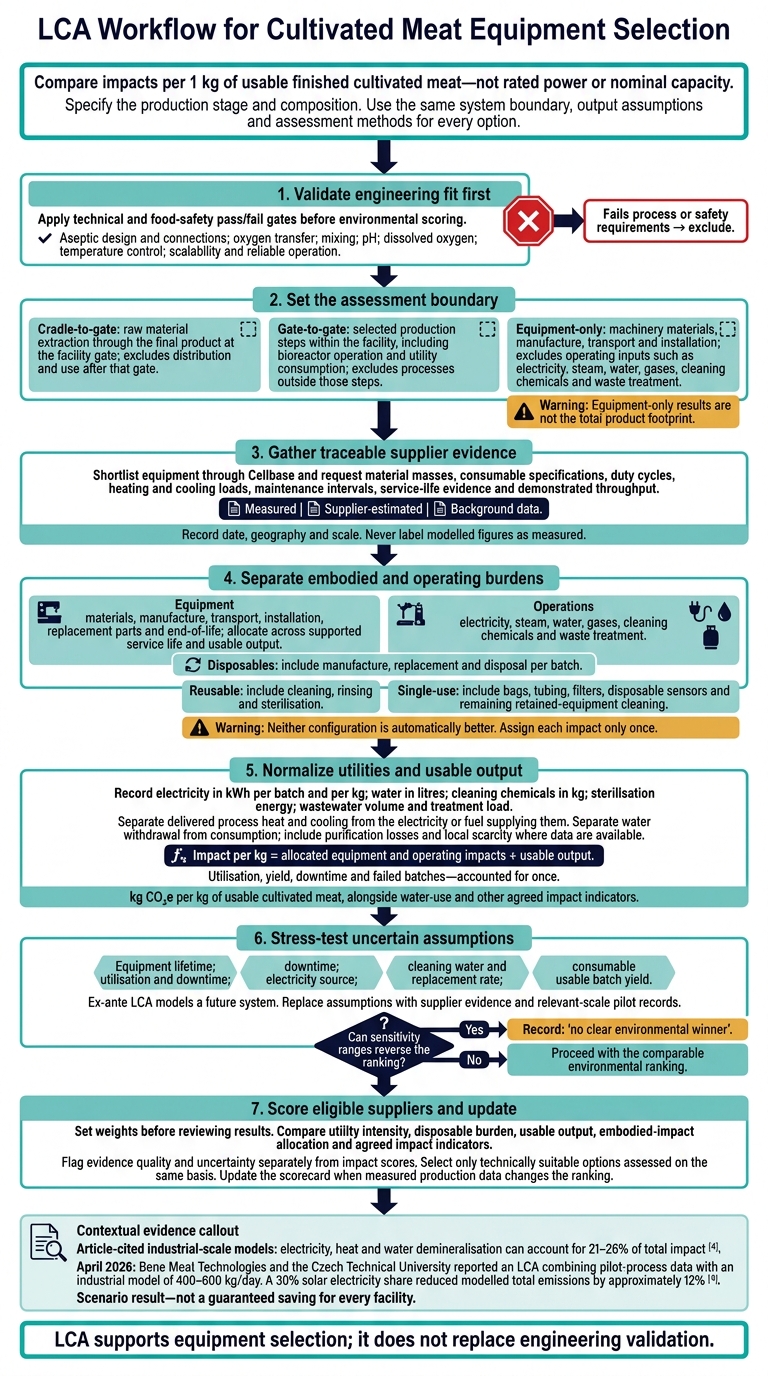
LCA Workflow for Cultivated Meat Equipment Selection
Set Assessment Boundaries and Gather Equipment Data
Define the Functional Unit and System Boundary
Use 1 kg of finished cultivated meat as the functional unit. Specify the exact production stage and composition being compared[4][6].
Apply the same scope to every option and state all exclusions. Equipment-only results do not represent the total product footprint[1][4][6].
| Scope item | Cradle-to-gate | Gate-to-gate | Equipment-only |
|---|---|---|---|
| Included processes | Raw material extraction through to the final product at the facility gate | Production steps within the facility, including bioreactor operation and utility consumption | Materials, manufacture, transport and installation of the machinery |
| Excluded processes | Distribution and use after the defined gate | Processes outside the selected facility steps | Operating inputs such as electricity, steam, water, gases, cleaning chemicals and waste treatment |
Once the boundary is fixed, separate embodied impacts from operating inputs before comparing options.
Separate Equipment Impacts from Use-Phase Impacts
Account for equipment materials, manufacture, transport, installation, replacement parts and end-of-life separately from electricity, steam, water, gases, cleaning chemicals and waste treatment[4][6]. Treat disposables as recurring inputs, including their manufacture and disposal, and assign each impact only once to avoid double counting.
For each listing considered through Cellbase, request material masses, consumable specifications, duty cycles, heating and cooling loads, bioprocess control parameters, maintenance intervals and service-life evidence[2]. Label each figure as measured, supplier-estimated or background data, and record its date, geography and scale[2][4]. Prefer pilot or industrial measurements; never label modelled figures as measured data[4].
Use equipment-only data to isolate embodied impacts and gate-to-gate data to isolate operating impacts. Neither replaces cradle-to-gate analysis when the comparison includes upstream inputs. Record realistic throughput and utilisation assumptions before accepting supplier lifespan claims[2].
sbb-itb-ffee270
Lab-grown meat (probably) won't save us
Compare Equipment, Disposables and Utility Use
With the boundary and data fields fixed, compare embodied impacts, utility demand and waste per kg of cultivated meat.
### Compare Reusable and Single-Use Equipment
Compare configurations only when they deliver the same output and product quality. Allocate embodied impacts across verified service life and throughput. For single-use systems, include the manufacture, replacement and disposal of bags, tubing, filters and disposable sensors used per batch [6]. Apply these allocations to supplier listings on Cellbase so each comparison uses the same per-kg basis.
| Comparison point | Reusable configuration | Single-use configuration |
|---|---|---|
| Embodied impacts | Allocate vessels, support equipment and replacement parts across service life | Allocate support equipment across service life; add disposable items per batch |
| Cleaning and sterilisation | Include cleaning chemicals, rinse water and sterilisation energy | Include cleaning or sterilisation for retained equipment |
| Water demand | Include process water, purification losses and cooling demand | Include remaining on-site water demand and upstream consumables |
| Waste | Include replacement parts, cleaning effluent and treatment | Include bags, tubing, filters and waste treatment |
Neither configuration is automatically better. Base the choice on verified service life, cleaning demand and replacement rate. Do not carry R&D assumptions directly into commercial procurement.
Once material and waste burdens are set, express energy and heat demand on the same per-kg basis.
Model Electricity Sources and Heating and Cooling Loads
Record agitation, aeration, pumping, heating, cooling, ventilation and controls in kWh per batch and per kg of usable output. Keep heat and cooling delivered to the process separate from the electricity or fuel used to supply them. This avoids double counting.
In industrial-scale models, electricity, heat and water demineralisation can account for 21–26% of total impact, making utility allocation a core procurement variable [4].
| Electricity scenario | Evidence to use | Accounting requirement |
|---|---|---|
| National grid | Factor for the facility's country and assessment year | State the source and scope of the factor |
| Documented renewable supply | Documented source and supply share | Include lifecycle impacts; do not assign zero impact |
| High-carbon supply | Relevant regional factor or a clearly labelled sensitivity scenario | Keep loads and output consistent across scenarios |
In April 2026, Bene Meat Technologies and the Czech Technical University reported an LCA combining pilot-process data with an industrial model of 400–600 kg/day. A scenario using 30% solar electricity reduced modelled total emissions by approximately 12% [4].
Use the same batch and throughput assumptions for water and cleaning inputs.
Measure Water Use and Cleaning Chemical Inputs
Separate operational water withdrawal from consumption. Include purification losses, cooling demand and local scarcity where location data are available. Record cleaning chemicals separately and compare like-for-like impact categories.
Water and chemical inputs affect supplier selection because they change the operating burden. Report kg CO₂e per kg of usable cultivated meat alongside water-use and impact indicators [4][6].
| Input to record per batch and per kg output | Reusable configuration | Single-use configuration |
|---|---|---|
| Electricity, kWh | Operation, cleaning and sterilisation utilities | Operation and any retained-equipment cleaning |
| Water, litres | Process water, rinses, purification and cooling | Process water and remaining on-site cleaning demand |
| Cleaning chemicals, kg | Cleaning agents and rinse-associated inputs | Remaining cleaning chemicals and upstream consumables |
| Sterilisation demand | Steam or thermal energy, including losses | Any required sterilisation energy |
| Wastewater load | Volume and treatment load after cleaning | Process effluent and remaining cleaning discharge |
Use LCA Results in a Cellbase Procurement Scorecard
Use the same per-kg LCA data to rank suppliers, not just describe them. Use Cellbase listings to shortlist suppliers and gather specifications, then turn the LCA results into a procurement scorecard.
For each shortlisted option, express every impact per kilogram of usable output.
Calculate Impacts Using Realistic Throughput and Utilisation
Divide allocated equipment and operating impacts by usable output, not nominal capacity. Base calculations on primary pilot data and industrial-scale models, rather than lab-scale estimates alone [4].
Keep utilisation, yield and batch-failure assumptions consistent. Account for cleaning, downtime and failed batches once, without double-counting. Underused production bioreactors may have higher impacts per kilogram, even when their specifications suggest greater efficiency [4]. Rank options on the basis of usable output, not nominal capacity.
Test Uncertainty and Ex-Ante LCA Limits
Ex-ante LCA models a future system, not an operating one. Lab results do not prove industrial oxygen transfer, cooling demand or stable proliferation and differentiation performance. Missing phase-specific data also weakens the estimate [1].
Modelled performance is not proof of commercial suitability. Test the variables below, then replace assumptions with supplier evidence and pilot records.
| Variable to test | What to recalculate | Evidence status |
|---|---|---|
| Equipment lifetime | Embodied impact per kg | Low: assumed service life |
| Utilisation and downtime | Annual output and impact allocation | Low: throughput forecast |
| Electricity source | Electricity impact per kg | Low: assumed energy mix |
| Cleaning water and chemicals | Water, heating and effluent impacts | Low: unvalidated cleaning cycle |
| Consumable replacement rate | Consumable manufacture and waste | Low: assumed replacement rate |
| Usable batch yield | Output denominator and losses | Low: extrapolated recovery |
Build a Supplier Evidence and Equipment Selection Matrix
After stress-testing the assumptions, turn the results into a procurement matrix with pass/fail gates. Apply technical and food-safety requirements before scoring. Lower LCA impacts cannot compensate for unsuitable aseptic connections, inadequate process control or unreliable operation.
If sensitivity ranges can reverse the ranking, record:
“no clear environmental winner”
Set scoring weights before reviewing the results.
| Selection field | Evidence supporting the decision | Scorecard treatment |
|---|---|---|
| Technical suitability | Validated aseptic design and control of oxygen transfer, mixing, pH, dissolved oxygen and temperature | Pass/fail against process requirements |
| Scalability and reliability | Relevant-scale trials and operating records | Assess demonstrated performance |
| Utility intensity | Normalised electricity, heat and water impacts | Compare on the agreed per-kg basis |
| Disposable burden | Allocated manufacture and disposal impacts | Include upstream and waste burdens |
| Expected usable output | Validated throughput, yield and rejection assumptions | Verify the output denominator |
| Embodied-impact allocation | Supported lifetime and replacement assumptions | Check allocation across usable output |
| Impact indicators | Climate, water and other agreed results | Score only comparable boundaries and methods |
| Evidence quality | Traceable sources and uncertainty ranges | Flag gaps separately from impact scores |
Conclusion: Base Equipment Selection on Comparable LCA Data
After scoring, select only options assessed on the same basis. Use the same functional unit and system boundary for each comparison. Allocate embodied equipment impacts and operating impacts across verified usable output - not nameplate capacity.[4][6]
Treat ex-ante LCA as a screening tool. Test whether changes in utilisation, electricity mix or throughput reverse the ranking, while keeping engineering validation as the primary basis for decisions.[1][4]
Use Cellbase to shortlist suitable equipment and request supplier evidence for utility demand and demonstrated throughput. Update the scorecard as measured production data becomes available, accounting for the challenges of scaling cultivated meat processes.[2][4] Revise the selection whenever those measurements change the ranking.
FAQs
How can I compare Cellbase suppliers with incomplete LCA data?
Use Cellbase’s structured metadata to compare technical specifications on a consistent basis, even when life cycle assessment (LCA) reports are missing. Cellbase organises information from supplier manuals and PDFs into standard fields.
Refine your selection with the Cellbase Product Finder, which combines published research and component data to help identify inputs that fit your sustainability goals, such as moving to serum-free media or optimising for scale.
How should I weigh carbon impacts against water use?
When selecting cultivated meat equipment, prioritise the electricity source and growth media efficiency. Life cycle assessments identify production electricity and growth media raw materials as major drivers of environmental impacts. Look for equipment that reduces media consumption and supports renewable energy integration.
Use Cellbase to compare equipment specifications and find suppliers that focus on lower-impact production methods. These comparisons can help you balance carbon impacts and water use across your facility.
What evidence makes an ex-ante LCA reliable enough for procurement?
Ex-ante life cycle assessments (LCA) for cultivated meat remain uncertain because commercial-scale data are limited [1][2]. Reliable procurement decisions require primary industrial-scale data, verified and transparent inputs, and system boundaries that account for media processing, scaffold recovery and wastewater treatment [1][3][4].
Cellbase supports evidence-backed decisions with structured, standardised product metadata. This helps researchers and procurement specialists compare products using consistent technical specifications [5][6][7].


