

For bioprocess engineers and cultivated meat researchers: Maintaining precise pH (6.8–7.4) and dissolved oxygen (DO) levels is critical in bioreactors for cultivated meat production. Optical sensors are transforming how these parameters are monitored by offering real-time, accurate, and contamination-free measurements. Unlike traditional electrochemical probes, selecting sensors for cultivated meat bioreactors now often involves choosing optical sensors to minimise fouling, require less maintenance, and integrate seamlessly into single-use systems like wave bags and microfluidic bioreactors.
Key Highlights:
- pH Monitoring: Optical sensors use fluorescent dyes with ratiometric readings for stable, accurate measurements in the mammalian cell culture range.
- DO Monitoring: Luminescent quenching with advanced phase-shift technology ensures reliable oxygen readings, even in low-DO environments.
- Integration: Compact designs and non-contact options make optical sensors ideal for single-use and miniaturised bioreactors.
- Recent Advances: Improved response times, anti-fouling coatings, and long-term stability now support extended culture processes.
Optical sensors are reshaping bioreactor optimisation by reducing downtime, improving process control, and supporting scalable cultivated meat production. Keep reading to explore how these sensors work, their latest advancements, and their role in automated bioprocessing.
How to Avoid Noisy Dissolved Oxygen Signals in Bioreactors: Anti-Bubble O2 Sensor
sbb-itb-ffee270
How Optical Sensors Measure pH and Dissolved Oxygen
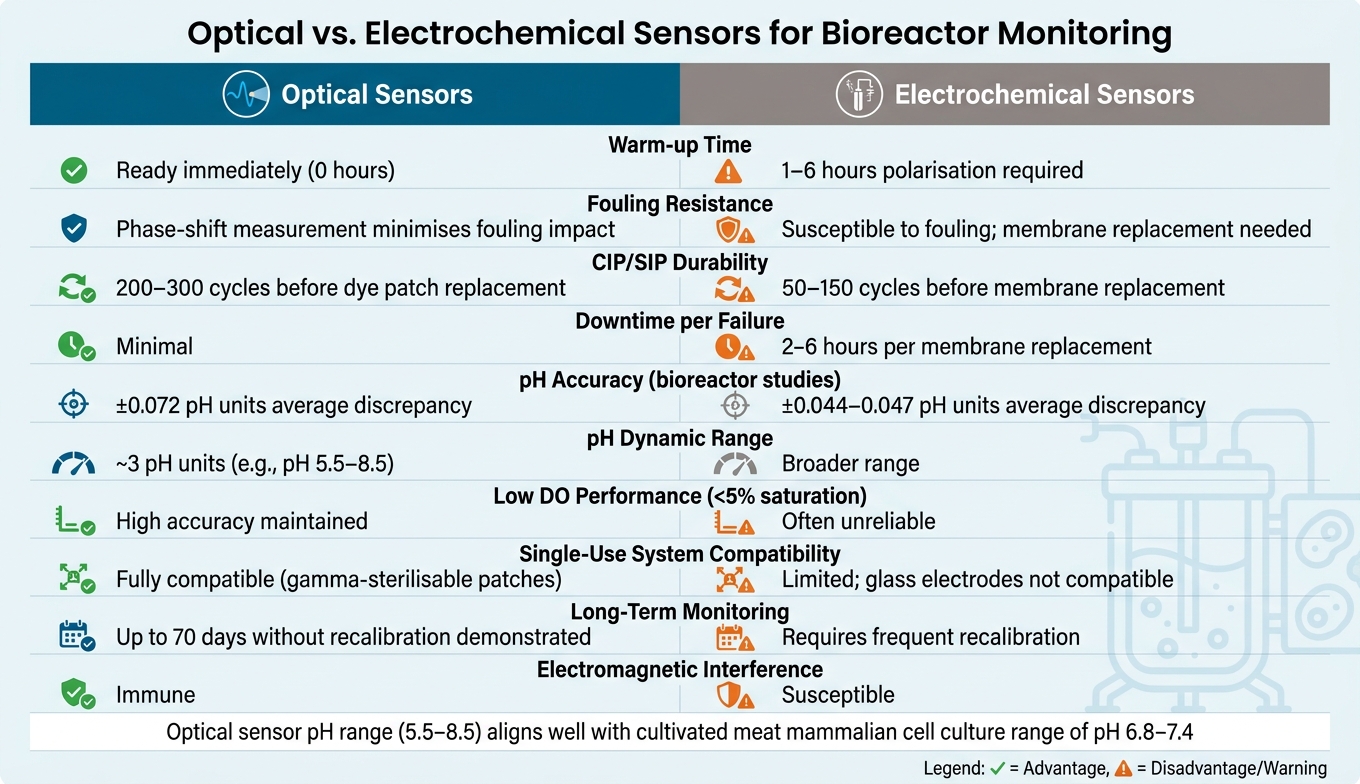
Optical vs Electrochemical Sensors for Bioreactor pH & DO Monitoring
pH Sensing Mechanisms
Optical pH sensors rely on a pH-sensitive fluorescent dye, often a derivative of HPTS (8-hydroxypyrene-1,3,6-trisulfonic acid), which is embedded in a hydrophilic polymer matrix. This dye exists in two forms - protonated and deprotonated - each with distinct absorption and emission spectra. The ratio of these forms shifts predictably with pH, as described by the Henderson-Hasselbalch equation [1][4].
To improve accuracy, modern sensors use a ratiometric approach. The dye is excited at a single wavelength, and emissions are measured at two different wavelengths, typically around 470 nm and 525 nm. The ratio of these emission signals correlates directly with pH, offering greater stability compared to simple intensity-based measurements. This method minimises the effects of light source drift and dye photobleaching, making it more reliable than traditional glass electrodes [4].
It’s worth noting that optical pH sensors have a limited dynamic range of about 3 pH units (typically pH 5.5–8.5), centred around the dye's pKa. However, this range aligns well with the requirements of cultivated meat production, where mammalian cells thrive within a narrow pH window of 6.8–7.4. For processes involving broader pH fluctuations, electrochemical sensors may be better suited [4].
These precise pH sensing methods complement the oxygen monitoring techniques discussed below.
Oxygen Sensing Mechanisms
Optical dissolved oxygen (DO) sensors operate using luminescence quenching. In this process, oxygen molecules interact with an excited luminescent dye - commonly a ruthenium or platinum-porphyrin complex embedded in an oxygen-permeable polymer matrix (e.g., silicone or hydrogel). These interactions reduce the dye’s light intensity and lifetime [1][5].
Modern designs use phase modulation to measure the phase shift in emitted light, which helps reduce noise and avoids common issues like dye degradation or false low readings in stagnant areas [1][5].
"Because the sensing signal is carried by light along a thin fiber, these devices combine a very small footprint with high sensitivity, immunity to electromagnetic interference, and the possibility of remote and multiplexed measurements." - Cui et al., University of Massachusetts Lowell [1]
These advanced sensing methods enhance bioreactor process control when integrated effectively.
Sensor Integration in Bioreactor Systems
Optical sensors are easily integrated into various bioreactor designs, making them versatile tools for process monitoring. In single-use vs reusable bioreactors, insertable fibre-optic probes are commonly used. A popular example is the Hamilton VisiFerm DO Arc, which supports multiple signal outputs, including Bluetooth [5]. For single-use bags, pre-integrated sensor spots or patches like the PreSens SP-PSt3 series are bonded to the inner wall, sterilised alongside the bag via gamma irradiation, and read externally through the bag wall using a fibre-optic reader [5].
Another option is non-invasive external monitoring, where a sensing patch is placed on the outside of a permeable vessel wall. This approach measures analyte levels without direct contact with the culture medium, completely eliminating sterility concerns [3].
For cultivated meat research, where single-use wave bags, shake flasks, and microfluidic systems are prevalent, patch-based and non-invasive sensors are particularly suitable. These methods require no in-situ sterilisation, electrolyte upkeep, or warm-up time. Optical DO sensors are ready to measure immediately, unlike polarographic sensors, which need 1–6 hours of polarisation before use [5].
| Configuration | Typical Format | Key Benefit |
|---|---|---|
| Insertable fibre-optic probe | Stainless steel bioreactor | Durable; supports CIP/SIP cycles |
| Pre-integrated sensor patch | Single-use bag | Gamma-sterilisable |
| Non-invasive external system | Permeable-wall vessel | Zero contamination risk; fully non-contact |
Recent Advances in Optical pH Sensors
High-Accuracy Fibre-Optic Sensors
The gap in performance between optical and electrochemical pH sensors has significantly narrowed in recent years. Modern fibre-optic probes, which utilise Neutral Red (NR) indicators embedded in biocompatible hydrogel matrices, now achieve a sensitivity of 17 nm/pH unit within the critical mammalian cell culture range of pH 6–8 [7].
Response times have also seen substantial improvements. Thin-film hydrogel sensors, just 100 µm thick, can stabilise readings in about 5 seconds and fully saturate within 30 seconds [7]. This rapid response is particularly critical in cultivated meat bioreactors, where swift metabolic changes can push pH levels outside the viable range before slower sensors can react.
"The unique specifications of these fiber sensors position them as promising candidates for applications in tissue engineering, cell growth, and continuous blood pH monitoring." - Mohamed Elsherif, Khalifa University [7]
Despite these advancements, photobleaching remains a challenge. Continuous illumination degrades the fluorescent dye over time, with a drift of approximately −0.1 pH units after 11 days of use, limiting continuous monitoring to around 15 days [4]. For longer processes, strategies such as scheduled sensor replacements or hybrid monitoring systems may be necessary. These improvements in fibre-optic sensors highlight the potential for further advancements through material innovation.
Solid-State and Sol-Gel Coatings
One persistent issue in optical pH sensing has been dye leakage. Embedding pH-sensitive dyes into a polyhydroxy ethyl methacrylate (pHEMA) matrix, a synthetic hydrogel, addresses this by covalently cross-linking the dye. This prevents migration into the culture medium, protecting cell cultures from contamination and preserving sensor accuracy over time [7].
Recent research has integrated diffractive nanostructures, such as Aztec-pattern gratings, into hydrogel matrices. These structures translate pH-induced swelling into measurable changes in light diffraction. This approach achieves a sensitivity of 25.5 µW/pH across the pH 4–10 range and introduces a "triple-readout" capability: visible colour changes, spectroscopic wavelength shifts, and diffractive power variations detectable with a laser [8]. This redundancy ensures that if one readout mode fails, others remain functional. These innovations enhance sensor durability and expand their utility, particularly in cultivated meat bioprocesses.
Applications in Cultivated Meat Production
A 2024 study by Fratz-Berilla et al. at the FDA evaluated PreSens single-use optical sensor spots across 22 bioreactor batches. The optical sensors showed an average discrepancy of 0.072 pH units, compared to 0.044–0.047 pH units for electrochemical probes [4]. While optical sensors are slightly less accurate, the study concluded that they are precise enough for tightly controlled fed-batch and continuous processes, provided pH stays within ±0.25 units of the calibration setpoint.
These advancements in optical sensors are particularly relevant for cultivated meat production, where precise pH control is essential. Single-use wave bags and microfluidic systems, commonly used in cultivated meat research, are not compatible with traditional glass electrodes. In these cases, gamma-sterilisable fluorescent patches bonded to the bag wall provide the only viable in-line pH monitoring solution. Their accuracy is sufficient for the narrow pH range (6.8–7.4) required for mammalian cell growth [4]. However, for processes that involve broader pH fluctuations or run longer than 15 days, electrochemical sensors in reusable stainless steel vessels remain the more dependable option.
Recent Advances in Optical Dissolved Oxygen Sensors
Polymer-Embedded Luminescent Sensors
Optical dissolved oxygen (DO) sensors operate on the principle of luminescence quenching, where oxygen molecules reduce the emission lifetime of an excited dye - commonly ruthenium or platinum-porphyrin. Instead of relying on raw intensity, modern sensors measure phase shifts in modulated light. This method makes them far less susceptible to issues like probe ageing and sensor fouling [5].
A noteworthy advancement in this field is the application of fluorescent microsensor beads for mapping oxygen levels within 3D scaffolds. Research published in March 2026 in Analytical Methods showcased the use of CPOx-50-PtP microsensor beads along with multifocal optical projection microscopy (MF-OPM). This combination allowed researchers to measure oxygen gradients as deep as 21 mm in fibroblast-seeded agarose hydrogels [9]. This depth significantly surpasses the few hundred microns achieved by earlier techniques, representing a major step forward for thick-tissue constructs used in cultivated meat scaffolds. Such progress opens up new possibilities for non-invasive and extended oxygen monitoring.
Non-Invasive and Long-Term Monitoring
One of the key benefits of optical DO sensors is their ability to measure oxygen levels without disrupting the system. These sensors often use spots or patches coated with Pt(II) porphyrin dyes, which are attached to the inner wall of transparent vessels. An external fibre-optic device excites the dye and collects the signal through the vessel wall, ensuring continuous, non-invasive monitoring [5][10].
This design is particularly advantageous for long-term monitoring. For instance, PreSens optical fibre microsensors and sensor foils have been used to track oxygen levels in 3D collagen I hydrogels seeded with adipose-derived mesenchymal stem cells over a 70-day period, without requiring recalibration. In this study, oxygen levels stabilised within the physiological range (7–9%) by day 35 [10]. Another study, published in ACS Sensors in March 2021, demonstrated automated DO monitoring in thick GelMA hydrogels for five weeks without manual intervention [10].
"The 70-day timeline is the strongest single piece of evidence in the reviewed literature for long-run stability of the chemistry: the authors did not report a single recalibration event across the campaign." - BioProcess Tools [10]
Additionally, optical sensors avoid the lengthy polarisation warm-up (1–6 hours) required by electrochemical probes. They also maintain high accuracy at low DO levels below 5% saturation, a range where polarographic sensors often falter [5]. This capability is crucial for optimising processes in cultivated meat production, as it allows for timely adjustments to prevent oxygen depletion that could harm cell viability. With their ability to perform consistently over extended periods, the focus now shifts to addressing challenges such as sensor fouling.
Anti-Fouling Coatings and Stability
In cultivated meat bioprocesses, the complex composition of culture media - containing cells, proteins, metabolites, and gas bubbles - can lead to fouling of sensor surfaces, potentially reducing measurement accuracy [1]. Optical sensors, however, counteract this issue through phase-shift measurements, which are less affected by moderate fouling. They also exhibit excellent durability, enduring 200–300 cleaning-in-place (CIP) or sterilisation-in-place (SIP) cycles before requiring dye patch replacement. In comparison, polarographic membranes typically last for only 50–150 cycles [5]. Each fouling-related failure in polarographic sensors can result in 2–6 hours of downtime for membrane replacement and re-polarisation, disrupting production schedules.
That said, optical sensors are not entirely immune to interference. For example, fluorescent components in media, such as riboflavin, could impact signal quality. Therefore, compatibility with specific formulations should be verified during implementation [5]. These improvements in durability and fouling resistance underscore the critical role of optical DO sensors in maintaining stable and efficient bioreactor environments for cultivated meat production.
Dual pH and Oxygen Sensors in Automated Bioreactor Control
Design and Performance of Dual Sensors
Combining pH and dissolved oxygen (DO) monitoring into a single optical system simplifies operations by reducing the number of ports and hardware components while improving data consistency. Optical fibre sensors, with diameters as small as 100–250 μm, can be easily threaded into narrow access points in miniaturised or single-use bioreactors. This compact design is particularly beneficial for microfluidic bioreactors where space is at a premium, ensuring that flow patterns and scaffold structures remain undisturbed [1].
Integrated systems, such as PreSens SensorPlugs, simultaneously monitor pH, O₂, and CO₂ through a compact, interference-resistant, and electrolyte-free interface. This setup reduces maintenance requirements and minimises signal drift during extended culture runs - an essential feature for cultivated meat processes that often last for weeks [1][2][6].
Advanced design features also address common challenges in bioreactor environments. For example, sensors like the Mettler Toledo InPro 6860i include angled tips with hydrophilic surfaces, which actively prevent bubble accumulation on the sensing surface. This design reduces measurement noise in aerated bioreactors, enabling cleaner and more responsive automated control loops [12]. These innovations contribute to more reliable and efficient bioprocess control systems.
Integration with Automated Bioprocess Control
Dual optical sensors play a key role in automated bioprocess control by providing real-time pH and DO data. These sensors integrate seamlessly with Process Analytical Technology (PAT) frameworks, allowing for automated adjustments to gas sparging, agitation, and the addition of base or CO₂. Maintaining a pH range of 6.8–7.4 is especially critical for cultivated meat production, as small deviations can significantly impact cell viability and product quality [1][11].
"Optical fiber sensors, with their high sensitivity, remote monitoring capability, compact size, and multiplexing, have become a promising technology for in situ bioreactor monitoring." - Guoqiang Cui et al., Department of Electrical and Computer Engineering, University of Massachusetts Lowell [1]
Digital communication protocols like MODBUS and RS-485 enhance sensor integration with biocontrollers, enabling predictive diagnostics and reducing the need for manual intervention. These advancements have yielded impressive results. For example, perfusion systems equipped with advanced monitoring have achieved cell concentrations of 50–100 million cells/mL, while concentrated fed-batch processes have reached product yields of 25–30 g/L [11][12].
Compatibility with Cultivated Meat Bioreactor Formats
Optical dual sensors are particularly well-suited to the unique demands of cultivated meat production. Their thin, flexible fibres can be integrated into or around scaffold structures without disrupting the cells' environment [1]. In single-use and wave bioreactors, pre-mounted optical patches eliminate the need for sterilisation-in-place procedures, streamlining early-stage optimisation and reducing media consumption [1][6].
Unlike traditional electrochemical probes, optical sensors perform reliably in the chemically defined media used in cultivated meat production. This compatibility not only safeguards cell cultures but also improves overall process efficiency. A study conducted by the BioSense Institute in Novi Sad, Serbia, demonstrated this advantage. Researchers used PreSens SensorPlugs in custom microfluidic bioreactors to monitor MRC-5 fibroblasts over 48 hours. They tracked culture acidification from pH 7.4 to 6.8 and simultaneous O₂ depletion, achieving a final cell viability of 95.45% at a concentration of 262,500 cells/mL [2].
For researchers and developers in cultivated meat R&D, Cellbase provides a specialised marketplace for sourcing optical sensors, single-use bioreactors, and scaffold-compatible monitoring solutions tailored to the industry's specific needs.
Conclusion: What Advanced Optical Sensors Mean for Cultivated Meat Production
Fibre-optic pH sensors, luminescent oxygen probes, and integrated dual systems are reshaping how bioreactor conditions are monitored and controlled. Unlike traditional electrochemical probes, optical sensors provide continuous, real-time data without issues like signal drift, fouling, or the need for frequent recalibration. Their compact design, resistance to electromagnetic interference, and compatibility with single-use systems make them a practical choice for cultivated meat production at any scale [1].
Keeping pH levels between 6.8 and 7.4, along with stable oxygen levels, is essential for maintaining cell health and ensuring consistent product quality. For example, optical technologies like Raman-based real-time control have been shown to increase titres by 85% in mammalian cell cultures [13]. These advancements are paving the way for next-generation systems that simplify and enhance bioprocess control software.
Looking ahead, multi-parameter platforms capable of monitoring pH, dissolved oxygen, temperature, and pressure along a single fibre are expected to become standard. These systems will integrate seamlessly with Process Analytical Technology (PAT) and advanced data-driven controls, supporting the move towards more automated and scalable bioprocessing. As cultivated meat is projected to make up 30% of global meat consumption by 2040 [13], such technologies will be critical in reducing production costs and achieving commercial feasibility.
For those working in this evolving field, Cellbase offers access to trusted suppliers of optical sensors, bioreactors, and monitoring solutions designed specifically for cultivated meat production.
FAQs
How do I choose between an optical patch and a fibre-optic probe?
Choosing between an optical patch and a fibre-optic probe comes down to the type of bioreactor you're using and your specific process requirements.
- Optical patches are a great fit for single-use bag bioreactors. They enable sterile, non-invasive monitoring, which is especially useful in disposable systems.
- Fibre-optic probes, on the other hand, work best with stainless steel vessels equipped with standard ports.
For large-scale stainless steel systems, you might find that electrochemical probes deliver higher precision. However, optical sensors shine in smaller setups or when reducing maintenance and contamination risks is a top priority.
What can interfere with optical pH or DO readings in culture media?
In cultivated meat production, optical pH and dissolved oxygen (DO) readings can be thrown off by a range of factors. Temperature and system pressure, for example, directly influence gas solubility, leading to variability. Similarly, dissolved CO2 fluctuations and the accumulation of metabolites like lactate and ammonia can significantly shift pH levels.
Other challenges include trapped air bubbles and biological fouling on sensor surfaces, both of which can compromise measurement accuracy. To tackle these issues, Cellbase provides access to dependable sensors designed to maintain precision under such demanding conditions.
How often do optical pH and oxygen sensors need recalibration or replacement?
Optical sensors offer excellent stability and dependability, often needing less upkeep compared to traditional electrochemical probes. When used for oxygen monitoring, certain models come pre-calibrated from the factory and can function for as many as 100,000 measurements without requiring recalibration. However, slight drift may develop over time due to factors like light exposure and experimental conditions. For those scaling up production, Cellbase serves as a reliable marketplace for obtaining these critical sensors and bioreactor components tailored for cultivated meat processes.


