

If I had to reduce this choice to one line, it would be this: use steam for scaffolds that can take 121 °C to 134 °C without changing shape or surface behaviour; use chemical sterilisation when heat, moisture, or pressure would damage the scaffold.
For bioprocess engineers and cultivated meat R&D teams, the trade-off is not just microbial kill. It is also about pore structure, surface chemistry, residue risk, cleaning steps, and what you can validate on the exact scaffold design in use.
At a glance, this article says:
- Autoclaving is usually the better fit for stainless steel, glass, metallic meshes, and some heat-stable synthetic polymers
- Chemical sterilisation is often used for hydrogels, heat-sensitive polymers, and biomimetic matrices
- Steam sterilisation has low residue risk, but it can change geometry, pores, and cell-facing surfaces
- Chemical routes avoid high heat, but they add residue removal and contact-time control
- In reusable systems, cleaning comes before sterilisation; steam does not fix poor cleaning
- For scale-up, the decision depends on material class, scaffold architecture, batch format, and validation data
Types of Autoclaves (Gravity vs. Vacuum Autoclaves) and Their Advantages
Quick comparison
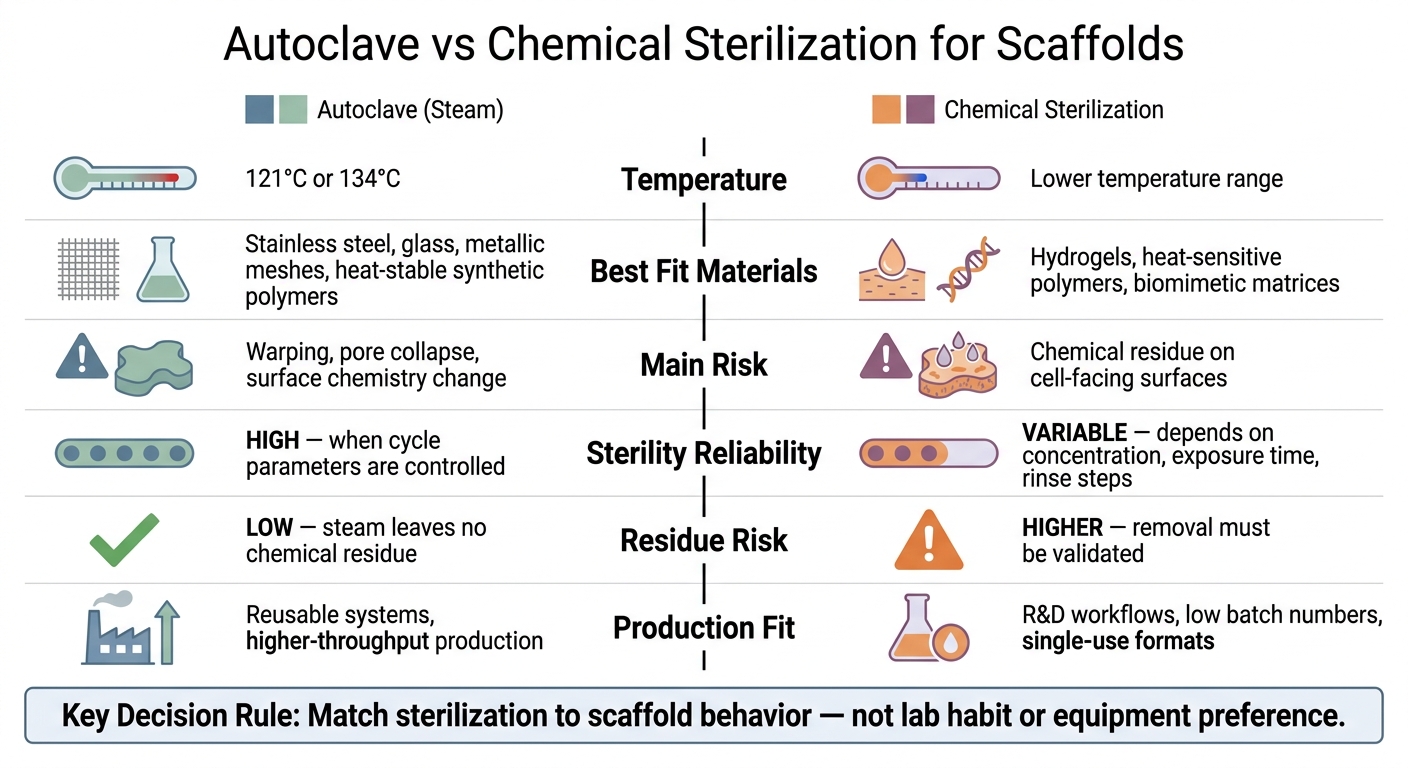
Autoclave vs Chemical Sterilization for Cultivated Meat Scaffolds
| Criteria | Autoclave | Chemical sterilisation |
|---|---|---|
| Temperature | Usually 121 °C or 134 °C | Lower-temperature route |
| Best fit | Heat-stable scaffold materials | Heat-sensitive or moisture-sensitive scaffolds |
| Main risk | Warping, pore collapse, surface change | Chemical residue on cell-facing surfaces |
| Sterility consistency | High when cycle parameters are controlled | Depends on concentration, exposure time, and rinse/removal steps |
| Cleaning needs | High for reusable systems; clean first, then sterilise | Also needs cleaning plus residue checks |
| Production fit | Often suits reusable, higher-throughput set-ups | Often suits R&D, low-batch, or single-use formats |
Bottom line: I would match the sterilisation method to how the scaffold behaves after treatment, not to lab habit or equipment preference.
Autoclave sterilisation
Autoclaving uses saturated steam under pressure, usually at 121 °C or 134 °C, to kill microorganisms. For scaffold work, the main issue is simple: does the steam change geometry, pore structure, or surface chemistry? With reusable scaffold systems, cleaning has to come first. If residue is left behind, steam sterilisation won’t fix that.
Where autoclaving works well
Autoclaving is a good fit for heat-stable scaffold materials. In practice, that usually means stainless steel, glass, some synthetic polymers, and metallic meshes.
Where autoclaving can damage scaffold performance
The same heat and moisture that make autoclaving effective can also damage delicate scaffold architectures. Pores can collapse. Polymer scaffolds can warp. Surface chemistry can shift in ways that reduce cell adhesion.
That matters in cultivated meat workflows, because a scaffold that looks intact after sterilisation may still perform badly once cells are seeded. In some cases, post-sterilisation coatings or surface treatments are needed to restore cell binding. If heat or moisture compromise scaffold structure, chemical sterilisation is the lower-temperature option.
Autoclave pros and cons
| Advantage | Drawback | Practical impact on cultivated meat scaffold workflows |
|---|---|---|
| Sterility reliability: highly effective at killing microbes through saturated steam | Material degradation: high heat and moisture can cause structural collapse or warping in delicate scaffolds | Limits material selection to thermally stable polymers or metals |
| Established SOPs: standardised conditions such as 121 °C are well understood by bioprocess engineers | Cleaning burden: reusable scaffold systems require intensive cleaning and residue control | Increases validation work before routine use |
| Straightforward batch processing: suitable for robust scaffold materials such as stainless steel and glass | Surface alteration: can change surface chemistry, potentially affecting cell adhesion and growth | May require post-sterilisation coatings or treatments to restore cell-binding properties |
sbb-itb-ffee270
Chemical sterilisation
When autoclaving risks warping a material or stripping out the function you need, chemical sterilisation is the lower-temperature option. It’s often used for heat-sensitive scaffolds that can’t handle steam, high heat, or pressure without damage. The main goal is simple: keep the scaffold sterile without changing its geometry, pore structure, or surface function. In practice, that makes material selection the key deciding factor.
Where chemical methods are the better fit
Chemical methods are usually the better fit for heat-sensitive polymers, hydrogels, and biomimetic matrices. These materials can deform, soften, shrink, or lose functional performance under autoclave conditions.
Autoclave vs chemical sterilisation: side-by-side comparison
The right method comes down to three things: what the scaffold is made from, how it is built, and what you can validate. If any one of those is off, sterilisation can solve one problem and create another.
| Criteria | Autoclave (Steam/SIP) | Chemical Sterilisation |
|---|---|---|
| Material compatibility | Best for heat-stable scaffold systems | Better for heat-sensitive scaffolds, provided residue removal is validated |
| Effect on scaffold structure | Can alter scaffold behaviour if the matrix is not steam-tolerant | Safer for scaffolds that cannot tolerate steam |
| Sterility reliability | High; SIP/autoclave workflows are highly reliable for microbial kill | More variable; depends on chemical concentration, contact time and residue control |
| Residue concerns | Low; steam leaves no chemical residue | Higher; removal must be validated so no harmful chemicals remain on cell-facing surfaces |
| Workflow burden | Moderate; cycle times are fixed, but the system must reach and hold temperature | Moderate to high; requires cleaning and residue-monitoring steps |
| Validation burden | Focuses on heat distribution and sterility confirmation | Focuses on cleaning efficacy and residue control |
| Routine production suitability | Strong for reusable systems and higher-volume production | Better for R&D-style workflows, low batch numbers and single-use formats |
Comparison by scaffold material and architecture
Material behaviour comes first. The sterilisation cycle needs to match the exact scaffold class, whether that is porous polymers, fibre scaffolds, hydrogels, or decellularised matrices. These systems do not fail in the same way under sterilisation.
A steam cycle that works well for one scaffold may deform pore structure, shift mechanical behaviour, or damage cell-facing surfaces in another. That is why validation has to be done on the specific scaffold material and architecture in use. It cannot just be assumed that a method transfers cleanly across scaffold types.
Comparison by operational workflow
Workflow is the next filter. In practice, reusable systems usually pair CIP with SIP/autoclaving. Single-use formats cut out much of the cleaning and residue work, which makes them a better fit for lower-batch or R&D workflows.
For higher-volume production, reusable stainless-steel systems that use SIP/autoclaving are often the better fit from an operations point of view [1].
How to choose the right method for cultivated meat scaffold operations
A practical selection framework
Use the material and workflow trade-offs above as a decision check, not a preference test.
If the scaffold can handle steam, autoclaving is the right fit for robust, steam-stable materials. If it cannot - because it is heat-sensitive, moisture-sensitive, or likely to shift in pore geometry or surface functionality - use chemical sterilisation instead. If you go with chemical sterilisation, make sure any residues can be removed or neutralised before the scaffold comes into contact with cells.
Conclusion: match sterilisation to scaffold behaviour, not preference
Once you’ve checked material compatibility and residue control, the choice is fairly direct. Autoclaving fits robust, steam-stable scaffold materials, while chemical sterilisation fits heat-sensitive or structurally delicate scaffolds.
FAQs
How do I validate scaffold sterilisation?
Validate scaffold sterilisation by confirming that your autoclave or chemical process consistently removes at least 99% of microorganisms. In cultivated meat production, this sits at the heart of scaffold safety and process control.
Use rigorous monitoring to show the method meets food safety standards and cuts contamination risk in a repeatable way. Cellbase can help you find the specialised equipment and infrastructure needed to support these validation workflows.
Which chemicals are suitable for delicate scaffolds?
For delicate scaffolds in cultivated meat production, chemical sterilisation is often the better fit because it avoids the high heat and pressure of an autoclave, which can damage the scaffold’s structure.
The source material doesn’t list specific chemicals. So the practical next step is simple: check your scaffold material’s compatibility data before choosing a sterilisation method. That helps you confirm that the process won’t alter shape, porosity, or mechanical performance. Cellbase can help you source relevant equipment and infrastructure.
Can sterilisation change cell attachment?
Yes. Sterilisation can affect cell attachment because it can change a scaffold’s surface properties.
Many cell lines used in cultivated meat production need a suitable surface for attachment, growth and differentiation. If autoclaving or chemical treatment changes the scaffold surface, it can alter how cells attach to the material and how well they spread through it.


