

For cultivated meat R&D teams, I would choose UCOE or cHS4 by measured expression retention - not initial expression strength. Compare matched constructs with an unprotected control across independent clones. Four passages can support an early screen, but cannot establish long-term stability.
The choice starts with what you need the element to do: UCOE helps maintain open chromatin; cHS4 provides barrier and enhancer-blocking activities, depending on its sequence and placement. Neither guarantees stable expression in your target primary or immortalised cell line.
Quick Comparison
| Criterion | UCOE | cHS4 |
|---|---|---|
| Main role | Resist silencing through chromatin opening | Limit heterochromatin spread or block enhancer input |
| Placement | Usually upstream of the promoter | At cassette boundaries for barrier protection; between enhancer and promoter for enhancer blocking |
| Sequence burden | Depends on the specified fragment; proposed test arm adds about 1.5–3.0 kb | Paired full-length flanks add about 2.4 kb; paired 250 bp cores add about 500 bp |
| Design caveat | Fragment boundaries and promoter activity matter | Short cores may provide less barrier protection |
I would track expression retention, clone-to-clone variation, delivery, growth and viability together. If expression falls, check cassette integrity and copy number before attributing the loss to silencing.
The decision is construct-specific. <u>Validate the final design in the intended species and production-relevant culture conditions</u>, including suspension culture where required.
How UCOE and cHS4 Work
UCOE opens chromatin; cHS4 insulates the cassette. Ubiquitous chromatin opening elements help resist transcriptional silencing. Chicken hypersensitive site 4, from the chicken β-globin locus, has two distinct activities: blocking heterochromatin spread and blocking enhancers. Both mechanisms are established in model systems, but neither guarantees expression retention in cultivated meat cell lines.
Each element acts at a different position in the cassette. This determines placement, cassette size and the risk of promoter interference.
| Feature | UCOE | cHS4 | What needs target-cell validation |
|---|---|---|---|
| Chromatin opening | Maintains a locally open chromatin state | Primarily provides insulation rather than UCOE-like opening | Resistance to silencing during extended culture |
| Barrier activity | Resists silencing through chromatin opening | Limits silencing from surrounding heterochromatin | Protection at the chosen integration site |
| Enhancer blocking | Generally absent | A distinct activity of the cHS4 core | Effects on the target promoter–enhancer pair |
| Placement | Usually upstream of the promoter | Typically flanks the cassette for barrier protection; must sit between the enhancer and promoter for enhancer blocking | Performance of the complete construct |
UCOE Formats and Placement
A2UCOE comes from the human HNRPA2B1–CBX3 locus. Specify the exact fragment sequence and boundaries: A2UCOE is a family label, not a single sequence.
| Format | Sequence length | Placement | Intended function | Limitation |
|---|---|---|---|---|
| Larger A2UCOE fragment | Varies by fragment | Usually upstream of the promoter | Maintain open chromatin | Greater sequence burden; possible promoter interference |
| Reduced UCOE | Varies by fragment | Usually upstream of the promoter | Reduce footprint while retaining activity | Silencing resistance cannot be assumed |
Fragments are not interchangeable. Their own promoter activity can also interfere with adjacent cassettes.
cHS4 Formats and Flanking Design
cHS4 is the better fit for unwanted enhancer input, while UCOE aims to maintain open chromatin. Where cHS4 sits determines which interaction it insulates.
| Format/design | Placement | Copy count | Added sequence | Retained functions and limitations |
|---|---|---|---|---|
| Full-length cHS4 | One at each cassette boundary | 2 | Approximately 1.2 kb per copy | Barrier and enhancer-blocking activities; larger vector burden |
| Approximately 250 bp core | Between enhancer and promoter | 1 | Approximately 250 bp | Primarily enhancer blocking; barrier activity may be reduced |
Full-length cHS4 increases cassette size and can reduce delivery and cloning efficiency. [1] Shorter formats reduce the sequence burden but may retain less function. Validate the exact cHS4 format in the final cassette; motif identity alone does not predict stability.
sbb-itb-ffee270
UCOE vs cHS4: Expression Retention and Vector Size
The main trade-off is expression retention versus insert size. Compare complete constructs, not just element names: both insert size and construct design affect cloning success and long-term expression stability.
| Comparison point | Specified UCOE sequence | Single cHS4 element | Paired cHS4 flanks |
|---|---|---|---|
| Insert size | Depends on the exact sequence used | Smaller than paired flanks | Larger than a single element |
| Main risks | Insert size and construct context | Placement effects and cassette design | Larger insert and sequence integrity |
What Published Comparisons Show
No published side-by-side UCOE–cHS4 comparison in bovine cell lines and other cultivated meat cell lines is available here. When assessing expression retention over extended passaging, distinguish epigenetic silencing from genetic and fitness changes.[1] Choose the final design through construct testing, rather than relying on the element name.
Choose a Construct for Your Engineering Goals
Base your choice on species (such as porcine cell lines), cell type, promoter, integration method and transgene. Track mean expression, positive-cell fraction and expression retention using the same assay schedule and baseline. Apply the same read-outs to each construct, then compare retention against total insert size.
| Engineering priority | Practical takeaway |
|---|---|
| Sustained expression | Compare retention using the specified UCOE sequence and cHS4 layout in your own system |
| Boundary insulation | Choose a cHS4 arrangement that matches the cassette boundaries |
| Limited vector capacity | Compare total insert size; shorter elements may retain less protective function |
| Poorly characterised line | Test matched constructs in parallel before choosing either design |
Design a Long-Term Expression Comparison
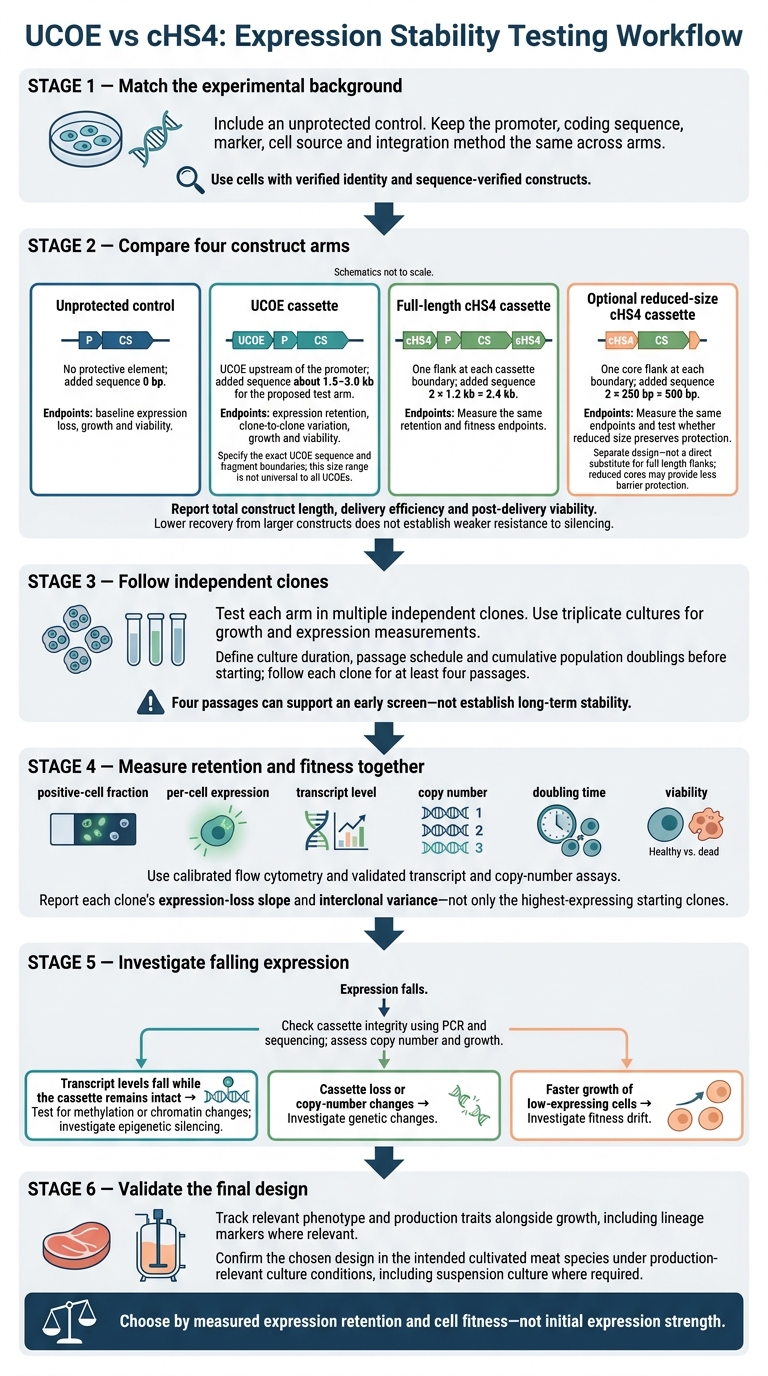
UCOE vs cHS4: Expression Stability Testing Workflow
Compare the constructs in a matched, side-by-side passaging test, with an unprotected control as the baseline. Keep the promoter, coding sequence, marker, cell source and integration method the same across arms.[1]
| Experimental arm | Placement | Added sequence | Endpoints |
|---|---|---|---|
| Unprotected control | No protective element | 0 bp | Baseline expression loss, growth and viability |
| UCOE cassette | Upstream of promoter | About 1.5–3.0 kb | Expression retention, clone-to-clone variation, growth and viability |
| Full-length cHS4 cassette | One flank at each cassette boundary | 2 × 1.2 kb = 2.4 kb | Same retention and fitness endpoints |
| Optional reduced-size cHS4 cassette | One core flank at each boundary | 2 × 250 bp = 500 bp | Same endpoints, testing whether reduced size preserves protection |
Report total construct length, delivery efficiency, post-delivery viability and expression retention. Larger constructs may be harder to deliver. Document size-related differences rather than interpreting lower recovery as weaker resistance to silencing.[2] Treat reduced-size cHS4 as a separate design, not a direct substitute for full-length flanks.
Test each arm in multiple independent clones.
Track Expression Across Independent Clones
Use triplicate cultures for growth and expression measurements.[1] Define the culture duration, passage schedule and cumulative population doublings before starting, then follow each clone for at least four passages.
Measure positive-cell fraction, per-cell expression, transcript level, copy number, doubling time and viability. Report each clone’s expression-loss slope and interclonal variance - not just results from the highest-expressing starting clones. Include suspension conditions if the intended process uses them.[1]
Distinguish Silencing from Genetic and Fitness Changes
When expression falls, distinguish epigenetic silencing from cassette loss or fitness drift. If transcript levels fall while the cassette remains intact, test for methylation or chromatin changes. Cassette loss, copy-number changes and faster growth of low-expressing cells require different explanations. Check cassette integrity using PCR and sequencing.[1]
Track relevant phenotype and production traits alongside growth, including lineage markers where relevant.[1][4] Confirm the chosen design in the intended cultivated meat species under production-relevant culture conditions.[1][4]
Source Materials and Assay Equipment
Use cells with verified identity, sequence-verified constructs, calibrated flow cytometry and validated transcript and copy-number assays.
Conclusion: Choose Through Cell-Line Validation
Neither UCOE nor cHS4 is a universal winner in cultivated meat cell lines. Performance depends on the promoter, integration site, cell type and construct design.
Test each element in the porcine primary cell lines rather than assuming stability from its name. Select for sustained expression and cell fitness across repeated passages under production-relevant conditions, including suspension culture where relevant. Track both expression retention and cell fitness: a strong R&D result remains a candidate until validated in the target production line.
FAQs
Can I combine UCOE and cHS4 in one cassette?
The provided search results do not establish whether UCOE and cHS4 can be combined in a single genetic cassette: neither element is mentioned. The only relevant patent text discusses CRISPR components in a single vector or separate vectors, which does not address this question.
How long should I test expression stability?
Test expression stability over dozens of cell divisions for large-scale cultivated meat production [1]. Monitor proliferation continuously throughout culture: livestock cells often show reduced proliferation after approximately 10 passages [1].
Regularly check for mutations and changes to the original protein profile [2]. Use karyotyping, genomic sequencing and epigenetic profiling to monitor cell integrity and assess whether cell lines retain their differentiation potential [3].
Should I test stability without selection pressure?
Yes. Testing without selection pressure is critical to validating a cell line for cultivated meat production. Selection pressure helps maintain exogenous constructs during development. Removing it lets you assess long-term genetic and phenotypic stability under conditions that mimic industrial production [1][2].
This testing helps identify silencing, loss of expression or unintended mutations that could compromise product quality or consistency during repeated passaging and long culture runs [1][2].


