

If you run cultivated meat process development, the choice is simple in principle: batch gives tighter lot isolation; continuous cuts hold time and smooths media return - but only if your loop control, diversion, and fouling management stay in spec.
I’d boil the article down like this:
- Batch regeneration treats spent medium as a separate lot: collect, clarify, condition, test, then release for reuse.
- Continuous regeneration treats spent medium in a live loop: withdraw, clarify, condition, replenish, monitor, and return in near real time.
- The decision turns on hold time, contamination spread, sensor control, fouling risk, utility profile, labour pattern, and stage fit.
- Perfusion is not regeneration. Perfusion moves medium through the culture; regeneration is the treatment applied to the removed stream.
- For stage fit, the split is usually clear: seed train = batch, high-density proliferation = continuous, differentiation = batch or staged hybrid.
- One hard number stands out: at >30 million cells/mL, depth filtration throughput can fall from 400 L/m² to 20 L/m² - a 95% drop. If prefiltration is undersized, the line can stall.
- Another key process point: ammonia stripping by alkalisation can damage growth factors, so metabolite removal and nutrient restoration must be handled as separate tasks.
- Reuse claims should not rest on one pass. The article calls for validation across four passages in triplicate to catch delayed inhibition.
Quick comparison
| Criteria | Batch | Continuous |
|---|---|---|
| Flow mode | Discrete lots | Connected loop |
| Hold time | Higher | Lower |
| Release logic | Lot-by-lot testing | Inline monitoring + diversion |
| Failure spread | Usually limited to one lot | Can move across the run before detection |
| Media profile | More lot-to-lot shift | More even over time |
| Labour pattern | More manual steps | less manual, more control oversight |
| Best fit | Seed train, differentiation | High-density proliferation |
If you’re choosing between the two, I’d frame it this way: do you want lot release control, or steady-state loop control? That is the core trade-off the article maps out.
sbb-itb-ffee270
Batch regeneration: discrete collection, treatment and release
In batch regeneration, spent medium is handled as a separate lot within the withdrawal-treatment-return boundary. The workflow is straightforward: collect, treat, test, release. That sounds clean on paper, and it is. But that same sequence also creates the main scaling challenges.
Process flow and hold-time implications
The process starts when spent medium is withdrawn from the bioreactor (typically a large-scale production bioreactor) and moved into a hold vessel. The source can be a batch culture or a perfusion bleed stream, but each regeneration run is still managed as its own lot [2][1]. Once the medium enters the hold vessel, it may remain there before treatment begins. So hold time becomes a control point, not a side detail.
Clarification is the first treatment step. Centrifugation or tangential flow filtration (TFF) is used to remove cells, debris, and large biomolecules from the liquid [2][5][4]. After that comes inhibitor reduction, mainly targeting lactate and ammonia. Ammonia removal by alkalisation can denature growth factors, which is why reconditioning is needed before the medium is reused [6].
Nutrient replenishment then restores depleted amino acids and growth factors. pH and osmolality are adjusted back to physiological set points before the lot moves into release testing.
Release testing is the gate for reuse. The lot stays on hold until it meets defined criteria for metabolite thresholds, nutrient concentration, pH, osmolality, and sterility. Only then is it blended back into the next media charge. Recycled media should be validated across multiple passages because a single-passage check can miss latent inhibition [6].
Strengths and limitations of the batch route
The biggest advantage of the batch route is control. Each lot is discrete, so it can be quarantined or released on its own. If one lot fails release testing, it can be held or discarded without pulling other lots into the same problem. Batch operation also fits stage-specific media changes well, especially when moving from proliferation medium to differentiation medium.
The downside is that the pauses between collection and treatment need tight control. Pretreatment performance also has to stay steady if you want to protect clean-in-place frequency and membrane life [6]. If transmembrane pressure rises between batches, that usually points to upstream clarification problems or biofilm formation, rather than simple membrane wear [6].
These trade-offs stand out even more once you compare them with continuous operation.
Continuous regeneration: integrated conditioning and return
Batch regeneration works on spent medium in separate lots. The continuous route does the same job as a live flow. Spent medium is pulled from the bioreactor at a set rate, cells are held back by a cell retention device, and the stream is sent back only when it meets spec. If it does not, it goes to waste instead. Because the loop stays live, control relies on steady-state monitoring.
In practice, the flow path usually uses centrifugation or TFF. The stream is clarified, conditioned, replenished, and then returned through a closed loop.
Steady-state control and monitoring requirements
With a connected loop, flow rate, residence time, and treatment capacity have to stay aligned the whole time. If one part drifts, the rest of the loop feels it.
That is why inline monitoring matters so much here. Track pH, dissolved oxygen, temperature, and transmembrane pressure continuously, and divert any out-of-spec stream to waste.
Strengths and failure modes of the continuous route
Continuous regeneration cuts hold time, manual handling, and fresh-medium demand. It also supports longer production runs, which can lift facility throughput and reduce dependence on fresh medium.
The main failure modes are fouling, sensor drift, and contamination. Fouling is a major issue when cell density climbs. At that point, filtration and membrane capacity can drop sharply, so upstream prefiltration becomes important before the TFF stage [6]. Sensor drift is another problem. Once a sensor shifts, every automated decision downstream can shift with it, so inline probes need routine calibration checks.
Contamination is the most serious failure mode because it can spread through the connected loop before anyone spots it. That makes ingress control critical not just for contamination control, but also for media consistency. It can also eat into the labour savings that steady-state operation is supposed to deliver.
Those differences become clearer in the direct comparison below.
Batch vs continuous: direct comparison of operating characteristics
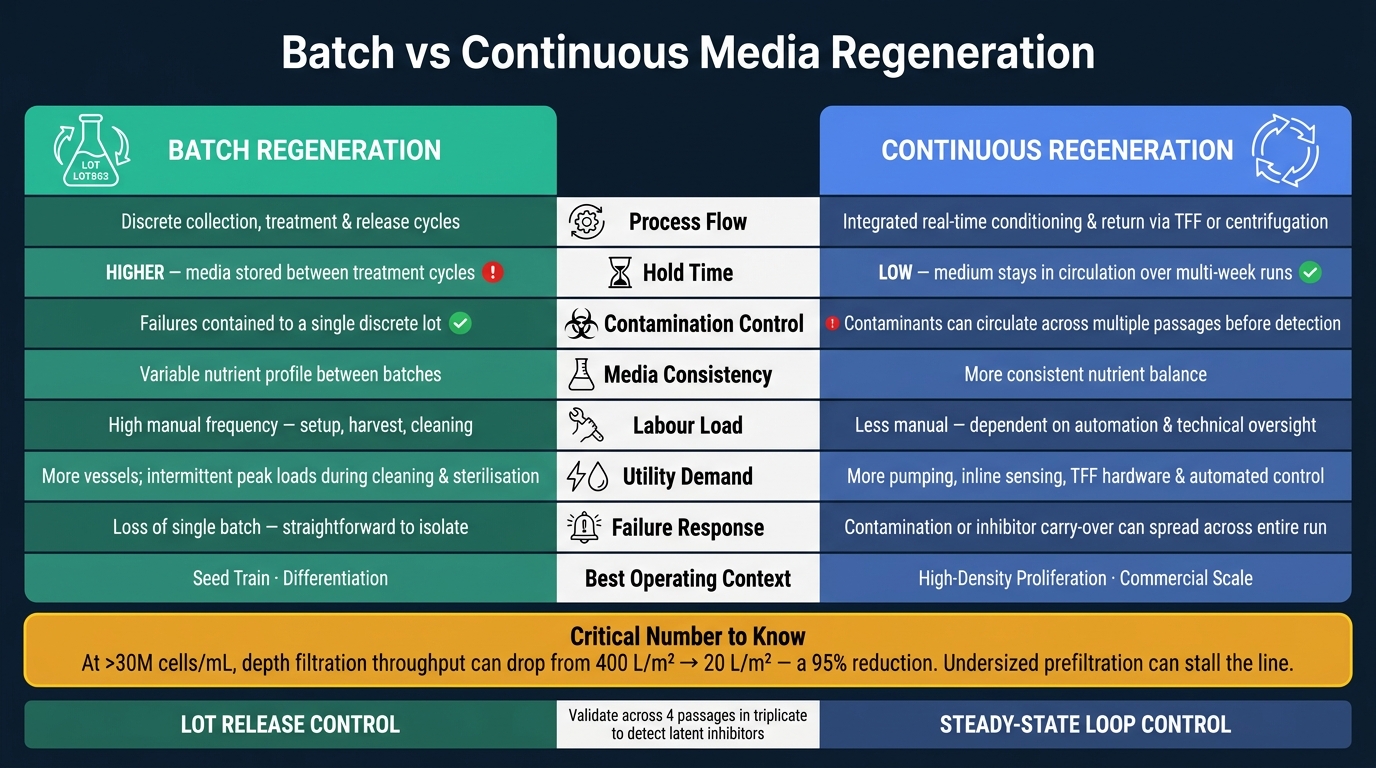
Batch vs Continuous Media Regeneration: Key Trade-Offs for Cultivated Meat Production
The choice comes down to hold time, contamination control, utility demand, media consistency, and staffing. Put side by side, the trade-offs are pretty clear.
Comparison table: operating characteristics
| Operating Characteristic | Batch Regeneration | Continuous Regeneration |
|---|---|---|
| Process Flow | Discrete collection, treatment, and release cycles | Integrated, real-time conditioning and return via TFF or centrifugation |
| Hold Time | Higher; media stored between treatment cycles | Low; medium stays in circulation over multi-week runs [2][3] |
| Contamination Control | Failures contained to a single discrete lot | Contaminants and latent inhibitors can circulate across multiple passages before detection [6] |
| Utility Demand | More vessels and intermittent treatment capacity; peak loads during cleaning and sterilisation | More pumping, inline sensing, TFF filtration hardware, and automated control systems |
| Media Consistency | Variable nutrient profile between batches | More consistent nutrient balance |
| Labour Load | High manual frequency for setup, harvest, and cleaning | Less manual, more dependent on automation and technical oversight |
| Failure Response | Loss of a single batch; straightforward to isolate | Contamination or inhibitor carry-over can spread across the run [6] |
| Best Operating Context | Seed train; differentiation | High-density proliferation; commercial scale |
The practical split is simple. Batch contains failure within one lot. If something goes wrong, isolation is usually straightforward. Continuous reduces hold time and smooths media conditions, but the same connected loop can move contamination or inhibitor carry-over through the whole run before anyone spots it [6].
That difference matters on the plant floor. Batch usually asks for more operator touchpoints: setup, transfers, cleaning, and restart. Continuous shifts the burden away from repeated manual handling and towards pumps, sensors, control logic, and people who can keep the system stable over long durations.
Stage fit: seed train, proliferation and differentiation
Route choice also depends on production stage, because the job changes as cells move from expansion to maturation.
| Production Stage | Preferred Route | Rationale | Minimum Prerequisites |
|---|---|---|---|
| Seed Train | Batch | Default for discrete expansion steps; lower risk | Validated cell bank; sterile batch vessels |
| Proliferation | Continuous | Suited to high-density steady operation | TFF or centrifuge perfusion; real-time pH, DO, and pressure sensing |
| Differentiation | Controlled batch or staged hybrid | Tighter control over maturation factor timing; reduces carryover risk from the proliferation loop; some processes use staged transfer into separate differentiation bioreactors | Controlled transfer protocols; rapid maturation tech |
In most programmes, seed train expansion stays batch. That fits the stepwise nature of the work and keeps risk contained while banks and early passages are being built out.
Proliferation is where continuous starts to make sense. If the goal is high cell density under steady-state conditions, perfusion hardware and live process data can support that mode well. But it only works if TFF or centrifuge retention is reliable and pH, DO, and pressure are watched in real time.
Differentiation is a different case. Here, timing often matters more than raw throughput. Controlled batch operation, or a staged hybrid setup, gives tighter handling of maturation factor addition and lowers the chance that carry-over from the proliferation loop affects the end state. That is why some groups transfer cells into separate differentiation bioreactors rather than keeping everything in one circulating system.
Facility selection criteria, implementation and conclusion
Once the operating trade-offs are clear, facility selection comes down to production mode.
Campaign-based production fits naturally with batch regeneration. Choosing continuous vs fed-batch production is different: it needs a regeneration loop that can keep pace with continuous outflow. And for multi-week continuous runs [2][3], that loop has to deal with peak spent-media generation, not just day-to-day average flow. If it can’t, the regeneration step becomes the bottleneck.
Implementation priorities and sourcing requirements
Four practical criteria should guide the decision.
- Closed transfer matters in both routes. Peristaltic pumps are a common choice for moving media while keeping the process closed.
- Regeneration capacity should be sized to peak output, not average output. At cell densities above 30 million cells/mL, depth filtration throughput can drop from 400 L/m² to 20 L/m². That’s a 95% reduction, and it can stop the line if prefiltration is undersized [6].
- Metabolite removal and nutrient restoration should be treated as two separate engineering tasks. For example, ammonia stripping by alkalisation can push pH high enough to denature sensitive growth factors [6].
- Continuous routes need online monitoring and diversion that have been validated in process. Real-time sensors for pH, dissolved oxygen, and pressure are needed to hold steady-state control [6].
These requirements only start to matter once the target production stage is fixed. Batch is a better fit for seed train and differentiation, where discrete release matters. Continuous is a better fit for proliferation and other steady-state operations.
The choice, in practice, is between lot release and steady-state control. Both routes should be validated across four passages in triplicate to pick up latent inhibitors such as ammonia carry-over.
That’s also the point where procurement starts to matter. Teams sourcing peristaltic pumps, TFF systems, and sensors for pH, dissolved oxygen, and pressure need equipment that fits closed-loop regeneration. Cellbase provides a curated procurement platform for cultivated meat facilities, helping teams identify equipment and infrastructure suited to those requirements.
Batch favours lot segregation and simpler release control. Continuous favours higher throughput, but it depends on strong monitoring, diversion logic, and contamination response.
FAQs
How do I choose between batch and continuous regeneration?
Choose the route that fits your facility’s scale, output targets and capital limits. Batch regeneration is often easier to validate and control in smaller operations. Continuous regeneration is more common at larger cultivated meat scale, where it can improve resource use, cut waste and support media reuse.
It’s also worth looking at your build schedule, target batch frequency and asset utilisation. Model facility throughput and utility demand before you commit to a route.
What can go wrong in a continuous regeneration loop?
The main risks are sterility and nutrient balance. When media is in constant circulation through tubing, pumps, sensors, and other external hardware, the contamination risk goes up. Every extra connection, seal, and wetted surface creates another point where bacteria can get in or persist.
The loop also has to keep metabolic waste under control, especially lactate and ammonia, while steadily replenishing key nutrients such as glucose and glutamine. If that control drifts, the culture environment can deteriorate fast, which can affect yield and product consistency.
When is a hybrid regeneration approach a better option?
A hybrid regeneration approach works best when a facility needs the efficiency of continuous systems and the flexibility to handle different stages of cultivated meat production.
It fits operations where continuous regeneration supports high-density proliferation, while batch or fed-batch methods are a better fit for the demands of differentiation. In practice, that gives operators room to match the process to each stage instead of forcing everything through a single process mode.


