

For cultivated meat R&D teams, I’d screen DMEM, Ham’s F12 and a 1:1 DMEM/F12 mix before choosing a basal medium. None is complete on its own: your cell line, supplements and culture conditions determine which works best.
I’d compare nutrient supply first, then test growth, phenotype retention and differentiation separately. For adherent cells, I’d include the attachment substrate in that assessment.
Quick Comparison
| Criterion | DMEM | Ham’s F12 | 1:1 DMEM/F12 |
|---|---|---|---|
| Nutrient profile | Higher concentrations of selected amino acids; low- and high-glucose options | Broader vitamin and trace-component coverage | Combines both profiles at changed concentrations |
| Supplements | Required | Required | Required |
| Buffering | Check bicarbonate and CO₂ requirements | Check bicarbonate and CO₂ requirements | Check bicarbonate, CO₂ and any added HEPES |
My selection rule: <u>choose by measured performance, not the medium name</u>. I’d check nutrient use, lactate, ammonia and osmolality alongside cell yield, then confirm pH control and phenotype in bioreactors. Small-scale growth alone is not enough - supplier records and lot consistency also need review.
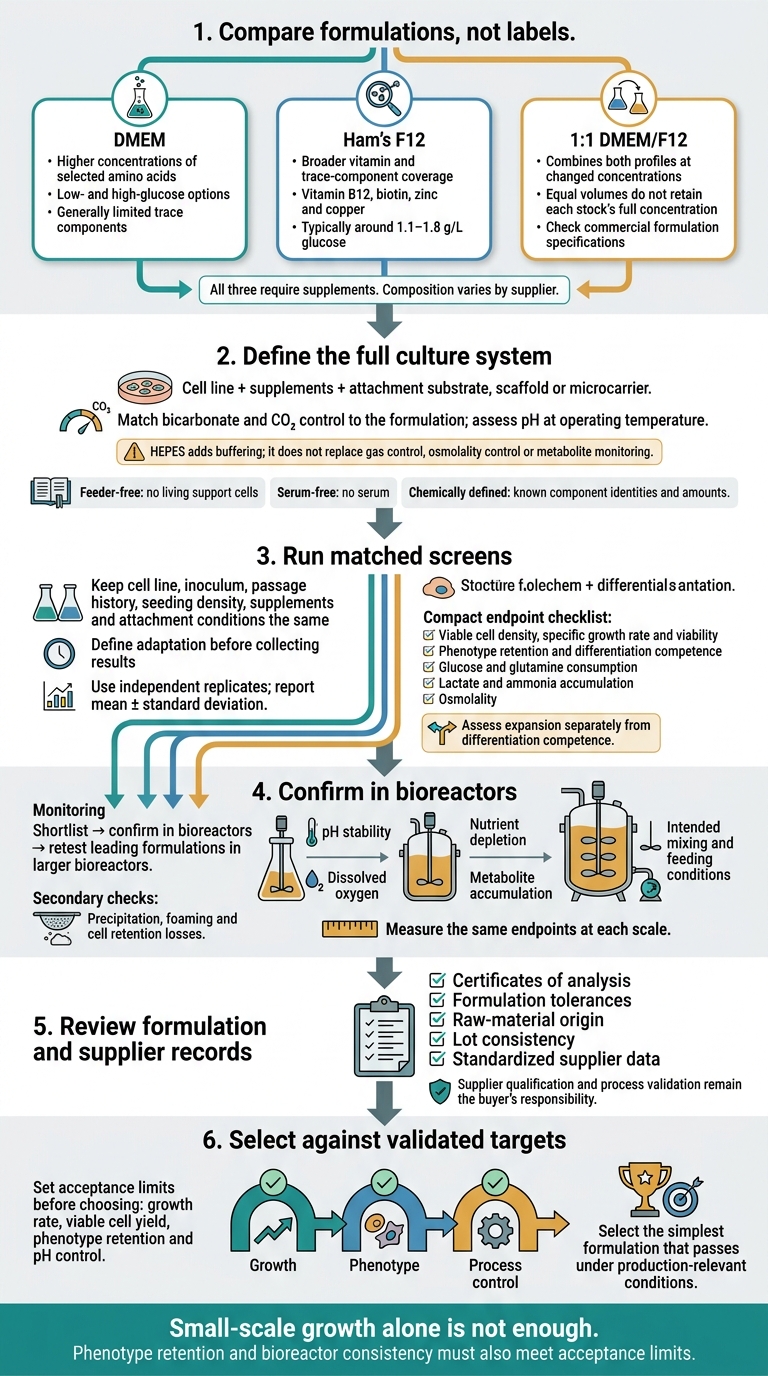
DMEM vs F12: From Screening to Scale-Up
Mammalian cell culture media basics
sbb-itb-ffee270
DMEM vs Ham’s F12: Nutrient Composition
Compare formulations, not labels. DMEM typically provides higher concentrations of selected nutrients, while Ham’s F12 provides a broader micronutrient set at lower concentrations. Composition varies by supplier, so check the product sheet before screening.[1] These differences can help you choose which basal medium to test first in your target cell line.
| Component | DMEM: reported profile | Ham’s F12: reported profile |
|---|---|---|
| Glucose | Available in low- and high-glucose forms | Typically around 1.1–1.8 g/L |
| Pyruvate | Present in some formulations | Check the formulation; standard Ham’s F12 formulations commonly contain sodium pyruvate |
| Glutamine | L-glutamine or stable dipeptide options | Check the selected formulation and glutamine source |
| Amino acids | Higher concentrations of selected amino acids | Generally lower concentrations |
| Vitamins | Higher concentrations of selected vitamins | Broader micronutrient set, including vitamin B12 and biotin |
| Trace elements | Generally limited | Includes zinc and copper |
DMEM: Glucose, Pyruvate and Glutamine Options
Low- and high-glucose DMEM provide different starting points for screening. Higher glucose can increase lactate accumulation without improving proliferation. Pyruvate can supply an additional energy source and help cells manage oxidative stress. Stable glutamine dipeptides can reduce spontaneous ammonia formation compared with L-glutamine.[1]
Ham’s F12: Vitamins and Trace Components
Ham’s F12 contains a broader micronutrient set, including vitamin B12, biotin, zinc, copper, putrescine, hypoxanthine and thymidine. It is worth testing when micronutrient diversity matters more than nutrient density, including in primary or progenitor cultures. Check each ingredient’s identity, purity and suitability.[1]
Amino Acids: Concentrations and Cell Demand
A longer ingredient list does not mean amino acid concentrations meet cellular demand. Compare each amino acid in consistent units, then measure depletion over the culture period. DMEM may suit cells with higher amino acid demand, while Ham’s F12 may suit cells that depend more on its broader micronutrient set. Base your choice on measured growth, phenotype and nutrient consumption.[1] After selecting the basal medium, test whether the cells attach and expand under feeder-free conditions.
Feeder-Free Culture, Media Mixtures and Buffering
After comparing compositions, test feeder-free performance with the intended supplements. Feeder-free, serum-free and chemically defined describe different conditions: feeder-free excludes living support cells; serum-free excludes serum; chemically defined culture uses components with known identities and amounts. None guarantees performance.[3][4]
| Starting medium | Supplementation needs | Nutrient coverage | Buffering provisions | Best use |
|---|---|---|---|---|
| DMEM | Requires targeted supplements | Higher concentrations of selected nutrients; fewer trace components | Primarily bicarbonate/CO₂ | Test for high metabolic demand or fast proliferation |
| Ham’s F12 | Requires targeted supplements | Broader vitamin and trace-element coverage | Primarily bicarbonate/CO₂ | Test when trace elements or vitamins are limiting |
| DMEM/F12 | A 1:1 mix still requires supplements | Broader combined nutrient coverage | Check specifications; some formulations include about 15 mmol/L HEPES[4] | Test when either medium alone fails to maintain growth or phenotype |
Supplements and Attachment Needs
For adherent cultivated meat cells, assess the medium together with the attachment substrate, scaffold or microcarrier. Compare growth and phenotype across the full culture system, rather than judging the medium in isolation.[1][3]
When to Test a 1:1 DMEM/F12 Mixture
Prioritise a 1:1 mixture when either basal medium alone gives inadequate growth or phenotype retention with the intended supplements. Mixing equal volumes changes individual nutrient concentrations; it does not retain each stock’s full concentration.
Check commercial DMEM/F12 specifications rather than assuming they match your selected stocks. If DMEM or F12 alone already meets the same performance criteria, a mixture may not be needed.[4]
Bicarbonate, HEPES and pH Control
Buffering capacity does not set culture pH. Match bicarbonate content and CO₂ control to the formulation, then assess pH at operating temperature and as cells produce metabolic acids.
HEPES adds buffering, but it does not replace gas control, osmolality control or metabolite monitoring. At bioreactor scale, track pH and acid production; incubator performance does not transfer directly.[1][4] Use these settings as the baseline for screening and bioreactor testing.
Testing Media from Screening to Scale-Up
Run Matched Basal-Medium Screens
Once buffer conditions are fixed, screen DMEM, Ham’s F12 and a 1:1 mix under identical culture conditions. Keep the cell line, inoculum, passage history, seeding density, supplements and attachment conditions the same. Use identical bicarbonate/CO₂ settings for all three media, and define the adaptation protocol before collecting results. Assess expansion separately from differentiation competence.[1]
Use independent replicates and report mean ± standard deviation for each endpoint. Compare the three media on:[1]
- Viable cell density, specific growth rate and viability
- Phenotype retention and differentiation competence
- Glucose and glutamine consumption
- Lactate and ammonia accumulation
- Osmolality
Test Performance in Bioreactors
Use screening to narrow the candidates, then confirm the shortlisted formulations in bioreactors and retest the leading formulations in larger bioreactors. Track pH stability, dissolved oxygen, nutrient depletion and metabolite accumulation under the intended mixing and feeding conditions.[1][3]
Check for precipitation, foaming and cell retention losses. Separate effects caused by medium chemistry from those caused by equipment. Measure the same endpoints at each scale rather than ranking media on small-scale growth alone.[1][3]
Check Formulation and Supplier Records
After performance testing, check the supplier records for each formulation. Review certificates of analysis, formulation tolerances, raw-material origin and lot consistency. Standardise supplier data before comparing formulations.[4]
Cellbase is a B2B marketplace for sourcing growth media and process materials, not a manufacturer. Supplier qualification and process validation remain the buyer’s responsibility.[4]
Conclusion: Choose by Growth, Phenotype and Process Control
After screening and scale-up testing, choose the basal medium that meets your cell line’s validated targets for growth, phenotype and process control. Start with DMEM as the baseline. Use Ham’s F12 when micronutrient coverage limits performance, and a 1:1 DMEM/F12 mix only when neither basal medium alone meets the target.[1][2]
Make the final selection under production-relevant conditions. Before choosing, set acceptance limits for growth rate, viable cell yield, phenotype retention and pH control.[1][3] Select the simplest formulation that passes, assessing growth first, then phenotype, then process control. Small-scale growth alone is not enough: phenotype retention and bioreactor consistency must also meet the acceptance limits.[1][3]
FAQs
How should I adapt cultivated meat cells to a new basal medium?
Change the medium gradually, retaining essential amino acids, vitamins and inorganic salts. Keep pH tightly buffered around 7.4 ± 0.4, and check cell performance after each step [1].
Match the adaptation process to the cells’ current phase: proliferation or differentiation [2]. If switching to serum-free medium, reproduce the required growth regulation with defined supplements, such as separately added growth factors or cytokines [3][2].
Do I need different media for expansion and differentiation?
Yes, cultivated meat production generally requires different media formulations for expansion and differentiation [1][2]. Expansion media support fast cell division and growth, while differentiation media support specialised protein synthesis and tissue development. Each stage often needs a different mix of growth factors, hormones and nutrients [1][2].
Cellbase connects researchers with suppliers of growth media and cytokines for both stages [3].
How do I distinguish nutrient depletion from metabolite toxicity?
In cultivated meat cultures, check whether declining culture performance tracks nutrient depletion or metabolite accumulation. Nutrient depletion occurs when key nutrients, such as glucose and glutamine, become scarce. Metabolite toxicity occurs when waste products, particularly lactate and ammonia, accumulate to levels that impair culture performance - even when nutrients remain available.
Media recycling and perfusion approaches focus on replenishing nutrients consumed at high rates and removing lactate and ammonia to prevent toxicity.


