

If you run cultivated meat at scale, waste handling is not just disposal - it is media cost, water load, contamination control, and utility demand.
I see the article’s main point as simple: the best route is usually a stepwise hierarchy, not one single pathway. Start with the streams that can return the most to production, then move lower-value residues to water or energy recovery. In this piece, the five pathways are spent media reuse and regeneration, targeted nutrient recovery, biomass processing, water recovery, and anaerobic treatment.
A few numbers make the trade-offs clear:
- TFF-enabled continuous culture was reported at over 20 days, 130 billion cells per litre, and 43% w/v biomass
- Microalgae-based recovery was reported to cut amino acids and serum by 50%
- The same algae work showed 40% higher muscle-cell growth, with some tests at more than 2× standard-medium performance
- Sterilisation control cited here is 121 °C for 15 minutes
If I had to reduce the whole article to decision logic, it would be this:
- Use spent media reuse when your feed is tightly defined, your plant is closed, and you already run perfusion-style hardware
- Use targeted nutrient recovery when a few media components drive cost and full recycle is too risky or too hard to hold stable
- Use biomass processing when the remaining solids are too mixed or too depleted for selective recovery
- Use water recovery after solids removal, but only if your site can hold aseptic control across the whole reuse loop
- Use anaerobic treatment as the end step for organic residues that no longer fit recycle back to culture
What matters most is not headline recovery yield, but fit with your actual plant: feed composition, contamination risk, utility load, bioreactor equipment match, and site layout.
Cost drivers of cultivated meat production
sbb-itb-ffee270
Quick Comparison
| Pathway | Best-fit feed | Main return | Risk level | Plant fit |
|---|---|---|---|---|
| Spent media reuse / regeneration | Defined media with costly inputs such as growth factors | Water + residual nutrients back to process | High | Closed, continuous systems with TFF or perfusion hardware |
| Targeted nutrient recovery | Spent media with leftover amino acids or growth-factor value | Selected media components or biological substitutes | Medium | Sites able to add separation or algae processing |
| Biomass processing | Cell debris, microcarriers, scaffold residues, mixed solids | Bulk solids handling, hydrolysis, or feed to later treatment | Medium | Plants with added solids-treatment steps or off-site support |
| Water recovery | Aqueous streams after solids removal | Reuse water, sometimes with partial nutrient return | Medium | Facilities designed around integrated filtration and reuse loops |
| Anaerobic treatment | Residual organics and spent concentrates | Biogas | Low in production line, but separate waste zoning is needed | End-of-line treatment outside sterile areas |
So, if you are a bioprocess engineer or cell culture scientist, the takeaway is straightforward: recover the highest-cost inputs first, but only where the loop stays under control. Once recycle starts to add too much contamination pressure, separation load, or utility demand, the better move is to step down to water recovery or digestion, acknowledging the broader challenges of scaling cultivated meat.
1. Spent Media Reuse and Regeneration
Spent media reuse puts usable water and nutrients back into the process instead of dumping the full stream after a run. The goal is simple: strip out inhibitory byproducts while keeping the parts of the medium that still have value.
Feed Composition
Media composition is one of the first filters for feasibility. If the medium contains serum or recombinant growth factors, regeneration becomes more attractive because those inputs are costly and worth recovering [2][4].
Recovery Yield
Once the feed looks suitable, the next issue is recovery yield: how much usable medium can you bring back without hurting growth, metabolism, or product quality?
The two main technical routes are Tangential Flow Filtration (TFF) and centrifuge-assisted perfusion. Both are used to remove byproducts while recycling nutrients and water in-line. Research from Believer Meats and the Hebrew University of Jerusalem showed that TFF-enabled continuous vs fed-batch manufacturing sustained culture for over 20 days, with biomass expansion reaching 130 billion cells per litre at a yield of 43% weight per volume [3][5]. That matters because it shows continuous operation can hold long culture durations and high biomass levels at the same time, which makes in-line regeneration look far more practical.
There is also another route. Instead of recycling the spent stream directly, it can be used as a feedstock. Spent media can support microalgae such as Chlorella BDH-1. The harvested algal biomass is then processed into lysate and used to replace part of the serum and amino acid demand while still supporting muscle cell growth [2].
Contamination Risk
Every recycle loop adds contamination pressure. Microbial ingress and viral carryover are the obvious concerns, especially during long runs. That is why closed-system design matters so much here.
Useful risk controls include:
- HEPA-filtered handling
- Automated sampling
- Sterilisation at 121 °C for 15 minutes
- Closed process architecture
For extended culture runs, genetic monitoring is also advisable, including RNA sequencing [4].
Utility and Equipment Fit
TFF and centrifuge-assisted perfusion are not drop-in add-ons. They need specialised bioreactor assemblies and filter stacks, so equipment fit needs checking early in process design [3][5]. SIP and CIP also add steam and heat demand, which can push up utility loads.
Even with that extra burden, regeneration can cut fresh media demand. That reduces water and nutrient use and may offset part of the utility cost at scale [1][4]. In practice, this route fits best in closed, continuous facilities that already have perfusion hardware and tight sterilisation control.
This pathway offers the biggest media-offset potential, but it also brings the hardest contamination-control and integration challenges. When full regeneration proves too unstable, selective recovery of specific nutrients becomes the next step.
2. Targeted Nutrient Recovery from Spent Media
Full media regeneration tries to recycle the whole stream. Targeted nutrient recovery is more selective. The idea is simple: find the most expensive parts left in spent media and recover or replace those first. In cultivated meat, that usually means amino acids and growth factors, because they make up much of the media cost.
Feed Composition
What you can recover depends on what is still in the stream. If the spent media still contains high-value amino acids or growth factors, direct recovery makes sense. If it contains more residual amino acids and metabolites, biological conversion may be a better fit.
Recovery Yield
After you identify the stream, the next step is practical: how much usable material can you get back without adding too much extra separation work?
In August 2026, researchers at the University of Queensland, led by Melanie Oey, worked with Magic Valley to grow Chlorella BDH-1 microalgae directly on spent culture media. The algae used residual nutrients in the spent media, and the lysate that came out of that process cut amino acid and serum demand while still supporting muscle cell growth. The study reported a 50% reduction in amino acids and serum, a 40% increase in muscle-cell growth, and, in some tests, more than double the performance of standard medium [2].
Contamination Risk
Biological recovery changes the contamination picture. It is not the same as mechanical filtration. Microalgae and mammalian cells need physical separation, along with tight process controls [2]. Any algal lysate also needs testing before it goes back into the culture system. That includes checks for residual growth-media components, antibiotics, and processing chemicals [4].
Utility and Equipment Fit
Biological recovery also changes the plant setup. Standard mammalian-cell facilities do not usually have the kit needed for algae-based recovery, such as light delivery and physical separation from mammalian cells [2]. TFF increases pump and filtration load. Algae-based recovery increases lighting demand.
In practice, mechanical recovery fits perfusion-based plants more easily. Algae-based recovery fits sites that can add separation steps and light-delivery systems.
When the recovered nutrient value no longer pays for the added process burden, the next route is to valorise non-product biomass.
3. Biomass Processing and Valorisation
When selective nutrient recovery stops making sense, the remaining solids should be handled as a bulk processing stream. In practice, that usually means dealing with residual biomass such as cell debris, spent microcarriers, and scaffold residues that are too depleted or too mixed to justify targeted nutrient recovery. At that point, the focus changes. It is no longer about isolating high-value fractions. It is about choosing the most suitable way to process what is left.
Feed Composition
Heavily depleted streams have little ingredient value. In those cases, thermal processing or anaerobic treatment is usually the more practical route.
Scaffold residues make things more complicated. Common biodegradable materials, including polylactic acid (PLA), polycaprolactone (PCL), alginate, and cellulose, each break down differently. Before any downstream use, residues and crosslinkers should undergo scaffold testing to confirm food-use compliance.
Recovery Yield
Once the stream has been classified, recovery potential depends on how much usable solid material is still present. For non-product biomass streams that cannot be recycled directly, recovery yields drop fast. Even so, streams that are too poor for selective recovery may still work as feedstock for hydrolysis, digestion, or other secondary processing.
Contamination Risk
Cultivated meat production reduces pathogen pressure, but residual biomass still needs screening for microbes, leftover media components, and process chemicals before reuse.
Utility and Equipment Fit
On-site processing calls for hydrolysis and sterilisation equipment that is not standard in most cultivated meat plants [1]. Closed-loop plants are a better fit for in-house treatment. Other facilities may need off-site processing until separation and scale-up issues are addressed [2].
If the stream is mostly aqueous, the better move is to switch from bulk solids processing to water recovery.
4. Water Recovery and Reuse
After biomass removal, the liquid fraction becomes the main stream for water recovery. At that point, once solids are out, the problem is mostly about how to reuse water without upsetting process control.
Feed Composition
The main aqueous stream is spent culture medium. It contains water, residual nutrients, amino acids, and metabolic byproducts. Recovery design also has to deal with separate process water from CIP and SIP circuits, and those streams need careful integration to protect aseptic operation [4].
Recovery Yield
TFF can remove metabolic byproducts while sending water and a usable nutrient base back into the process [3]. There is also an experimental route: biological recovery with microalgae. In that setup, water returns to the system, residual nutrients are taken up by the culture, and usable lysate can be sent back to support cell growth [2].
If direct reuse does not stay stable in practice, the same stream may fit energy recovery better.
Contamination Risk
Water reuse needs tight contamination control. Closed-loop operation should combine CIP/SIP integration with HEPA filtration in bioreactors to cut microbial contamination during water and media recycling [4]. In plain terms, utility system design becomes the main design limit.
Utility and Equipment Fit
Water reuse increases power demand, so filtration, centrifugation, and site-wide water loops need to be planned as one system [1]. The same applies to cooling water and cleaning water reuse. Those decisions sit at plant level, not just unit-operation level, and should be built into facility design from the start.
Water recovery only works when contamination control and plant-wide utility integration stay manageable. If the liquid stream cannot be recovered in a reliable way, anaerobic treatment is the more practical fallback.
5. Anaerobic Treatment and Energy Recovery
When reuse and nutrient recovery stop making sense, anaerobic digestion is usually the next step for residual organics. Instead of sending nutrients back into another cultivation cycle, it converts organic waste into biogas, mainly methane, which can help cover plant heat and power demand.
Feed Composition
Anaerobic treatment is a fit for lower-value organic residues left after reuse and recovery. That includes spent media concentrates, cell biomass, and filtration residues. CIP/SIP residues should be kept out of the digester feed because they can upset process stability. In practice, that means pre-segregation is a must before digestion.
Recovery Yield
Anaerobic digestion converts organics to biogas, not reusable nutrients [2].
Contamination Risk
Sterile production areas need to stay separate from waste handling zones [2]. Digesters should sit outside sterile zones to cut the risk of pathogen transfer back into production, including transfer from pathogens such as E. coli or Salmonella [1].
Utility and Equipment Fit
Unlike recovery routes, digestion sits outside the cultivation line and relies on separate utility infrastructure. Anaerobic digestion needs dedicated footprint, biogas handling, and physical separation from sterile production areas [1][3].
Trade-Offs, Advantages and Limitations of Each Pathway
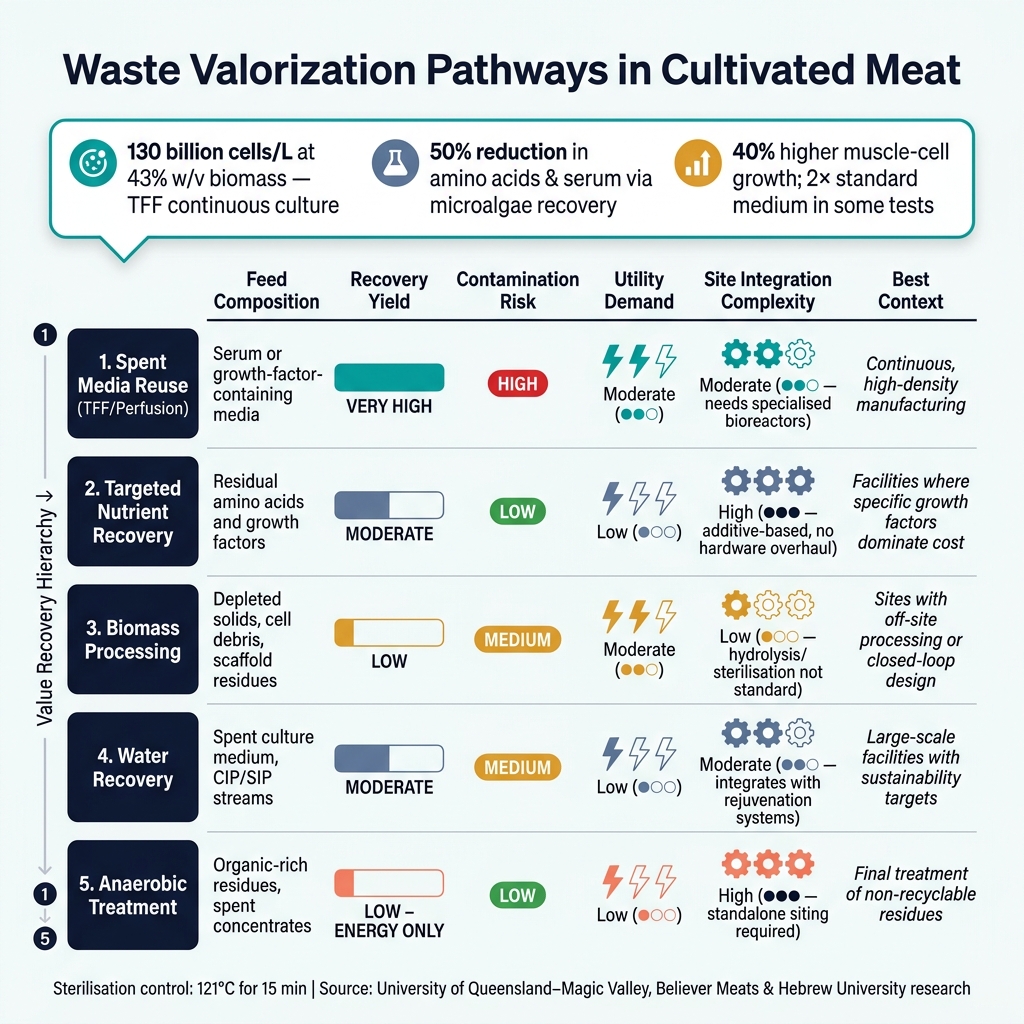
Waste Valorization Pathways in Cultivated Meat: Recovery Hierarchy & Trade-Offs
The sections above set out each pathway in detail. This comparison looks at where each route fits best at facility level. There isn’t a one-size-fits-all option for every waste stream. Each pathway works well within a certain operating window, and it matters just as much to know where performance starts to fall off as it does to know where it works best.
Spent media reuse gives the highest recovery yield. The trade-off is process complexity. It suits tightly controlled continuous systems, especially where operators can manage lactate, ammonia, and other metabolic byproducts using bioprocess control software in real time.
Targeted nutrient recovery is more selective. It’s simpler to slot into an existing process than full media regeneration, but it recovers a smaller share of the waste stream’s total value.
Biomass processing comes into play when selective recovery no longer pays off. At that point, residual solids are usually a better fit for hydrolysis or digestion than for more nutrient extraction.
Water recovery helps mainly by cutting utility demand. That said, contamination risk sits at a moderate level if purification isn’t rigorous enough [4][3].
Anaerobic treatment has the lowest recovery value in terms of process inputs, but it fits best as the final step for residues that can’t be recycled back into production. In that case, the main return is biogas rather than media components [1].
The main distinction is simple: does the pathway recover usable media, specific nutrients, residual biomass, water, or only energy? The table below pulls those trade-offs into a facility-level view.
| Pathway | Feed Composition | Recovery Yield | Contamination Risk | Utility Demand | Site Integration | Best Context |
|---|---|---|---|---|---|---|
| Spent Media Reuse (TFF/Perfusion) | Serum or growth-factor-containing media | Very High | High - requires strict closed-system controls | Moderate | Moderate - needs specialised bioreactors | Continuous, high-density manufacturing |
| Targeted Nutrient Recovery | Residual amino acids and growth factors | Moderate | Low - stable additives, no complex separation | Low | High - additive-based, no hardware overhaul | Facilities where specific growth factors dominate cost |
| Biomass Processing | Depleted solids, cell debris, scaffold residues | Low | Moderate - screening required before reuse | Moderate | Low - hydrolysis and sterilisation equipment not standard | Sites with off-site processing capacity or closed-loop design |
| Water Recovery | Spent culture medium, CIP/SIP streams | Moderate | Moderate - purification rigour is critical | Low | Moderate - integrates with rejuvenation systems | Large-scale facilities with sustainability targets |
| Anaerobic Treatment | Organic-rich residues, spent concentrates | Low - energy only | Low - sits outside sterile production areas | Low | High - standalone siting | Final treatment of non-recyclable residues |
Conclusion
No single pathway recovers all the value locked in cultivated meat waste streams. Spent media reuse and targeted nutrient recovery retain the most value. By contrast, biomass processing, water recovery, and anaerobic treatment do more to cut the remaining load than to retain high-value inputs. In practice, these routes work best as a value recovery hierarchy.
Anaerobic treatment sits at the end of that chain for residues that cannot be recycled.
At facility level, the strongest outcomes usually come from sequencing recovery steps rather than depending on one route alone. Biological recovery looks especially promising when nutrient levels are still high enough to justify it. Recent University of Queensland–Magic Valley work shows that microalgae-based recovery can push loop closure further by converting spent media into reusable biomass [2].
That also makes procurement part of process design, not just a purchasing task. Cellbase can help teams source the specialised equipment, materials, and infrastructure, such as scalable production systems, needed to put these recovery systems in place.
FAQs
Which waste stream should we prioritise first?
Culture media recovery and recycling should come first in cultivated meat production. Media make up the largest share of production cost and have the biggest impact on process footprint.
Recovering nutrients such as amino acids and glucose, or removing inhibitory by-products like lactate and ammonia, goes straight at two of the main barriers to commercial scale: cost and process footprint.
When is full media reuse better than targeted recovery?
Full media reuse works best when the spent medium still holds enough usable nutrients to support another cycle. That includes not just leftover basal components, but also cell-secreted growth factors and cytokines that would otherwise be discarded. In that setup, you can replenish what’s been consumed and recycle the medium with only limited waste removal.
In practice, this approach is a better fit for an on-line recirculation loop. The idea is simple: remove unwanted by-products as they build up, while keeping the rest of the medium in the system. That can cut raw material loss and make better use of high-cost components. Of course, it only works if sterility is maintained and contamination risk is kept tightly under control.
What usually stops water reuse at plant scale?
At plant scale, water reuse in cultivated meat production is mainly limited by the need to maintain sterile conditions in the bioreactor. The process is highly sensitive to contamination from bacteria, fungi or viruses, so an aseptic environment is non-negotiable.
There’s also a data gap. Many teams still don’t have quantifiable data on the quality of the water generated during processing, which makes reuse harder to assess and control.
Techniques such as media rejuvenation and perfusion can improve water use. But they still depend on robust sterilisation to control safety risks and meet regulatory standards.


