

Maintaining pH in bioreactors is critical for cultivated meat production. Cells thrive in a narrow pH range of 7.1 to 7.4, and even slight deviations can disrupt processes like the lactate metabolic shift, which directly impacts product yields. Here's what you need to know:
- Challenges: Large-scale bioreactors face localised pH gradients, CO₂ accumulation, and osmolality spikes, all of which can hinder cell growth.
-
Key Strategies:
- Buffer Systems: Offer early-stage pH stability but have limited capacity.
- Acid/Base Addition: Effective but increases osmolality and risks uneven distribution.
- Gas Sparging: Adjusts pH without affecting osmolality, ideal for scaling.
- Automated Systems: Real-time adjustments using sensors for precise control.
- Best Practices: Combine methods, use reliable sensors, and delay base addition until after the exponential growth phase to reduce stress on cells.
For bioprocess engineers and R&D teams, optimising pH control means minimising localised stress, maintaining stable osmolality, and ensuring accurate monitoring. This article dives deeper into methods, equipment, and troubleshooting to refine your approach.
pH Measurement and Monitoring in Bioreactors
Types of pH Sensors and Their Uses
Accurate pH monitoring is a cornerstone of effective bioreactor control. The inline potentiometric probe, such as the Hamilton EasyFerm, is the most commonly used sensor in bioreactor settings. These probes are directly integrated into the bioreactor vessel, enabling continuous pH monitoring. This is especially critical in cultivated meat production, where even a minor 0.1-unit shift in pH can disrupt the lactate metabolic shift, ultimately impairing the process [3].
In addition to inline probes, offgas sensors like the BlueInOne are used to measure dissolved CO₂ (pCO₂) in the exhaust gas. Since pCO₂ levels directly influence the pH of the medium, offgas data provides an indirect but highly informative perspective on the pH environment. This is particularly useful when bulk medium pH readings don't fully capture the dynamic changes within the bioreactor [3].
However, inline probes are prone to biological fouling, often caused by cell debris accumulating on the sensor. This can lead to sudden pH drops that do not reflect actual conditions in the bulk medium [3]. If unexpected pH dips occur, fouling is likely the cause rather than genuine acidification of the culture. To address this, proper calibration and maintenance are essential, as outlined below.
Calibration and Maintenance Best Practices
Maintaining accurate pH readings throughout a cultivation run requires more than a single calibration before starting. Sharp, sudden pH changes are often indicative of sensor issues, while genuine acidification typically results in a gradual drift [3]. Differentiating between these two scenarios is key to effective monitoring.
Certain operational strategies can also enhance sensor reliability. For instance, delaying the addition of base until the exponential growth phase and using gas sparging for pH control in the early stages can reduce fouling risks and improve culture stability [3]. Combining inline pH measurements with offgas pCO₂ monitoring offers a valuable cross-check, helping to detect sensor drift early and ensuring accurate control responses.
pH Monitoring Across Different Bioreactor Designs
As bioreactor designs and scales vary, so do the challenges of pH monitoring. Larger bioreactors introduce scale-induced gradients, making precise pH measurement even more critical for maintaining control strategies.
In smaller lab-scale systems, such as the 3 L Labfors system from Infors, cultures are typically well-mixed, and a single inline probe can provide reliable bulk pH readings [3]. However, in large-scale production bioreactors - which can hold up to 25,000 L - mixing times are longer, leading to localised pH gradients, particularly near base addition points [3].
"Increasing mixing times in large-scale bioreactors can result in the formation of gradients. Exposure of different cell lines to even minor pH amplitudes resulted in a negatively affected process performance." - Katrin Paul et al., Engineering in Life Sciences [3]
In such large-scale systems, a single probe positioned away from the base addition zone may fail to detect the pH fluctuations that cells experience. With approximately 50% of biologics expected to be produced in bioreactors of 5,000 L or larger, this is a practical challenge that demands attention [3]. To address this, researchers often use two-compartment systems (2-CS) in bench-scale studies. These systems simulate industrial-scale conditions by recirculating a portion of the cell population through a bypass where base is added, providing a realistic model of the pH variations encountered in production [3].
For rocking and perfusion bioreactors, similar principles apply. Rocking systems, with their gentler mixing, tend to minimise localised gradients. Perfusion systems, on the other hand, introduce additional complexity. The continuous exchange of media in these systems can alter the culture's buffering capacity over time, necessitating close monitoring of both inline pH and offgas data to ensure stable pH conditions.
Buffer Systems and Media Design
Buffer Systems Used in Cultivated Meat Bioprocesses
In mammalian cell culture, the bicarbonate-CO₂ system plays a central role in buffering. It regulates the partial pressure of CO₂ (pCO₂) within the bioreactor, which in turn maintains the balance between carbonic acid and bicarbonate ions in the medium [3]. This system mimics mammalian physiological processes but can be disrupted by CO₂ stripping - caused by vigorous sparging or high agitation - leading to a rise in pH.
For smaller-scale or open systems where controlling CO₂ is more difficult, zwitterionic buffers like HEPES are often used. HEPES provides stable buffering that doesn’t depend on the gas phase. However, unlike bicarbonate, it doesn’t participate in cell metabolism, which limits its application in large-scale production.
Both approaches highlight the importance of buffering systems in maintaining stable pH, a key factor further influenced by media composition.
How Media Composition Affects pH Stability
Cellular metabolism significantly impacts pH stability. As cells metabolise glucose and amino acids, they produce lactate, which acidifies the medium. The extent of this acidification depends on factors such as cell density, glucose levels, and the feeding strategy employed [3]. A critical process marker here is the lactate metabolic shift, where cells switch from producing lactate to consuming it. Even minor pH changes - just 0.1 units - can disrupt this shift, leading to lactate accumulation and further pH decline [3].
To counteract this, maintaining controlled glucose levels (e.g., 2 g/L through continuous feeding) and ensuring sufficient amino acid supplementation are essential [3].
"The sensitivity of the cells not only to pH excursions, but to base addition in itself shows the importance of process design as a tool to minimize negative effects on process performance." - Katrin Paul et al., Institute of Chemical, Environmental and Bioscience Engineering, TU Wien [3]
This underscores how media composition and process design must work together to maintain pH stability.
Media Design Considerations for Cultivated Meat
When designing media for cultivated meat systems, buffering and metabolic factors must align with the unique requirements of these processes. Serum-free, chemically defined media are the standard for cultivated meat production due to their reproducibility and regulatory compliance. However, these formulations lack the protein matrix found in serum, which naturally aids buffering. This absence makes precise pH management even more critical, requiring careful buffer selection and process control.
Culture format also plays a significant role in pH dynamics. Suspension cultures and microcarrier-based systems exhibit different behaviours. For instance, microcarrier systems can create localised microenvironments with pH variations distinct from the bulk medium. To stabilise pH, it’s essential to tailor buffer capacity and feeding strategies to the specific culture format and growth phase [3].
During early growth phases, CO₂ sparging can be an effective method for pH control. It avoids the creation of localised high-pH zones, which are a common issue with direct liquid base addition [3].
Understanding pH Measurements in Bioprocess
Acid/Base Addition and Gas Sparging Strategies
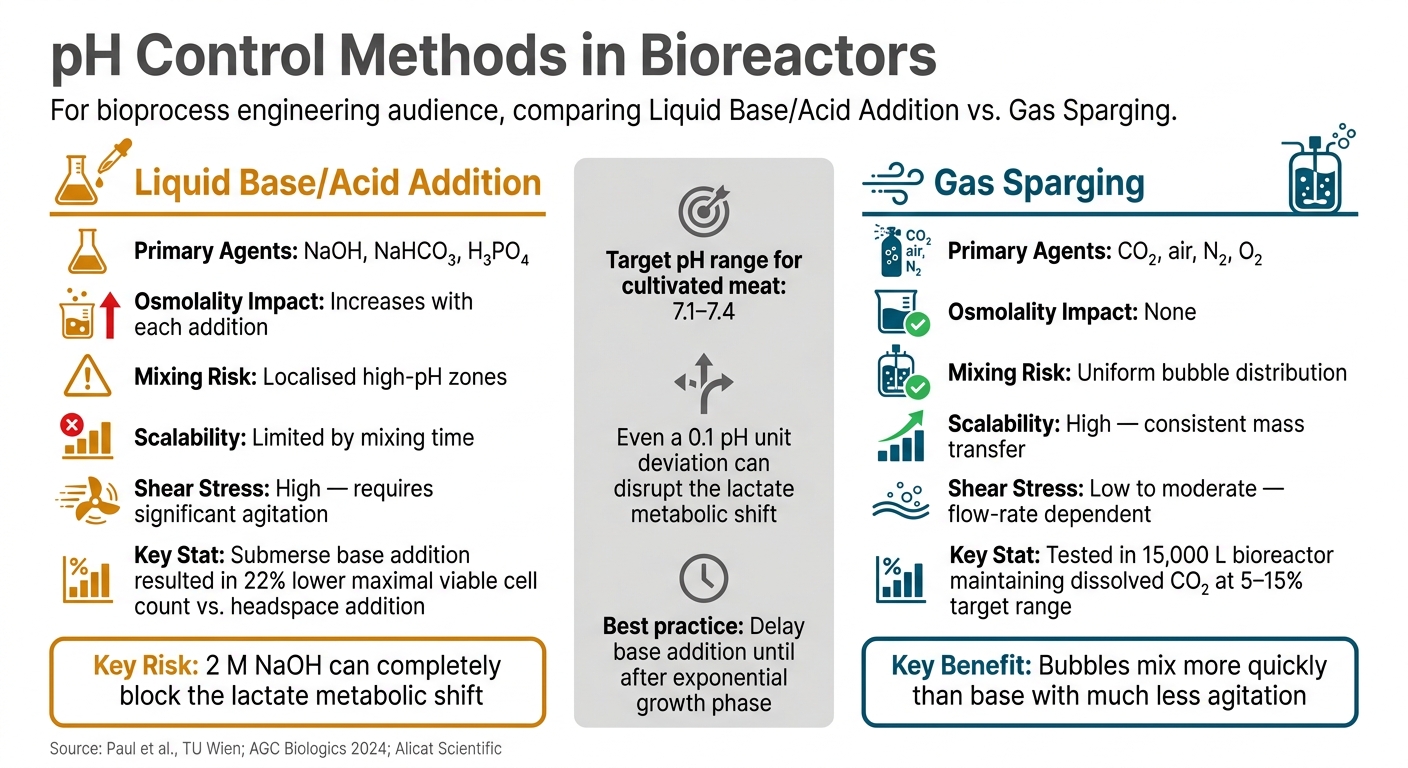
pH Control Methods in Bioreactors: Liquid Addition vs. Gas Sparging
Using Base and Acid Additions for pH Control
Liquid titrant addition is a common approach to address pH drift in bioreactors. Sodium hydroxide (NaOH) and sodium bicarbonate (NaHCO₃) are typically used to increase pH, while phosphoric acid (H₃PO₄) or dissolved CO₂ is employed to decrease it. This method relies on a straightforward pump–sensor feedback loop, making it effective at bench scale.
However, this technique has its drawbacks. Liquid titrants raise the medium's osmolality, and inadequate mixing can lead to localised high-pH zones, which can stress cells. Research conducted at TU Wien highlighted this issue, showing that submerse base addition resulted in a 22% lower maximal viable cell count compared to headspace addition. The likely cause was continuous localised stress. A practical solution is to delay base addition until after the exponential growth phase, when cells are less vulnerable to pH fluctuations.
For those looking to avoid these challenges, gas sparging presents an alternative approach.
Gas Sparging Techniques for pH Regulation
Gas sparging adjusts pH by introducing CO₂ to form carbonic acid, which lowers pH, or by sparging with air, oxygen, or nitrogen to strip dissolved CO₂ and raise pH. Unlike liquid titrant addition, gas sparging does not affect osmolality.
"Gas bubbles from spargers can be evenly mixed and distributed more quickly than base, and with much less agitation." - Alicat Scientific [1]
The effectiveness of gas sparging depends heavily on sparger design. Micro-spargers, with their high surface area, are excellent for dissolving gases like CO₂ and O₂ into the medium. On the other hand, macro-spargers, which produce larger bubbles, are more effective at removing CO₂. However, maintaining a strict CO₂ set-point through continuous sparging can lead to CO₂ build-up, which negatively impacts mammalian cell growth and protein production. As noted by Stephanie R. Klaubert et al. in Biotechnology Progress, "for CO₂ controlled cultures, using a set-point can result in an accumulation of CO₂, which has detrimental effects on mammalian cell growth and protein production" [4]. Adjusting the set-point dynamically during the exponential phase can help mitigate this issue.
Scaling Acid/Base and Gas-Based Approaches
While liquid titrant addition works well at the lab scale, its scalability is hampered by mixing challenges and osmolality increases. Gas sparging, on the other hand, offers consistent mass transfer and avoids osmolality issues, even in large-scale operations:
| Feature | Liquid Base/Acid Addition | Gas Sparging |
|---|---|---|
| Primary Agents | NaOH, NaHCO₃, H₃PO₄ | CO₂, air, N₂, O₂ |
| Osmolality Impact | Increases with each addition | None |
| Mixing Risk | Localised high-pH zones | Uniform bubble distribution |
| Scalability | Limited by mixing time | High, due to consistent mass transfer |
| Shear Stress | High (requires significant agitation) | Low to moderate (flow-rate dependent) |
In February 2024, researchers at AGC Biologics demonstrated a predictive mass-transfer model for CO₂ control in a 15,000 L bioreactor. This model was tested with CHO cell cultures reaching a peak density of 20×10⁶ cells/mL, successfully maintaining dissolved CO₂ levels within a target range of 5–15%, reducing reliance on empirical adjustments. For cultivated meat production, where cells require a pH range of 7.1–7.4, such model-informed gas sparging is particularly beneficial.
These approaches highlight the importance of aligning pH control methods with reactor size and process requirements, which is crucial for optimising cultivated meat production.
sbb-itb-ffee270
Automated pH Control and Advanced Strategies
Standard Automated pH Control Systems
Automated pH control relies on a closed-loop system where sensors monitor pH levels, a controller processes the data (usually using PI or PID logic), and an actuator makes adjustments - often through a liquid pump or mass flow controller. The proportional band (p-band) determines how aggressively the controller responds to pH changes. Beckman Coulter Life Sciences illustrated this in their BioLector Pro technical note (2026), which examined E. coli cultivations in Wilms-MOPS medium with 3 M NaOH. They found:
- A p-band of 0.1 maintained pH within the target range.
- A p-band of 0.01 caused overshooting.
- A p-band of 5 responded too slowly to counteract metabolic acid production [6].
For media with strong buffering capacity, smaller p-band values can improve response times, but they require careful monitoring to avoid overshooting.
Most systems include a dead band (typically ±0.02 to 0.05 pH units) to prevent unnecessary corrections when pH is already within an acceptable range. These features, combined with advancements in sensor and sparging strategies, enable accurate pH management in dynamic bioreactor conditions.
Combined pH and Dissolved Oxygen Control Loops
Advanced systems integrate pH and dissolved oxygen (DO) control into a single loop, adjusting a mixture of air, O₂, N₂, and CO₂ based on feedback from pH, DO, and pCO₂ sensors [1].
"The most up-to-date setups primarily use sparging gases to control pH… to focus on optimising the control loop for sparging gases using feedback from pH and other critical process parameters - including pCO₂." - Alicat Scientific [1]
This integrated approach enhances scalability. As bioreactor volumes increase, sparge rates and bubble sizes often remain consistent, reducing shear stress on cells compared to liquid titrant mixing. Additionally, osmolality remains stable, an advantage for maintaining cell viability [1][2]. However, multi-gas sparging systems require precise mass flow controllers and well-designed spargers, which can increase complexity and costs - particularly in R&D settings where liquid addition may still be a practical option.
One critical point: pCO₂ and pH are not always directly correlated in buffered media. Metabolic byproducts like lactate contribute to acidity but may not be reflected in pCO₂ levels [1]. Monitoring both pCO₂ and pH provides a more comprehensive view of the culture environment, though neither should be used as a standalone indicator.
Model-Based and Data-Driven Control Techniques
Advanced techniques go beyond standard PID loops to refine pH control further. Model-based control uses chemical equilibrium equations to predict the quantities of CO₂ or sodium bicarbonate needed to achieve a target pH, rather than simply reacting to deviations. This predictive approach is especially useful during periods of rapid growth when metabolic acid production can outpace reactive control [7].
An example of data-driven monitoring comes from researchers at the École Polytechnique Fédérale de Lausanne (EPFL). In 2008, they demonstrated a model-based pH control system using mid-infrared (MIR) spectroscopy in E. coli batch cultures. By analysing the molar absorbance of buffer species and applying Debye–Hückel theory to estimate activity coefficients, the system achieved a pH discrepancy of less than 0.12 units compared to conventional electrochemical probes. This approach eliminates the need for invasive sensors or dyes [5]. MIR spectroscopy has shown a standard error of prediction below 0.15 pH units, making it a promising non-invasive alternative as optical sensing technology advances [5].
For teams employing optical sensors, it’s important to allow a one-hour wetting period after adding media. This ensures optodes equilibrate with the medium before initiating control loops, avoiding premature corrections [6].
The table below summarises these methods, outlining their strengths and limitations:
| Control Method | Mechanism | Key Advantage | Key Limitation |
|---|---|---|---|
| PID (Liquid Addition) | Pump feedback loop | Simple; effective at small scale | Poor scalability; increases osmolality [1][6] |
| Multi-Gas Sparging Loop | CO₂/N₂/air blend control | Scalable; stable osmolality [1] | Requires complex sparger engineering [1] |
| MIR Spectroscopy | Absorbance-based prediction | Non-invasive; no dyes needed [5] | Complex calibration; multivariate models required [5] |
| Equilibrium Modelling | Mathematical feedforward | Predictive; reduces corrections [7] | Relies on accurate media composition data [7] |
Optimisation and Troubleshooting for pH Control
Common pH Problems in Cultivated Meat Bioreactors
Cultivated meat cells require a pH range of 7.1–7.4 to thrive [1]. Even a minor deviation of 0.1 pH units can disrupt the lactate metabolic shift [3]. As bioreactor volumes increase, maintaining consistent pH becomes more challenging. In reactors up to 25,000 L, localised pH pockets can deviate by as much as 0.4 units due to longer mixing times [2]. Frequent liquid base additions to the headspace can worsen these fluctuations [3]. High osmolality levels, particularly above 400 mOsmol/kg, further inhibit cell growth [2]. Notably, using 2 M NaOH for pH adjustments has been shown to completely block the lactate metabolic shift, unlike lower concentrations such as 0.5 M or 1 M, which have less impact on process performance [2].
Another issue is cell lysis byproducts, particularly DNA, which can foul pH probes and lead to inaccurate readings [3]. These false signals often trigger unnecessary base additions, compounding problems like osmolality spikes and localised pH imbalances.
How to Troubleshoot pH Control Problems
The first step in troubleshooting is to distinguish between sensor errors and actual pH changes. If a sharp pH drop occurs without corresponding changes in metabolic activity or CO₂ levels, probe fouling is likely the culprit. Cleaning or recalibrating the probe and verifying the reading with an offline measurement should clarify the situation.
For genuine pH drops, identifying the root cause - whether CO₂ accumulation or lactate production - is essential. In buffered media, pCO₂ and pH are not always tightly linked [1]. Monitoring lactate levels can help pinpoint issues that gas sparging alone may not resolve.
At larger scales, addressing pH localisation requires careful consideration. While increasing agitation might seem like an obvious solution, higher impeller speeds can introduce shear stress that damages mammalian cells [1]. Instead, increasing headspace aeration is often more effective. A 2018 study by Hoshan et al. demonstrated that maintaining constant sparge rates while increasing headspace aeration during scale-up from 30 L to 250 L preserved product titres without adding shear stress [1].
"Gas bubbles from spargers can be evenly mixed and distributed more quickly than base, and with much less agitation." - Alicat Scientific [1]
When base addition is unavoidable, its timing can make a significant difference. Delaying base addition until after the exponential growth phase helps minimise stress on dividing cells and reduces the overall volume of base required [3]. These steps provide a strong starting point for refining pH control strategies through targeted experimentation.
Using Design of Experiments to Refine pH Strategies
After troubleshooting, a structured Design of Experiments (DoE) approach can fine-tune pH management strategies. DoE enables the simultaneous evaluation of multiple factors, uncovering interactions that might be missed with single-variable testing. Parameters to test include base molarity, deadband width, gas mix ratios, and sparging flow rates.
Deadband optimisation is particularly impactful. Identifying the widest deadband that does not compromise cell growth reduces the frequency of base additions and limits osmolality spikes [2]. Similarly, testing different base molarities can highlight metabolic shifts [2].
One limitation of small-scale DoE studies is that bench-top bioreactors do not replicate the pH inhomogeneities of larger systems. Researchers at TU Wien suggest using two-compartment systems to mimic the circulation times (around 35–44 seconds) and localised pH gradients typical of production-scale reactors [2]. This approach enhances the predictive value of small-scale experiments for large-scale applications.
"To avoid these pitfalls during scale up, the pH correction strategy should be well designed. Either a continuous addition of small amounts of base, a large pH dead band or the control of the pH with sparged gases only, are all viable options." - Katrin Paul et al., Institute of Chemical, Environmental and Bioscience Engineering, TU Wien [2]
Using lactate consumption as a key metric in DoE studies is highly recommended. It provides a more sensitive measure of optimised pH control for mammalian cell health, revealing metabolic effects that may not be evident from cell count or viability data alone [2].
Conclusion: Key Takeaways for pH Control in Cultivated Meat
Best Practices for pH Control
Maintaining pH within the range of 7.1 to 7.4 is essential for ensuring cell viability and optimising product yield in cultivated meat production[1]. To achieve this, regularly calibrated inline pH probes, often paired with dissolved oxygen (DO) sensors, are indispensable. This combination allows for early detection of sensor drift and quick system adjustments during critical growth phases. The integration of pH and DO sensors enhances the responsiveness of control loops, particularly during the exponential growth phase.
For pH adjustments, gas sparging is generally the method of choice at scale. Gas bubbles provide even distribution with minimal agitation, reducing the risk of localised pH imbalances and osmolality spikes that can occur with liquid base additions[1]. Postponing the addition of liquid base until after the exponential phase can further minimise metabolic disturbances[3]. Optimising control systems with a wider deadband can also reduce intervention frequency, helping to stabilise osmolality. While buffer systems offer an initial layer of pH stability, they become less effective as CO₂ production increases. Therefore, a combination of well-designed media and active control measures is essential.
These strategies provide a solid framework for selecting equipment that aligns with the specific demands of cultivated meat production.
Using Cellbase to Source pH Control Equipment

Effective pH control depends on both a well-thought-out process design and the right equipment. For teams moving beyond bench-top systems, finding suitable tools - such as high-precision inline sensors and mass flow controllers for gas sparging - can be a complex task. Cellbase simplifies this process. This specialised B2B marketplace is designed exclusively for the cultivated meat industry, connecting procurement teams, R&D scientists, and production managers with trusted suppliers of bioreactors, sensors, and other essential infrastructure. Listings on Cellbase are tagged with specific use-case details, making it easier to identify equipment that meets the precise needs of cultivated meat bioprocesses.
FAQs
How do I choose between liquid base addition and gas sparging for pH control?
The decision hinges on the scale of production and the level of precision required. Gas sparging is well-suited for large-scale cultivated meat manufacturing. It provides consistent pH control, minimises shear stress, and avoids raising osmolality. On the other hand, liquid base addition is better for smaller systems or when precise, localised pH adjustments are needed. However, improper management can lead to pH imbalances and osmotic stress. For large-scale setups, automated gas sparging systems are preferable to maintain uniformity and support cell viability.
What’s the best way to spot pH probe fouling versus a real pH change?
To determine if a pH probe is fouled rather than detecting an actual pH shift, look out for signs like sluggish response times, elevated asymmetry potential, reduced slope, or diffusion potential errors. Conduct diagnostics by examining the junction for blockages or coatings and reviewing the probe's calibration and maintenance records. These measures help pinpoint probe-related issues instead of genuine pH changes.
How can I reduce pH gradients when scaling up to large bioreactors?
To keep pH gradients under control in large bioreactors, gas sparging combined with automated control systems is a reliable approach. This method promotes uniform pH regulation while maintaining low shear stress. By using mass flow controllers, you can fine-tune sparge rates to evenly distribute gases such as CO₂ and air, helping to stabilise pH levels effectively.
Advanced sensors paired with feedback loops allow for real-time adjustments, ensuring precise pH management throughout the process. Additionally, avoiding the addition of bases minimises inhomogeneity, further supporting consistent pH levels. These techniques not only optimise cell growth but also maintain product consistency during scale-up operations.


