

If you test endotoxin in cultivated meat samples, the right method depends more on the sample matrix than the kit label.
I’d sum it up like this: LAL gives you a familiar workflow, while rFC can reduce false positives in beta-glucan-rich media and supports animal-free sourcing. But neither method should be picked on principle alone. For media, bioreactor broth, and harvest samples, the main question is simple: which assay gives clean, recoverable EU/mL data in the actual matrix you run?
Here’s what matters most for you:
- LAL uses horseshoe crab lysate and can be affected by Factor G cross-reactivity
- rFC uses recombinant Factor C and is often a better fit when beta-glucans are present
- Both methods can fail in complex samples with growth factors, surfactants, chelators, cell debris, or high biomass
- Serial dilution, MVD setting, and spike recovery are the core checks for matrix fit
- Validation must be done in the real process matrix, not just in buffer
- If LAL and rFC disagree, I’d first check dilution, inhibition, reagent lot, and matrix effects before trusting the number
Endotoxin from Gram-negative bacteria can affect cell health, process consistency, and batch variation. That is why this choice matters in cultivated meat R&D and QC, especially where USP and Ph. Eur. expectations apply.
Comparison of Traditional LAL to Recombinant Reagents Associates of Cape Cod, Inc. APR Webinar
Effective endotoxin testing is a critical component of cell monitoring protocols to ensure the safety and purity of cultivated meat products.
sbb-itb-ffee270
Quick comparison
| Criteria | LAL | rFC |
|---|---|---|
| Reagent source | Horseshoe crab lysate | Recombinant single-enzyme reagent |
| Main read-out | Gel-clot, chromogenic, turbidimetric | Fluorescence or chromogenic |
| Beta-glucan risk | Yes; false positives can occur via Factor G | No Factor G; lower risk from beta-glucans |
| Animal-free fit | No | Yes |
| Matrix risk | Can be affected by inhibition and non-endotoxin reactivity | Can still be affected by inhibition and matrix mismatch |
| Best use case | Teams that want a familiar compendial workflow | Teams dealing with plant-derived ingredients or animal-free sourcing targets |
I’d treat method choice as a matrix-validation problem first, and a sourcing decision second. This approach is critical when navigating the challenges of scaling cultivated meat production.
LAL and rFC: how each assay works and what it delivers analytically
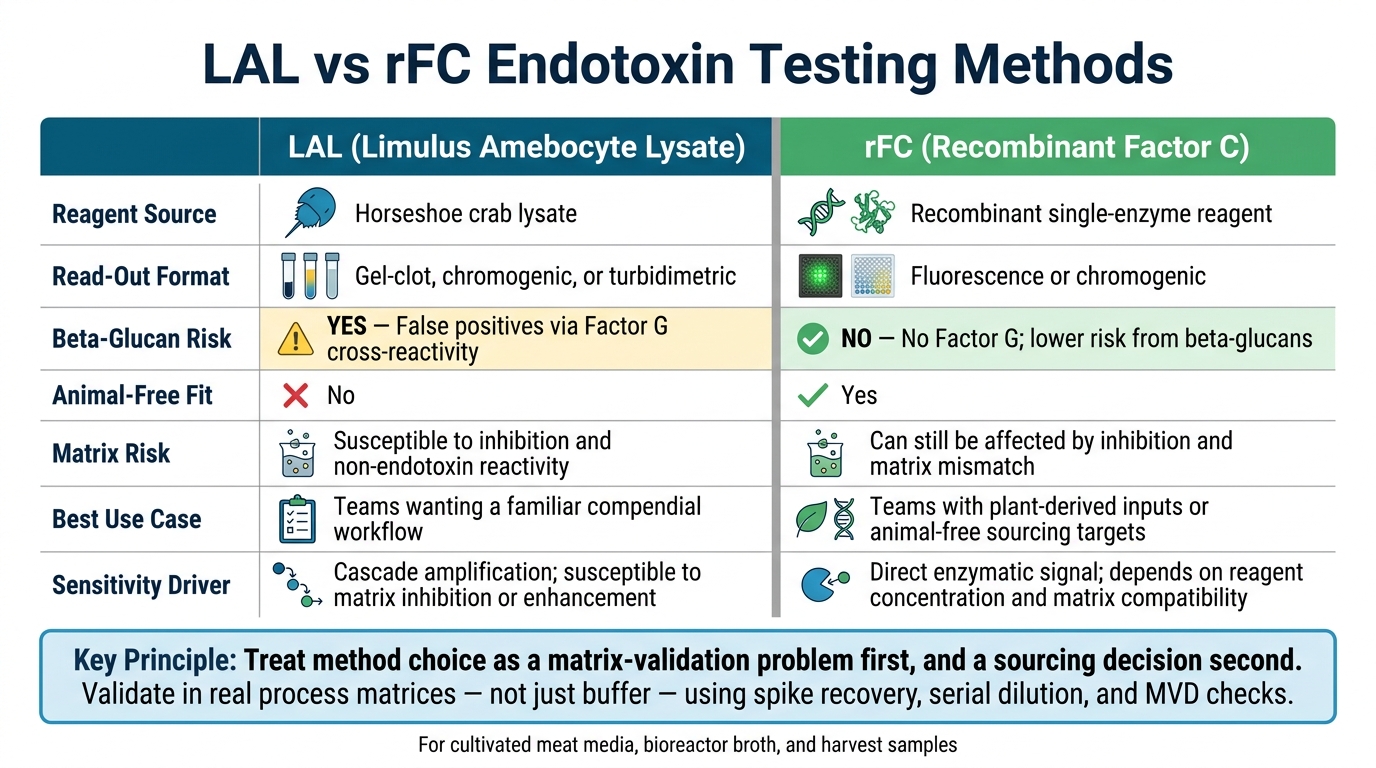
LAL vs rFC Endotoxin Testing: Method Comparison for Cultivated Meat
How LAL detects endotoxin
LAL detects endotoxin by triggering the horseshoe crab clotting cascade. That reaction produces a gel-clot, chromogenic, or turbidimetric signal.
On paper, that sounds straightforward. In practice, the key question is whether the signal stays stable in the matrices used for cultivated meat production.
How rFC detects endotoxin
rFC detects endotoxin through recombinant factor C, producing a fluorescence or chromogenic read-out.
That point matters once media components and biomass begin to distort the read-out. In those conditions, the signal itself can become the problem.
Comparison table: assay principle, format and sensitivity
| Parameter | LAL | rFC |
|---|---|---|
| Biological source | Horseshoe crab lysate | Recombinant single-enzyme reagent |
| Read-out format | Gel-clot, chromogenic or turbidimetric | Fluorescence or chromogenic |
| Sensitivity driver | Cascade amplification; susceptible to matrix inhibition or enhancement | Direct enzymatic signal; sensitivity depends on reagent concentration and matrix compatibility |
| Animal-derived inputs | Yes | No |
These differences only matter if the assay stays reliable in the cultivated meat matrix you plan to test. The next issue is matrix interference in media, harvests and biomass-rich samples.
Matrix interference and sample suitability across cultivated meat workflows
Once the assay chemistry is set, matrix interference tends to decide whether an endotoxin method works in a cultivated meat process.
Media samples: proteins, surfactants and plant-derived components
Cultivated meat media can be highly protein-dense, especially when albumin and transferrin are part of the formulation. At high concentrations, both proteins can suppress or distort signal in LAL and rFC assays.
Transferrin is a high-molecular-weight glycoprotein and can vary in quality from one production batch to another [3]. Plant-derived inputs add another layer of risk. They may contain beta-glucans and other polysaccharides, which can trigger false positives in LAL through Factor G. rFC does not contain Factor G, so it is often the better fit for beta-glucan-rich media formulations [5]. Surfactants and chelating agents can also suppress both assays, so they need to be checked during dilution and interference testing.
Harvest samples are harder again.
Cell harvest and biomass-rich samples
Cell harvests are more complex matrices. High cell density, aggregates, intracellular debris, and soluble biomolecules from spent media can all cause inhibition or enhancement in both assays [4].
A practical way to deal with this is serial dilution. Use it to find the MVD: the highest dilution that removes interference without pushing endotoxin below the assay detection limit. If filtration is used to clarify harvest samples, keep an eye on membrane fouling. Flux loss and increasing transmembrane pressure can trap endotoxin and lower recovery [1].
Comparison table: method suitability by sample type
| Sample type | Common interference risks | LAL strengths | LAL limitations | rFC strengths | rFC limitations |
|---|---|---|---|---|---|
| Growth media | High protein (albumin, transferrin), surfactants, chelators | High sensitivity across a range of matrices | False positives in beta-glucan-rich media via Factor G | Higher specificity in beta-glucan-rich media; no Factor G cross-reactivity | Requires fluorescence or chromogenic plate reader |
| Bioreactor broth | Cell debris, soluble biomolecules, pH shifts from metabolic byproducts | Robust in simpler, lower-complexity matrices | Susceptible to inhibition from high cell density and metabolic waste | Consistent signal across complex biochemical environments | Signal quality depends on adequate dilution and matrix compatibility |
| Cell harvest | High biomass density, aggregates, intracellular debris | Effective when sufficient dilution is achievable | Significant inhibition risk at high protein concentrations | Cleaner signal in the presence of non-endotoxin polysaccharides | Sensitivity reduced if dilution is insufficient |
The next step is to validate the chosen method against actual process samples and then work through any differences between methods.
Validation, regulatory fit and data interpretation
Once an assay works in the matrix, validation tells you if it can handle routine testing.
Key validation points for LAL and rFC
Validate LAL and rFC in each actual process matrix, not only against reference standards in buffer.
For both methods, validation should cover inhibition and enhancement testing, spike recovery, and checks on assay behaviour in the real media or harvest matrix. Spike recovery is one of the clearest ways to show whether a sample is suppressing or boosting the signal. If the media formulation changes, or a different cell line shifts the sample matrix, re-validation is needed.
Interpreting EU/mL results and resolving differences between methods
If LAL and rFC disagree, start with the dilution and the matrix, not the reported number.
When the two methods give different EU/mL results from the same sample, compare the data across runs and reagent lots. If LAL reads higher than rFC, look first for LAL-specific enhancement. If rFC reads low, inhibition is a sensible first suspicion. Poor spike recovery in either assay is a warning sign for interference, so check recovery at the same dilution used for the sample result before deciding that the matrix is clean.
In complex matrices, the main job is to work out whether the problem is:
- enhancement
- inhibition
- an unsuitable dilution
Regulatory expectations vary by market, but both Singapore and the US expect endotoxin data validated in the sample matrix, not buffer-only kit results.
How Cellbase supports endotoxin testing implementation

Once the method is validated, teams need the right hardware and consumables to run it the same way each time.
Cellbase helps cultivated meat teams source the instruments and consumables needed for validated endotoxin testing from verified suppliers.
Conclusion: Choosing the right endotoxin test method for cultivated meat
Assay chemistry, matrix compatibility, and validation data should drive the final decision. Neither method is better in every case. Use LAL when you need a well-known workflow. Use rFC when beta-glucan interference is a major concern or animal-free sourcing carries more weight.
The sample matrix should lead the choice. Cultivated meat media, harvest samples, and additives can affect assay performance far more than buffer-based kit data suggests. That’s why matrix validation matters more than kit specifications on their own.
Validate the method on actual cultivated meat media and harvest samples with inhibition, enhancement, and spike recovery tests. If the media formulation changes, re-validation is not optional [3].
After validation, jurisdictional requirements are the last check. In Singapore and the United States, align the method with product- and process-specific safety expectations from the start to avoid late-stage rework [2]. Choose the method that is validated in the real process matrix and accepted in the target market.
FAQs
Which method should I trial first?
It depends on your workflow. LAL remains the standard assay used across the industry, while rFC offers an animal-free option.
The right choice comes down to two things: the sensitivity you need and how much matrix interference you expect from your growth media or cell harvest samples. In practice, many teams test both in parallel first. Another sensible route is to start with the method that lines up best with your animal-free production goals.
How do I know if my sample matrix is interfering?
Run a spike recovery assay. Add a known endotoxin concentration to your cultivated meat media or cell harvest sample, then compare the measured recovery with a control.
If recovery falls outside the usual acceptable range of 50% to 200%, the sample matrix is likely interfering with the assay, either by enhancing or inhibiting the reaction.
When should I re-validate the assay?
Re-validate your endotoxin assay whenever a major change could affect test results or method reliability in your cultivated meat workflow.
That includes changes to growth media composition, cell harvest steps, raw materials, equipment, or the testing environment.


