

Monitoring metabolites like glucose, lactate, and ammonium in bioreactors is essential for efficient cultivated meat production. Real-time sensors ensure precise control over nutrient levels, improve yields, and reduce waste. Here are the top five sensor technologies tailored for this purpose:
- Raman Spectroscopy: Tracks multiple metabolites simultaneously with high precision, offering non-contact monitoring.
- 2D-Fluorescence Spectroscopy: Detects metabolic shifts by measuring intrinsic fluorophores, enabling nutrient and waste tracking.
- Near-Infrared (NIR) Spectroscopy: Analyses nutrients and biomass in real time, ideal for maintaining optimal cell growth conditions.
- Electrochemical Biosensors: Provides fast, targeted detection of specific metabolites like glucose and lactate.
- Ion-Selective Field Effect Transistors (ISFETs): Measures pH and ions, monitoring cellular activity and nutrient profiles directly.
Each sensor has strengths suited to specific production needs, from non-contact options to direct medium interaction. Combining these technologies can achieve predictive accuracy and streamline production processes.
1. Raman Spectroscopy
Key Metabolites Measured
Raman spectroscopy is capable of measuring glucose, lactate, and glycerol all at once from a single reading. This allows for simultaneous tracking of energy sources, metabolic byproducts, and feedstocks. Each compound generates a unique spectral signature, enabling precise identification even in complex mixtures that include amino acids and organic acids.
Accuracy Metrics
When it comes to glucose monitoring, inline Raman spectroscopy achieves a Standard Error of Prediction (SEP) of 0.2009 g/L within a typical range of 0.1–40 g/L. For lactate, the SEP is 0.1166 g/L across a range of 0.0–5.0 g/L [7]. In July 2024, researchers at Biophotonics Diagnostics GmbH employed a Wasatch Photonics 785 nm Raman spectrometer to monitor an E. coli bioprocess. They reported a RMSEP of 0.41 g/L for the main product and 1.45 g/L for glycerol feedstock over 49 hourly samples [6]. These results underline the precision and reliability of Raman spectroscopy in dynamic bioreactor settings.
Non-Invasive Capabilities
Raman spectroscopy offers versatile deployment options. Measurements can be taken non-invasively through a bioreactor viewport, preserving the sterile environment, or via autoclavable immersion probes, which are particularly suited for dense cultivated meat cultures. Its natural insensitivity to water makes it ideal for aqueous bioprocesses, where other methods often face interference. Modern systems deliver near-instant feedback through rapid spectral averaging, ensuring effective monitoring even under demanding conditions.
Primary Advantages for Cultivated Meat Bioreactors
The ability to provide real-time feedback makes Raman spectroscopy a game-changer for scaling up cultivated meat production. Unlike offline HPLC, it delivers continuous data without the risk of contamination. For optically dense media with high cell concentrations, immersion probes equipped with sapphire ball lenses are recommended. These lenses, with a short working distance of around 100 µm, help reduce light scattering, ensuring accurate readings in challenging environments.
2. 2D-Fluorescence Spectroscopy
Key Metabolites Measured
2D-Fluorescence Spectroscopy produces EEMs (excitation-emission matrices) that reveal the unique fluorescence profiles of various metabolites. This method directly detects intrinsic fluorophores such as NADH, tryptophan, riboflavin, and pyridoxine. By applying chemometric models, it estimates concentrations of glucose, lactate, ammonium, and glutamine - all crucial for tracking cell growth and metabolism in cultivated meat bioreactors. Each compound has distinct spectral peaks, allowing for real-time monitoring of nutrient usage and waste build-up while maintaining sterile conditions.
Accuracy Metrics
In June 2022, researchers at the University of Loughborough demonstrated the capabilities of 2D-Fluorescence Spectroscopy in a 2 L bioreactor using CHO cells. Under the guidance of Dr Karen Coopman, they achieved RMSEP values of 0.29 mM for glutamine and 0.72 mM for ammonium over 120 hours. This enabled real-time media adjustments that reduced lactate levels by 25% and increased titre by 18%. Typical RMSE_CV values for this technique range from 0.15–0.35 mM for glucose, 0.12–0.28 mM for lactate, and 0.08–0.22 mM for ammonium. Cross-validation results show R² values exceeding 0.95 for multi-metabolite partial least squares (PLS) models [1].
Non-Invasive Capabilities
The non-invasive nature of this technology is a major advantage for real-time monitoring in bioreactors. It uses fibre-optic probes that are inserted through bioreactor ports, ensuring sterile conditions are maintained. These probes can be sterilised at 135°C and reused in GMP environments. The system captures full spectra every 5–10 minutes, with response times of less than a minute. This makes it an excellent tool for optimising processes in cultivated meat production [3].
Primary Advantages for Cultivated Meat Bioreactors
2D-Fluorescence Spectroscopy offers exceptional sensitivity for tracking multiple metabolites simultaneously. Its speed and precision address common challenges in monitoring bioprocesses for cultivated meat production. For example, in September 2023, Ncardia incorporated BioView 2D-Fluorescence Spectroscopy into 5 L bioreactors for iPSC-cardiomyocyte production. This system predicted viable cell density with a 12% margin of error and achieved an R² of 0.97 for lactate measurements. Led by Dr Robert Passier, the project achieved a 30% faster optimisation process over seven-day runs. The technique supports process analytical technology (PAT) for fed-batch optimisation, leading to yield improvements of 20–30% in muscle cell cultures [4]. Additionally, platforms like Cellbase connect professionals in the cultivated meat industry with suppliers of 2D-Fluorescence sensors and bioreactor probes, ensuring access to tools that enable precise process control.
3. Near-Infrared (NIR) Spectroscopy
Key Metabolites Measured
Near-infrared (NIR) spectroscopy plays a crucial role in real-time tracking of essential metabolites like glucose, glutamine, lactate, and ammonia - key elements for the successful growth of cultivated meat. It also helps predict pH levels and viable cell density by analysing baseline spectral data and light scattering. Using FT-NIR (Fourier Transform Near-Infrared), this method delivers precise chemical analysis, even for compounds present in very small amounts. Monitoring ammonia levels is particularly important, as excessive ammonia can disrupt protein glycosylation and harm cell health [9].
Accuracy Metrics
Back in March 2008, researchers at Thermo Fisher Scientific in Logan, Utah, demonstrated the capabilities of the Thermo Scientific Antaris FT-NIR analyser. They used it to monitor a 10 L stirred-tank bioreactor containing HEK293 cells. Spectral data was collected hourly over an 11-day period, enabling the prediction of six critical components with correlation coefficients ranging from 0.926 to 0.995. For instance, glucose measurements achieved an RMSECV (Root Mean Square Error of Cross-Validation) of 0.14 g/L, while lactate measurements reached 0.11 g/L. Viable cell density showed a strong correlation (R = 0.989) across a range of 0.0 to 9.0 × 10⁶ cells/mL. Additionally, pH levels were monitored with an RMSECV of 0.02 within a range of 6.7 to 7.3 [9]. These metrics highlight the method's reliability for non-invasive and accurate monitoring.
Non-Invasive Capabilities
The online monitoring setup of NIR spectroscopy, which includes a recirculation loop and an optical flow-cell, significantly reduces the risk of contamination. This setup allows for immediate adjustments to nutrient feeds and waste management, helping to avoid issues like poor reaction performance or cell death caused by the accumulation of toxic byproducts [9].
Primary Advantages for Cultivated Meat Bioreactors
NIR spectroscopy provides a thorough overview of bioprocess performance in real time. By covering a wide spectral range (4,000 cm⁻¹ to 10,000 cm⁻¹), it simultaneously analyses nutrients, waste products, and physical cell properties. This makes it an integral part of process analytical technology (PAT), as it ensures precise environmental conditions are maintained through continuous data feedback. Platforms such as Cellbase connect cultivated meat specialists with suppliers of NIR spectroscopy and bioreactor monitoring systems, offering the essential tools needed for detailed multi-component analysis - an indispensable feature for monitoring cultivated meat bioprocesses [9].
4. Electrochemical Biosensors
Key Metabolites Measured
Electrochemical biosensors are a valuable tool for real-time monitoring in cultivated meat bioreactors. These devices track critical metabolites such as glucose and lactate, which are essential for the production process. They achieve this by using specialised biorecognition agents like glucose oxidase enzymes, antibodies, or molecularly imprinted polymers (MIPs) that specifically bind to the target metabolites. Some advanced systems can even detect trace amounts of essential amino acids and vitamins, offering a detailed picture of nutrient levels.
Accuracy Metrics
The performance of these biosensors is assessed using metrics like sensitivity (expressed in μA/mM), the linear correlation coefficient (R²), and the limit of detection (LOD). For instance, a 2013 study introduced an epidermal tattoo sensor incorporating lactate oxidase and multiwalled carbon nanotubes. When tested on 10 healthy volunteers during cycling, the sensor demonstrated a linear response to lactate levels ranging from 1–20 mmol/L, with no noticeable delay in response to changes in exercise intensity [12]. Another crucial metric, selectivity coefficients, measures the sensor's ability to maintain accuracy in the presence of interfering substances - an important factor in the complex environment of bioreactor media. These sensors are also highly adaptable, making them suitable for various applications.
Invasive or Non-Invasive Capabilities
Electrochemical biosensors can operate in both invasive and non-invasive setups. For example, the "NutriTrek" patch, developed by Wei Gao's team at the California Institute of Technology in August 2022, uses laser-engraved graphene electrodes enhanced with MIPs. Clinical trials showed the patch could track real-time amino acid levels during exercise and after eating, with sweat concentrations closely matching serum levels [10][11]. In bioreactor settings, these sensors can be directly integrated into the culture medium or placed in recirculation loops to reduce contamination risks while ensuring continuous monitoring. This dual functionality makes them highly versatile for different applications.
Primary Advantages for Cultivated Meat Bioreactors
One of the standout benefits of electrochemical biosensors in cultivated meat production is their ability to monitor amino acids and vitamins non-invasively. This feature helps optimise the use of costly media components while avoiding contamination from sampling. A study highlights this potential:
"Electrochemical sensors have strong potential for integration into POCT systems because they offer high sensitivity, accuracy, specificity, low detection limits, can be miniaturised, are cost-effective, and are easy for users to operate." - Bio-Design and Manufacturing [12]
Additionally, advanced sensors with in situ regeneration capabilities maintain their performance over time by preventing sensor fouling [10][11]. Platforms like Cellbase connect cultivated meat producers with suppliers of these biosensors, ensuring access to reliable technology for precise, real-time monitoring of metabolites.
sbb-itb-ffee270
5. Ion-Selective Field Effect Transistors (ISFETs)
Key Metabolites Measured
ISFETs work by translating changes in ion concentrations into electrical signals, using threshold voltage modulation. They are particularly effective in measuring pH (H⁺ ions), glucose, and key electrolytes like potassium (K⁺), sodium (Na⁺), and calcium (Ca²⁺). Beyond these, they play a role in monitoring cellular respiration by detecting pH shifts caused by dissolved CO₂, a direct result of cell activity. Additionally, ISFETs can measure proteins (antigens/antibodies) and enzyme-driven reaction products, making them invaluable for tracking growth factors or specific metabolic processes in cultivated meat bioreactors. This real-time, precise monitoring aligns perfectly with the demands of cultivated meat production.
Accuracy Metrics
ISFETs are known for their exceptional sensitivity and low detection limits, which enable tight control over bioprocesses. For example, they can detect glucose concentrations as low as 10⁻⁸ M and potassium ions with similar precision. When it comes to biomolecules, they can identify proteins at concentrations as low as 10⁻¹⁴ g/mL and DNA down to 10⁻¹⁵ M. Their rapid response times and high sensitivity make them ideal for the constantly changing conditions within bioreactors. However, they do have some limitations, including signal drift, sensitivity to temperature changes, and a restricted dynamic range. [13]
Invasive or Non-Invasive Capabilities
ISFETs are designed to operate inline, directly contacting the media, which allows for continuous monitoring without contamination risks. Thanks to their miniaturisation and compatibility with CMOS technology, they can track cellular respiration and metabolic activities in real time by detecting pH changes in the nanogap between cells and the sensor gate. For instance, Wang’s research team developed a portable diagnostic device using a dual-gate ISFET and In₂O₃ nanobelts, achieving a detection range of 1 to 1,000 pg/mL for cardiac troponin I within just 20 minutes. [13]
Primary Advantages for Cultivated Meat Bioreactors
ISFETs offer a significant advantage in cultivated meat production due to their integration with CMOS technology. This allows for extreme miniaturisation, high-throughput sensor arrays, and seamless digital signal processing. As noted in the Journal of Materials Chemistry B:
"ISFETs provide a streamlined approach to instrument design by requiring only a single reference electrode for target detection, as opposed to the conventional three-electrode system." [13]
Their all-solid-state design ensures durability, even in harsh chemical environments such as those involving acids and alkalis. Moreover, the ability to incorporate ISFETs into CMOS arrays enables simultaneous monitoring of numerous parameters, which is essential for managing the complex nutrient profiles required in cultivated meat bioreactors. These features make ISFETs an essential tool for accurate, real-time metabolite tracking in this field. Cellbase connects cultivated meat producers with ISFET suppliers, ensuring access to these robust, scalable sensors for optimised production.
Biosensors for bioreactors: glucose, pH, lactate, oxygen
Sensor Comparison Table
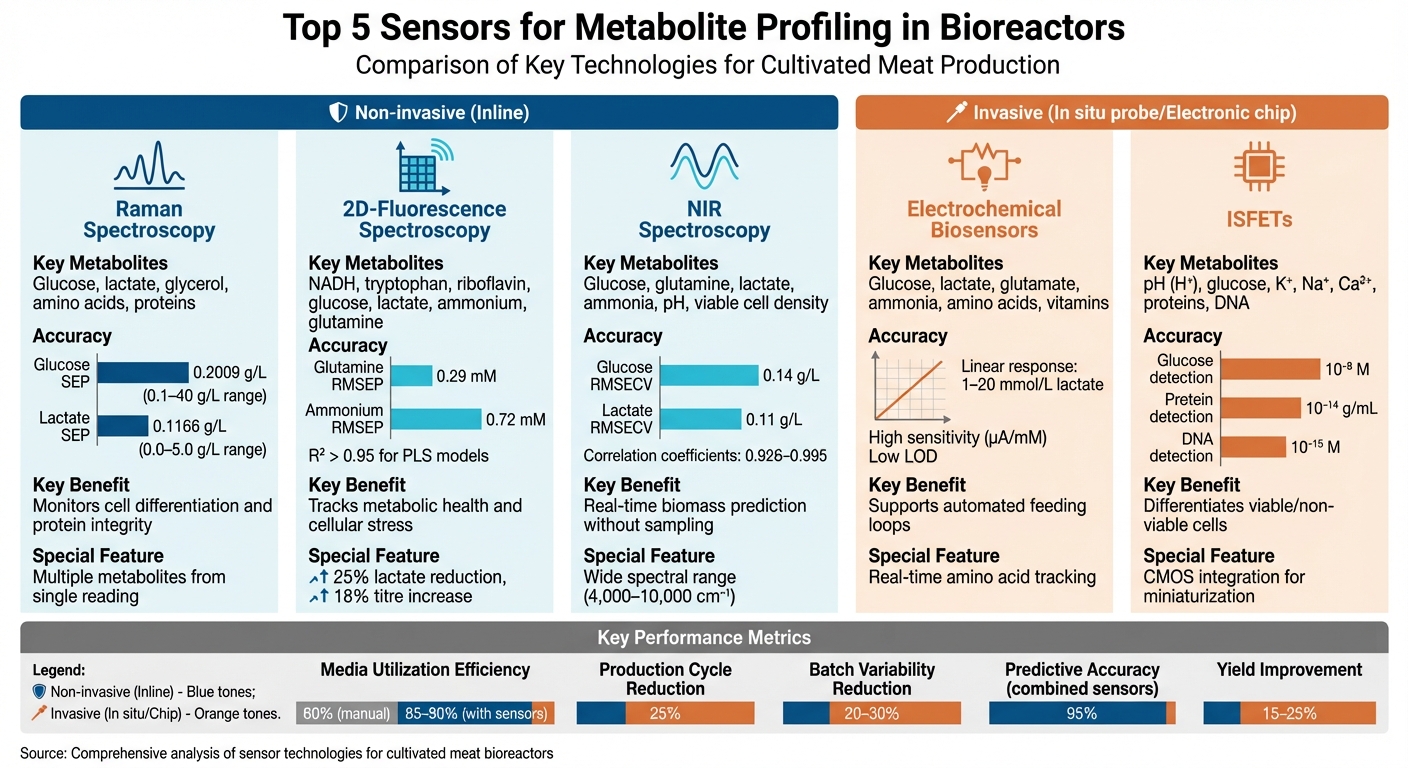
Comparison of Top 5 Metabolite Sensors for Cultivated Meat Bioreactors
Choosing the right sensor for cultivated meat production depends on the target metabolites, level of invasiveness, and specific process parameters. Below is a table summarising key sensor technologies, focusing on their performance characteristics and advantages in this field.
| Sensor Type | Key Metabolites/Parameters | Accuracy & Reliability | Operation Mode | Cultivated Meat Benefit |
|---|---|---|---|---|
| Raman Spectroscopy | Glucose, lactate, glutamine, ammonium, amino acids, proteins | High; requires MVDA models for precision | Non-invasive (Inline) | Monitors cell differentiation and protein integrity |
| 2D-Fluorescence Spectroscopy | Redox state, cellular functioning | High sensitivity to metabolic shifts | Non-invasive (Inline) | Tracks metabolic health and cellular stress |
| NIR Spectroscopy | Total biomass, general metabolites | High for biomass; developing for metabolites | Non-invasive (Inline) | Real-time biomass prediction without sampling |
| Electrochemical Biosensors | Glucose, lactate, glutamate, ammonia | High; fast profiling of specific targets | Invasive (In situ probe) | Supports automated feeding loops |
| ISFETs (FET Biosensors) | pH, ions, proteins, live/dead cell forms | High sensitivity; emerging technology | Invasive (Electronic chip) | Differentiates between viable and non-viable cells |
Non-invasive optical sensors, such as Raman and NIR spectroscopy, are particularly well-suited for maintaining sterility since they don't require physical contact with the culture medium. This is crucial for the fragile nature of cultivated meat cells. On the other hand, invasive sensors like electrochemical biosensors and ISFETs provide direct medium interaction, offering precise, real-time data. However, these require stringent sterilisation protocols to ensure accuracy and hygiene.
David Ede, Process Technology Manager at Sartorius, highlights the adaptability of Raman spectroscopy:
"Raman spectroscopy has been adapted for the measurement of concentrations of many different analytes, including glutamine, ammonium, amino acids, and even proteins." [14]
This adaptability makes Raman spectroscopy a standout choice for detailed metabolite profiling using a single sensor.
Cellbase serves as a bridge, connecting cultivated meat producers with trusted sensor suppliers designed for this specialised industry.
Conclusion
Precise metabolite monitoring is a game-changer for cultivated meat production, as highlighted in the detailed sensor profiles discussed earlier. Technologies like Raman spectroscopy, 2D-fluorescence spectroscopy, NIR spectroscopy, electrochemical biosensors, and ISFETs tackle specific bioprocessing hurdles. Sensor-equipped bioreactors significantly outperform manual systems, achieving 85–90% media utilisation efficiency compared to just 60%, while also cutting production cycles by 25% and reducing batch variability by 20–30% [15][5]. These advancements directly address the challenges faced in optimising bioprocesses.
To fully realise these benefits, it’s crucial to align sensor capabilities with specific production needs. For instance, Raman and NIR are ideal for large-scale bioreactors (over 100 litres) where sterile and non-contact monitoring is critical. On the other hand, electrochemical biosensors are better suited to portable, inline applications requiring quick metabolite detection. Experts have found that combining multiple sensors, such as Raman with ISFETs, can achieve 95% predictive accuracy for metabolic changes, bridging the gap between research and commercial-scale production [2][4]. This tailored approach allows for efficient process adjustments and more consistent production outcomes.
Adopting the right sensor strategy involves targeting key metabolites, maintaining strict sterilisation standards, ensuring rapid response times, and seamlessly integrating sensors into existing bioreactors. Real-time metabolite profiling supports automated feeding systems and timely waste removal, enabling cell densities of up to 10⁸ cells/mL and boosting yields by 15–25% [8][2].
For cultivated meat producers looking for reliable suppliers of Raman probes, NIR systems, biosensors, or bioreactor-integrated ISFETs, Cellbase offers a dedicated B2B marketplace. By providing curated listings and transparent sourcing, the platform simplifies procurement decisions and ensures compatibility with the specialised requirements of cultivated meat production.
FAQs
Which sensor is best for my target metabolites (glucose, lactate, ammonium, glutamine)?
To monitor glucose, lactate, ammonium, and glutamine in cultivated meat bioreactors, the choice of sensors largely depends on your process requirements. For glucose and lactate, enzymatic biosensors or spectroscopic methods are effective. Meanwhile, ion-selective electrodes or optical sensors are suitable for tracking ammonium and glutamine. Make sure to evaluate your specific application and bioreactor setup to determine the most appropriate option.
Do I need non-invasive sensors, or can I use in-line probes without risking sterility?
In the production of cultivated meat using bioreactors, the choice between in-line probes and non-invasive sensors hinges on sterility requirements and specific production goals.
- In-line probes (e.g., RTDs and pH electrodes) are reliable tools when properly sterilised and maintained. They provide direct measurements but require careful handling to ensure sterility.
- Non-invasive sensors, such as spectroscopic sensors, offer an alternative by avoiding direct contact with the culture. This approach helps maintain sterility and lowers the risk of contamination.
Ultimately, the right option depends on the design of your bioreactor and the type of monitoring your process demands.
How do I combine multiple sensors to improve predictive accuracy in a bioreactor?
Combining various sensors improves predictive precision by offering a thorough assessment of essential parameters. Using tools like pH electrodes, dissolved oxygen sensors, Raman analysers, and capacitance sensors together allows for a detailed understanding of bioreactor conditions. Automated systems can then analyse this real-time data with AI or advanced analytics, ensuring precise management of critical factors like pH levels, oxygen availability, and cell health - elements that are crucial for scaling up cultivated meat production.


