

Temperature deviations can lead to spoilage, reduced shelf life, and regulatory compliance issues. Effective monitoring systems ensure safety, quality, and traceability throughout the supply chain. Here's what you need to know:
- Chilled products: Store at 0–4 °C (UK max: 8 °C).
- Frozen products: Maintain at −18 °C or colder (EU deviation limit: −15 °C).
- Pathogen risk: Bacteria thrive from 5 °C to 60 °C, making strict monitoring essential.
Key features of reliable systems:
- Sensor Accuracy: ±0.3–0.5 °C, with 0.1 °C resolution.
- Data Logging: Continuous time–temperature curves, not isolated readings.
- Real-Time Alerts: Cellular trackers for immediate action during transit.
- Compliance: Devices must meet EN 12830 and support HACCP documentation.
Critical areas to monitor:
- Loading/unloading docks, multi-drop delivery routes, and customs delays.
- Place sensors inside product cartons for accurate readings.
Selecting the right system involves mapping your logistics chain, defining temperature thresholds, and choosing devices with suitable features like battery life, connectivity, and alarm functionality. Pilot testing and optimised sensor placement are key to ensuring consistent cold chain integrity.
For cultivated meat R&D and logistics professionals, this guide outlines the technical essentials for safeguarding product quality and meeting regulatory standards.
ColdChain Complete XS - How to Use
Key Requirements for Temperature Monitoring Systems
Temperature monitoring systems for cultivated meat logistics must fulfil three main objectives: aligning temperature profiles with specific product needs, targeting high-risk points in the supply chain, and adhering to UK and EU regulatory standards. These elements form the foundation for evaluating sensor accuracy, reducing risks, and ensuring compliance.
Temperature Ranges and Cold Chain Profiles
Cultivated meat products typically fall into two primary cold chain categories. Chilled products must be stored at 0–4 °C, with UK law enforcing an upper limit of 8 °C. For frozen products, the EU requires temperatures of −18 °C or below, as outlined in Regulation (EC) 37/2005, since deviations above −15 °C can compromise quality. Additionally, intermediate materials, such as cell-derived components, may need tightly controlled ambient conditions. As a result, monitoring systems must accommodate multiple setpoints and provide programmable alarm thresholds to handle varied product requirements.
To meet these demands, sensors should deliver ±0.3–0.5 °C accuracy and a resolution of 0.1 °C, ensuring even minor temperature shifts are detected. Logging intervals should be flexible: 1–5 minutes during transport and handling, and 10–30 minutes for stable storage environments. Importantly, systems must capture a continuous time–temperature curve, not just isolated readings, to help quality assurance teams evaluate cumulative thermal exposure and make informed decisions on batch release.
High-Risk Points in the Logistics Chain
Temperature fluctuations are most likely to occur at specific stages in the logistics chain. Loading and unloading docks are particularly vulnerable, as pallets often remain exposed to ambient conditions during paperwork processing. Additionally, frequent door openings can cause 30–40% of temperature variability inside refrigerated vehicles. Placing sensors directly inside product cartons, rather than on vehicle walls, provides a more accurate reflection of product temperatures.
Multi-drop delivery routes introduce further risks, as each stop exposes the vehicle to external conditions. Studies on last-mile food delivery reveal that over 20% of shipments experience temperature deviations when passive cooling is used without active monitoring. Real-time systems equipped with compartment-level sensors and per-stop reporting can mitigate these issues. Similarly, customs and border inspections, especially on UK–EU routes, can lead to extended delays. Real-time trackers with geofencing and remote alerts enable operators to prioritise handling and prevent compliance breaches caused by prolonged exposure.
Regulatory Compliance in the UK and EU
Although cultivated meat lacks dedicated cold chain regulations, existing standards fully apply. Regulation (EC) 852/2004 requires HACCP-based procedures, including robust temperature monitoring and verification. Regulation (EC) 178/2002 mandates full traceability, linking temperature records to specific batches, suppliers, customers, and timestamps. UK equivalents, such as the Food Safety and Hygiene (England) Regulations 2013, enforce similar requirements.
Monitoring equipment must comply with EN 12830, and data must be exportable in formats like PDF or CSV to meet audit standards for BRCGS, ISO 22000, and FSSC 22000. Calibration records for all sensors should be maintained and updated regularly as part of HACCP verification. Accurate and accessible records not only ensure product quality but also simplify regulatory inspections, supporting seamless tracking throughout the supply chain to maintain product integrity.
Temperature Monitoring Technologies
Sensor Types and Their Applications
The choice of sensor plays a critical role in ensuring accurate temperature data. For cultivated meat logistics, Resistance Temperature Detectors (RTDs), particularly Pt100 types, are the go-to option. These sensors provide precise readings with an accuracy of ±0.3 °C in the essential range of −20 °C to +40 °C [1][2]. Their long-term stability makes them ideal for continuous monitoring in cold chain operations. Additionally, RTDs can operate in extremely low temperatures, down to −196 °C [1], which is crucial for cryogenic cell bank storage often required alongside refrigerated or frozen products.
Thermocouples, on the other hand, can measure temperatures up to 1,100 °C but are less accurate and more prone to drift over time [2]. This makes them better suited for high-temperature industrial settings rather than the tightly controlled conditions of cultivated meat cold chains. Meanwhile, digital sensors, which are often integrated into IoT-enabled devices, provide data in a format ready for cloud transmission. These are commonly used in real-time trackers during transportation [1].
Design considerations are equally important. For instance, vibration-resistant RTDs can handle forces above 60g, ensuring reliability in delivery vehicles [2]. Self-calibrating Pt100 sensors reduce the need for manual recalibration [2]. In sterile environments, such as dispatch-adjacent holding tanks, sensors must meet hygiene standards like 3-A, EHEDG, and FDA and have at least an IP69K ingress protection rating [2]. These standards are essential for maintaining product quality throughout production and logistics.
Next, we’ll examine how data devices complement these sensors for thorough monitoring.
Data Loggers, Indicators, and Real-Time Trackers
Choosing the right device depends on whether immediate action or post-shipment analysis is required.
- Single-use loggers: Small, disposable devices placed in shipments to record data, reviewed upon delivery. These are suitable for less expensive consignments or routes with unreliable connectivity.
- Multi-use loggers: Similar to single-use models but reusable, making them ideal for routine shipments on familiar routes.
- Temperature indicators: Provide a simple pass/fail visual check. While useful for quick verification, they fall short of meeting HACCP documentation needs.
- Real-time cellular trackers: Continuously transmit data over 4G, sending alerts to the cloud when temperature thresholds are breached [1]. These are indispensable for high-value shipments, as they allow for immediate intervention - such as addressing a cooling unit failure - while the shipment is still en route.
Data integrity is a key consideration for real-time devices. Modern cellular trackers can store over 100,000 readings in onboard memory, ensuring no data loss in areas with poor cellular coverage [1]. Once connectivity is restored, all data is synced to the cloud. Devices equipped with GPS and LBS typically last at least 14 days, while LBS-only models can operate for over three months [1].
These devices work alongside fixed systems, ensuring comprehensive monitoring across both transport and storage environments.
Cold Room and Vehicle Monitoring Systems
In cultivated meat logistics, fixed temperature monitoring systems in cold rooms and vehicles must adhere to strict control standards. These systems share core features with in-transit devices, including multi-channel sensor support, cloud connectivity, and audit-ready reporting. Multi-channel loggers are especially useful for monitoring multiple points simultaneously, which is critical for identifying temperature variations in large freezers or multi-compartment vehicles [3]. Such variations could lead to localised product damage or compliance issues that might otherwise go unnoticed.
For vehicles handling multi-drop routes, per-stop reporting combines temperature data with location tracking, making it easier to pinpoint where a temperature excursion occurred [1]. Fixed cold room systems, meanwhile, benefit from GMP-compliant software with automated reporting capabilities. This eliminates the need for manual record-keeping and ensures compliance with standards like BRCGS, ISO 22000, and FSSC 22000 [3]. Additionally, these systems should include calibration traceability linked to sensor serial numbers, simplifying audit processes.
| System Type | Application | Key Feature |
|---|---|---|
| Real-Time Cellular Tracker | In-transit vehicles | 4G/GPS, 24/7 cloud alerts, onboard memory [1] |
| Fixed Multi-Channel Logger | Cold rooms and warehouses | Multi-point mapping, GMP-compliant reporting [3] |
| Sanitary Digital Thermometer | Sterile holding and process areas | IP69K, EHEDG/3-A certified, hygienic design [2] |
sbb-itb-ffee270
How to Select a Temperature Monitoring System: A Step-By-Step Guide
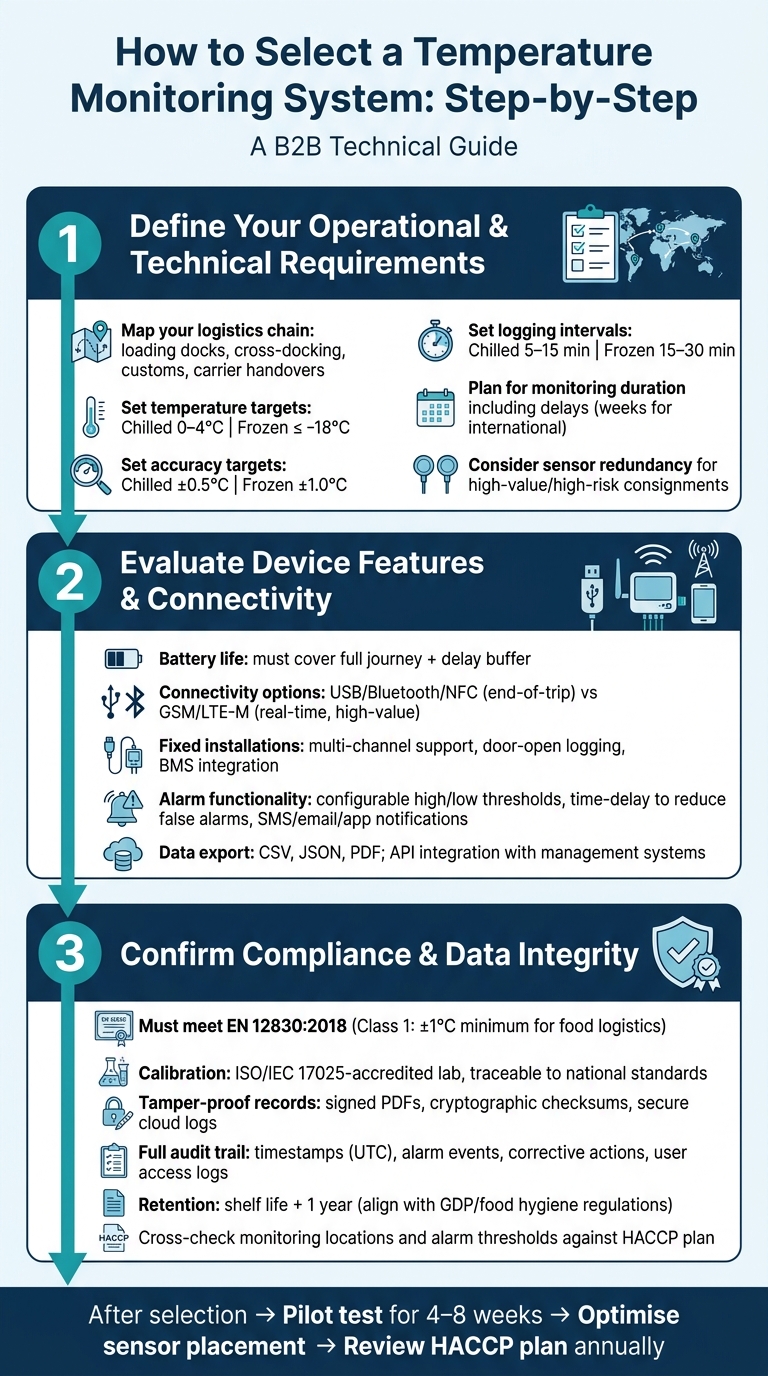
How to Select a Temperature Monitoring System for Cold Chain Logistics
Define Your Operational and Technical Requirements
Start by mapping your entire logistics chain, pinpointing areas where temperature control is critical. These might include loading docks, cross-docking points, customs delays, or carrier handovers. This mapping exercise will inform every decision you make from this point forward.
Next, align your product requirements with established temperature standards: chilled goods typically require 0–4 °C, while frozen products should remain at ≤ −18 °C. Define acceptable temperature excursion limits based on stability data for your specific products. Then, establish technical parameters: chilled monitoring should aim for an accuracy of ±0.5 °C, while frozen monitoring can use a baseline of ±1.0 °C. For logging intervals, 5–15 minutes is ideal for chilled shipments, while 15–30 minutes usually works for frozen goods. These parameters help reduce spoilage risks and ensure compliance, especially in cultivated meat logistics.
Monitoring duration is another key factor. Devices must operate for the entire journey, including potential delays, with a safety margin. For international shipments, this could mean several weeks of continuous operation.
For high-value or high-risk consignments, consider sensor redundancy. Use multiple sensors per pallet, enable real-time alerts, and ensure backup communication channels are in place. Categorising your routes into risk tiers can help strike the right balance between protection and operational simplicity.
Once your requirements are set, move on to examining specific device features and connectivity options.
Evaluate Device Features and Connectivity
With your requirements in hand, evaluating devices becomes a matter of matching features to your needs. Battery life is a critical consideration - it must last through the longest journey, including delays, while ensuring memory capacity can store all readings without overwriting. This is particularly important if data downloads or return logistics might be delayed.
Next, consider connectivity options. For shipments where end-of-trip analysis suffices, USB, Bluetooth, or NFC loggers are suitable. However, for high-value shipments, real-time GSM or LTE-M trackers are better, as they allow for immediate interventions like rerouting or re-icing. For fixed installations, such as cold rooms and vehicles, prioritise devices with multi-channel support, door-open event logging, and integration with building management systems.
Alarm functionality is another essential feature. Alarms should be configurable for high and low temperature thresholds, with time-delay settings to reduce false alarms caused by brief door openings. Notifications via SMS, email, or app ensure that the right people are alerted promptly.
Device compatibility with existing systems is often overlooked but crucial. Ensure that devices can export data in standard formats like CSV, JSON, or PDF, and verify that platform APIs integrate seamlessly with your management systems. This integration streamlines processes like automated release decisions and deviation logging, reducing the risk of manual errors.
After selecting devices, ensure they meet all necessary compliance and data integrity standards.
Confirm Compliance and Data Integrity
Compliance with regulatory standards is a must. In the UK and EU, temperature recorders for chilled and frozen logistics must meet EN 12830:2018. This standard specifies accuracy classes and performance requirements for electronic recorders, with Class 1 devices maintaining accuracy of ±1 °C across their operating range - the minimum acceptable for food logistics. Sensors should also be calibrated by an ISO/IEC 17025-accredited laboratory, with certificates linked to device serial numbers and traceable to national standards. Regular calibration intervals should be integrated into your quality management system.
Data integrity is equally important. Records must be tamper-proof, whether through signed PDFs, cryptographic checksums, or secure cloud logs. Full audit trails are essential, including unambiguous time stamps (e.g., UK time or UTC with offsets) to support investigations. Alarm events, corrective actions, and user access changes should all be logged automatically. Retain records in line with UK and EU food hygiene and traceability regulations. For medicinal products, GDP guidelines recommend keeping records for at least the shelf life plus one year. The same principle applies to high-risk food items.
Finally, cross-check your monitoring locations, logging frequencies, and alarm thresholds against your HACCP plan. Ensure that each control point is monitored and has a documented corrective action procedure in place.
Implementation Tips and Ongoing Improvement
After selecting a temperature monitoring system, proper implementation and consistent refinement are key to maintaining cold chain integrity.
Pilot Testing and Sensor Placement
Before fully rolling out your system, conduct a structured pilot across representative logistics scenarios. This should include chilled storage at 0–4 °C, frozen storage at ≤ −18 °C, and at least one live transport leg. A pilot duration of 4–8 weeks is ideal for cultivated meat products, as it accounts for variables like seasonal weather changes, weekend operations, and peak-season congestion that shorter trials might overlook.
Accurate monitoring depends on strategic sensor placement. Use a grid approach in cold rooms: position loggers in corners, near doors, at both high and low shelf levels, and at the back of the room to pinpoint hot and cold spots. In refrigerated vehicles, place sensors at the front near the evaporator, in the middle of the load, and at the back near the doors, ensuring at least one sensor is at pallet level rather than suspended in free air. For cultivated meat, embed probes within product simulators that replicate the thermal mass of actual products. This helps differentiate between brief ambient fluctuations and genuine temperature changes during events like loading or door openings. Pharmaceutical protocols often use 15–30 sensors to map temperature distributions in cold rooms before determining routine monitoring points [4][5].
After the pilot, identify and validate sensor positions that reliably capture the warmest and coldest spots. Document these positions in standard operating procedures to ensure consistency across sites and vehicles. Once sensor placement is optimised, establish clear alarm protocols to enable prompt responses.
Alarm Thresholds and Corrective Action Protocols
Set alarm thresholds based on product stability data and shelf-life studies, and validate these during the pilot phase. Use a two-tier system: a warning threshold below the critical limit to allow for proactive measures (e.g., checking door seals or adjusting fan speeds) and a critical threshold that demands immediate action, such as quarantining affected lots or halting transport. Time-over-threshold criteria can be applied to filter out transient fluctuations caused by brief events like door openings, ensuring genuine risks are not overlooked.
Maintain a detailed log for every alarm event, including responder actions, timing, and final product outcomes. Integrate this log into your HACCP plan and quality management system to provide auditors with a complete temperature history for any product lot. Regularly review alarm trends on a monthly basis by site and route. This systematic analysis can reveal recurring issues, such as a specific carrier consistently breaching thresholds or repeated failures in cold room door seals, which may not be evident from isolated incidents.
Using Specialist Marketplaces to Source Equipment
Once your monitoring approach is validated, streamline the process of sourcing equipment by using specialist platforms. Procuring temperature monitoring equipment for cultivated meat logistics comes with specific technical challenges: high accuracy requirements, food-grade probe materials, compatibility with bioprocess systems, and compliance with UK food hygiene and HACCP standards. General lab supply catalogues often lack the filtering options or supplier verification needed to meet these demands effectively.
Cellbase provides a verified marketplace designed for these needs. It allows procurement teams to filter equipment by criteria such as measurement range, accuracy class, connectivity type, IP rating, and regulatory compliance. Suppliers can also offer validation support and provide the necessary documentation. For a sector where equipment choices directly impact food safety and regulatory compliance, this focused approach reduces both technical and supplier-related risks.
Conclusion: Getting Cold Chain Monitoring Right for Cultivated Meat
In the UK and EU, cultivated meat production must comply with strict temperature regulations to prevent pathogen growth, ensure product quality, and maintain detailed audit trails [6].
To achieve effective cold chain management, focus on three key steps: establish critical temperature thresholds, optimise sensor placement while automating data logging, and define corrective actions in advance. Additionally, it's important to review HACCP plans and monitoring systems annually or whenever there are changes to processes or equipment [6].
Automation plays a vital role by providing continuous monitoring and addressing the limitations of manual checks, as highlighted by the Food Standards Agency [6]. Once automation is in place, sourcing the right equipment becomes a priority.
Finding compliant equipment can be tricky due to the high standards for accuracy, food safety, and regulatory compliance. Cellbase simplifies this process with a verified marketplace tailored to the cultivated meat sector, helping procurement teams find equipment that fits these exacting needs.
Beyond preventing spoilage, effective monitoring supports traceable audit trails, ensures regulatory compliance, and strengthens brand credibility.
FAQs
Do I need real-time tracking or a data logger?
For cultivated meat logistics, having a system that combines data logging and real-time monitoring is crucial. Data logging creates a comprehensive historical record, essential for regulatory compliance. Meanwhile, real-time monitoring, enabled by IoT sensors, provides instant alerts for any temperature deviations, allowing for swift corrective measures to prevent spoilage. Solutions like those available through Cellbase offer both continuous data recording and real-time visibility, ensuring the cold chain remains intact.
How many sensors should I use per shipment?
The number of sensors you need isn’t set in stone - it depends entirely on your monitoring strategy. Studies indicate that deploying more than 30 sensors offers little added value. In fact, accurate monitoring can often be achieved with just two strategically placed sensors: one positioned at the bottom of the coldest pallet near the refrigeration unit and another at the centre of the warmest pallet, typically near the door. Cellbase provides professionals with the specialised tools required for managing logistics in the cultivated meat industry.
How often should temperature sensors be calibrated?
Temperature sensor calibration frequency in cultivated meat production hinges on several factors, including risk assessments, regulatory guidelines, system importance, and past performance records. In GxP-regulated settings, calibration intervals typically range from quarterly to annually. However, for high-risk processes, monthly calibration may be necessary. Additionally, sensors must be recalibrated following significant events like equipment failures or temperature deviations. Maintaining a well-documented calibration policy is crucial to ensure precise and compliant measurements throughout the production process.


