

For professionals in biotechnology and cultivated meat, regulatory compliance is a major operational hurdle. Both industries face stringent requirements for safety, traceability, and documentation, but they differ in frameworks, timelines, and cost structures. Understanding how biotech has navigated these challenges offers practical strategies for cultivated meat producers to manage costs and meet compliance standards effectively.
Key takeaways:
- Shared Challenges: Both industries rely on controlled bioreactor systems, requiring strict traceability, primary and immortalised cell lines, and audit-ready facilities.
- Regulatory Differences: Biotech adheres to cGMP standards focused on clinical safety, while cultivated meat follows HACCP-based food safety laws.
- Cost Management: Early regulatory engagement, data sharing, and sandbox programmes can reduce compliance costs.
- Documentation Needs: Comprehensive records are critical for traceability and audits, with cultivated meat requiring HACCP-trained staff and POAO-specific labelling.
Quick comparison:
| Aspect | Biotechnology | Cultivated Meat |
|---|---|---|
| Framework | cGMP / Clinical Safety | HACCP / Food Safety Law |
| Traceability | Batch records, raw materials | Cell lineage, culture media |
| Audit Focus | Process consistency, efficacy | Hygiene, labelling, POAO rules |
| Testing | Stability, PTMs, batch runs | Stability, allergens, media |
| Regulatory Pathway | Lengthy but predictable | Fragmented, food-specific rules |
Biotech’s experience underlines the importance of starting compliance efforts early. Tools like regulatory sandboxes and platforms such as Cellbase can help cultivated meat firms streamline processes, reduce costs, and meet safety standards efficiently.
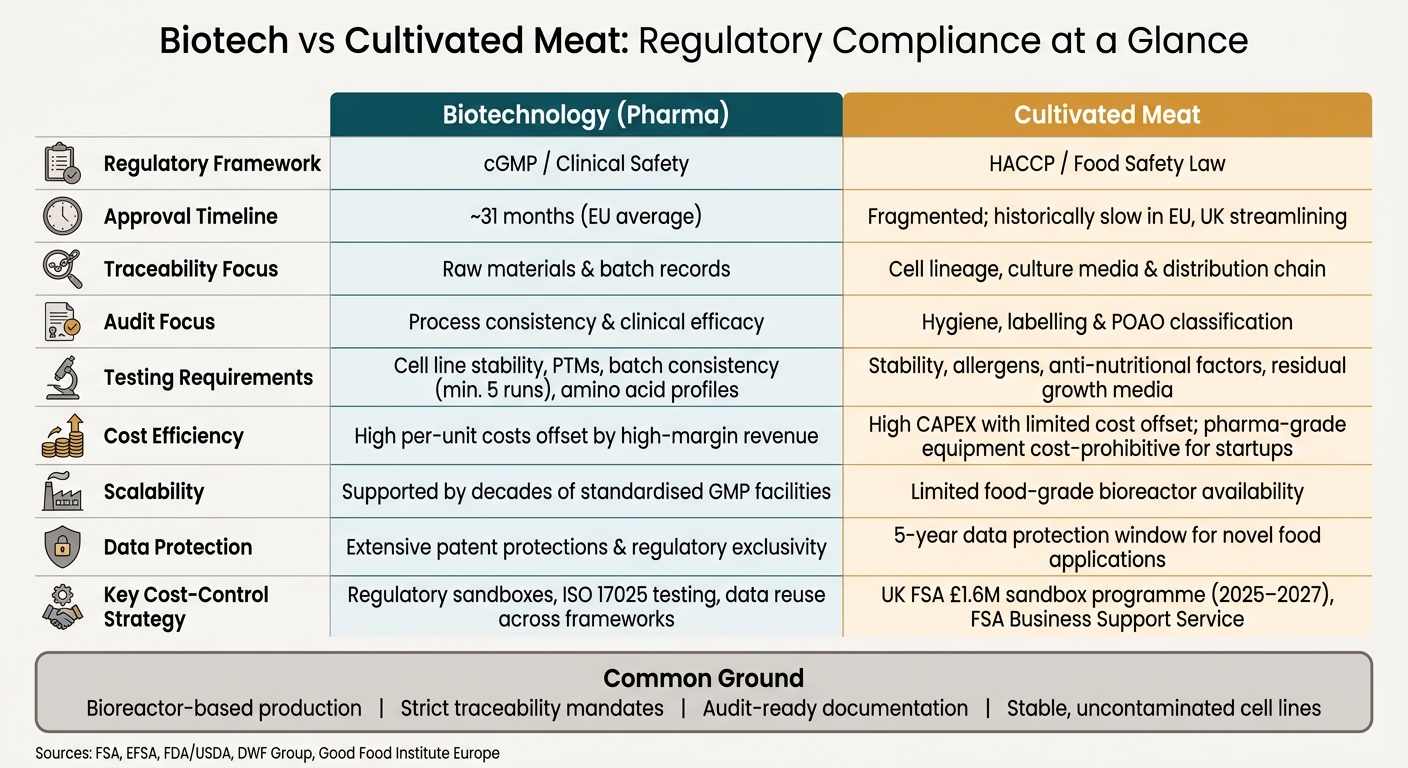
Biotech vs Cultivated Meat: Regulatory Compliance at a Glance
Parallels Between Biotech and Cultivated Meat
Pharmaceutical biotechnology and cultivated meat may deliver different products - medicines versus food - but both hinge on the use of controlled bioreactor systems. In these systems, cells are carefully guided through proliferation and differentiation under strictly regulated conditions. This shared reliance on precision and control brings about similar regulatory expectations for both industries.
Both sectors face stringent requirements from regulators. They must demonstrate that cell lines remain stable and uncontaminated throughout production, ensure that every input - such as culture media and growth factors - is fully traceable, and maintain facilities that are always audit-ready. As the Food Standards Agency emphasises:
"HACCP plans, as well as being a legal requirement, are the cornerstone of the food safety management system in all food production premises" [1]
This principle applies equally, whether the final product is a biopharmaceutical or cultivated meat.
Traceability is one of the most striking parallels. In biotechnology, current Good Manufacturing Practice (cGMP) mandates detailed batch records, tracking every step from raw material intake to the final product. Similarly, under General Food Law, cultivated meat production must document the entire cell lineage, from the initial biopsy to the harvested product. The rationale behind this is the same: if an issue arises, regulators need a clear chain of evidence to pinpoint the source of the problem.
Maintaining thorough documentation is critical for both traceability and audit readiness. Audit readiness in both industries involves adhering to strict SOPs for sterilisation, cleaning, and training. For cultivated meat, at least one HACCP team member must hold Level 4 HACCP training to ensure the food safety management system is robust [1]. These practices allow cultivated meat companies to manage compliance costs effectively while maintaining safety.
While biotech audits prioritise process consistency and clinical efficacy, cultivated meat audits also extend to food-specific concerns such as hygiene, accurate labelling, and classification as a Product of Animal Origin (POAO). This means that cultivated meat companies must adapt their compliance frameworks to fit food safety laws rather than directly applying biotech protocols.
| Compliance Driver | Biotechnology | Cultivated Meat |
|---|---|---|
| Primary Framework | cGMP / Clinical Safety | HACCP / Food Safety Law |
| Traceability Focus | Raw materials & batch records | Cell inputs, media & distribution chain |
| Audit Focus | Process consistency & efficacy | Hygiene, labelling & POAO classification |
| Testing Requirements | Cell line stability & purity | Stability, purity, allergens & anti-nutritional factors |
Cultivated meat producers can draw on biotech's expertise in documentation, monitoring critical control points, and ensuring supply chain traceability. However, they should adapt these practices to meet food safety requirements rather than mirroring biotech systems entirely. Platforms like Cellbase offer solutions to simplify compliance processes while keeping costs under control.
sbb-itb-ffee270
1. Biotechnology Industry
Regulatory Pathway Complexity
Entering the biotech market is a time-intensive process. For instance, securing approvals in the EU takes an average of 31 months, compared to just 12 months under GRAS regulations in the United States[6]. This extended timeline directly impacts European biotech firms by increasing R&D costs, delaying revenue generation, and prolonging operational expenses and scaling challenges.
Testing Intensity
Meeting regulatory requirements involves extensive analytical testing. Companies must provide detailed amino acid profiles, perform in vitro protein digestibility studies (DIAAS), and use mass spectrometry to identify post-translational modifications (PTMs)[7]. Regulators also demand proof of batch consistency across at least five production runs, ensuring that the manufacturing process is well-controlled and yields uniform products[7].
However, the lack of coordinated data sharing can inflate costs. A striking example comes from the CBD sector, where over 19 separate applications were submitted to EFSA, many of which duplicated safety studies unnecessarily. A more collaborative approach could have significantly reduced these redundant expenses[6].
Documentation and Quality Systems
Regulatory uncertainty presents another financial burden. When approval standards shift mid-process, companies must adjust their evidence packages, often at great cost. Dominic Watkins, Partner and Global Head of Consumer Sector at DWF Group, referred to this as "moving the goalposts"[8].
Maintaining audit-ready documentation under such conditions requires robust systems and dedicated compliance teams. For smaller firms, which lack the resources of larger pharmaceutical companies, this can be particularly challenging. These documentation hurdles have driven the adoption of innovative strategies to manage costs.
Cost-Control Tactics
One effective strategy to manage these challenges is early regulatory engagement. Structured regulatory sandboxes - frameworks that allow companies to test and refine data generation methods before formal authorisation - are becoming increasingly popular. These initiatives have proven valuable in reducing expensive late-stage failures[6].
"Sandbox access would allow government and industry bodies to pool funding around shared data challenges, reducing unnecessary duplication."
- Dr. Mark Tallon, Managing Partner, Legal Foods[6]
Another cost-saving approach involves reusing validated data from additive or processing aid frameworks for novel food applications[6]. Additionally, employing ISO 17025 accredited testing methods ensures reproducible results suitable for international dossier submissions[7]. Together, these strategies help companies control compliance costs while maintaining the necessary scientific rigour.
2. Cultivated Meat Industry
Regulatory Pathway Complexity
The cultivated meat industry, much like the biotech sector, operates within a fragmented and complex regulatory environment. In the United States, oversight is split between the FDA and USDA. The FDA oversees early-stage activities, such as cell banking and growth, while the USDA's Food Safety and Inspection Service (FSIS) takes charge of harvest, processing, and labelling stages [5]. As of March 2025, only five cultivated protein products have successfully navigated this dual-agency review process, highlighting the challenges and early-stage nature of the industry [5]. Adding to this complexity, state-level bans in regions like Mississippi, Montana, and Nebraska create additional legal hurdles, further increasing compliance costs and delaying market entry.
"For companies evaluating opportunities in this sector, regulatory strategy is quickly becoming as critical as technological capability." - Claudia Vetesi, J.D., Partner at Morrison Foerster [5]
Testing Intensity
Testing requirements for cultivated meat go far beyond standard food safety protocols. Regulators demand detailed hazard analyses covering cell line identity, consistency, and divergence. This also includes assessing residual growth media and anti-nutritional factors [1]. In the UK and EU, cultivated products are categorised as Products of Animal Origin (POAO). However, since they do not involve animal slaughter, they fall outside traditional meat hygiene frameworks, leading to additional evidencing costs [1][3].
When genetic modification is part of the production process, the regulatory challenge intensifies. Such products must comply with GMO-specific regulations, which are stricter than the Novel Food pathway alone [3]. This dual-layered framework, while reminiscent of biotech, introduces food-specific assessments like allergenicity and nutritional equivalence.
Documentation and Quality Systems
Producers of cultivated meat must maintain comprehensive, audit-ready documentation. This includes implementing HACCP plans, often requiring Level 4-trained staff, and ensuring compliance with individual labelling requirements in the US [1][4]. For instance, labels for cultivated meat and poultry in the US must undergo prior review by the USDA's Labelling and Program Delivery Staff, which adds time to the commercialisation process [4].
Cost-Control Tactics
To address the high costs associated with regulatory compliance, government-funded regulatory sandboxes have emerged as a practical solution. In February 2025, the UK government allocated £1.6 million to the Food Standards Agency and Food Standards Scotland for a two-year sandbox programme running until February 2027 [3]. This initiative involves key players like Mosa Meat, BlueNalu, and Hoxton Farms, alongside academic institutions such as the National Alternative Protein Innovation Centre. Together, they are working with regulators to create technical guidance on microbiology, toxicology, and production methods, reducing the likelihood of late-stage dossier failures [3].
Early engagement with regulatory support services can also help manage costs. For example, the FSA's Business Support Service provides pre-submission advice on allergenicity and nutritional data, enabling companies to align their testing protocols with regulatory expectations before scaling up [3]. Additionally, platforms like Cellbase streamline the sourcing of verified, GMP-compliant equipment, further aiding cost management. These strategies, borrowed from biotech, are proving effective in controlling regulatory expenditures in the cultivated meat sector.
Pros and Cons
When comparing the regulatory landscapes of biotechnology and cultivated meat, it’s clear that both sectors face hefty compliance demands but under vastly different conditions. Biotechnology benefits from decades of Good Manufacturing Practice (GMP) standards, a skilled workforce, and the ability to absorb high regulatory costs thanks to its high-margin products. Cultivated meat, on the other hand, contends with similar regulatory expectations but without the same infrastructure or pricing advantages.
Here’s a breakdown of how these industries compare across key compliance strategy areas:
| Area | Biotechnology (Pharma) | Cultivated Meat Industry |
|---|---|---|
| Cost Efficiency | High per-unit costs are manageable due to established, high-margin revenue pathways | High capital expenditure (CAPEX) with limited offset; pharmaceutical-grade equipment is cost-prohibitive for startups [8] |
| Scalability | Supported by decades of standardised GMP facilities | Faces hurdles due to limited availability of food-grade bioreactors [2] |
| Compliance Readiness | Strong, with well-defined frameworks and predictable milestones | Developing, aided by regulatory sandboxes and HACCP-based guidance [1] |
| Regulatory Speed | Lengthy but predictable multi-phase trials | Historically slow in the EU; the UK aims to streamline processes [3] |
| Data Protection | Robust, with extensive patent protections and regulatory exclusivity | Limited, offering a five-year data protection window for novel food applications [3] |
The most striking contrast lies in scalability. While biotechnology enjoys the support of mature GMP infrastructure, cultivated meat struggles with the lack of food-grade bioreactor capacity. This challenge is compounded by the financial strain of scaling up, as Linus Pardoe, Senior UK Policy Manager at the Good Food Institute Europe, explains:
"If you want to scale your processes, you must invest in expensive capital equipment or contract pharmaceutical-grade facilities. Both of those are extremely expensive, potentially prohibitively so for small start-ups." [8]
Biotechnology offsets these costs through established revenue streams and high-margin products - an advantage that cultivated meat producers have yet to achieve. Despite this, the cultivated meat sector can draw valuable lessons from biotech, particularly in prioritising early compliance readiness.
There are also structural benefits for cultivated meat. For instance, the UK's five-year data protection provision incentivises companies to invest in thorough regulatory dossiers early on [3]. The takeaway from biotech is straightforward: investing in compliance readiness from the start can yield significant long-term benefits.
Conclusion
When comparing biotechnology and cultivated meat, one thing becomes clear: regulatory compliance is not something to address at the last minute. Biotech's experience demonstrates that engaging with regulators early, prioritising high-quality dossier preparation, and establishing standardised processes from the outset are key to reaching the market faster and with lower costs. These lessons offer a roadmap for cultivated meat companies aiming to navigate the regulatory landscape effectively.
For cultivated meat producers, the message is straightforward. Initiatives like the UK Food Standards Agency's sandbox programme - featuring participants such as Mosa Meat, Hoxton Farms, and Roslin Technologies - provide a valuable opportunity to build relationships with regulators and refine safety data for growth media before formal submissions. This proactive approach has become a crucial advantage in a competitive field [3][8]. As Claudia Vetesi, Partner at Morrison Foerster, aptly states:
"Regulatory strategy is quickly becoming as critical as technological capability." [5]
An essential aspect of this strategy is ensuring supplier reliability. General food law mandates comprehensive traceability for all inputs, and gaps in this chain can make or break a compliance dossier. Early procurement planning is critical here. Tools like Cellbase streamline this process by connecting cultivated meat companies with verified suppliers of specialised equipment and materials. This reduces sourcing challenges that could otherwise delay regulatory approvals.
Ultimately, the biotech sector's experience highlights the value of prioritising compliance as a strategic investment rather than chasing speed. Companies that adopt this disciplined approach are better equipped to attract funding, scale operations efficiently, and bring their products to market on their own terms.
FAQs
What’s the biggest compliance cost driver for cultivated meat?
One of the biggest challenges for cultivated meat companies lies in the preparation of regulatory dossiers required for product approval. These dossiers demand extensive safety data, which can take more than two-and-a-half years to compile. The process also involves substantial investment in both legal and technical expertise.
On top of that, companies often need to upgrade their facilities with specialised infrastructure to meet stringent safety standards, which further drives up costs. To help navigate these hurdles, Cellbase offers a trusted B2B marketplace, simplifying the sourcing of essential equipment and materials needed for compliance.
How can cultivated meat firms reuse biotech compliance practices without overbuilding GMP?
Cultivated meat companies can streamline their compliance efforts by borrowing key practices from the biotech sector. A strong emphasis on sterility and quality control is crucial, but there's no need to overcomplicate things with pharmaceutical-grade setups if they're not required. Instead, employing validation protocols for equipment, materials, and processes ensures safety and consistency without inflating costs or complexity.
Tools like HACCP analysis (Hazard Analysis and Critical Control Points) are particularly useful for pinpointing and managing risks at critical stages of production. To support these efforts, Cellbase connects companies with reliable sources for equipment and materials, helping them establish infrastructure that is both efficient and compliant.
What should I prepare before engaging regulators or joining a regulatory sandbox?
Before approaching regulators or participating in a regulatory sandbox, it’s crucial to have a thorough grasp of your product’s safety profile and production processes. Reach out to the Business Support Service (BSS) at least six months before submitting your application. Be prepared to share detailed data, including:
- Hazard identification
- Manufacturing methods
- Potential risks (toxicological or microbiological)
- Allergenicity
- Nutritional quality
Tools like Cellbase can assist in sourcing high-quality materials that align with these stringent requirements.


