

If you work on cultivated meat process design, spent media is not just a waste stream. I’d treat it as a composition-driven side stream that can go in seven different directions: nutrient recovery, amino acid fractionation, salt and mineral recovery, water reuse, feedstock conversion, secondary fermentation inputs, or analytical benchmarking.
Here’s the short version: the right route depends on what is left in the media after culture, how the bioreactor is run, and how much clean-up the stream needs before reuse or conversion. Batch and fed-batch runs usually leave higher lactate, ammonia, solids, osmolality drift and pH shift. Perfusion gives a more dilute stream, often with lower solids, but it usually needs concentration before recovery. Chemically defined, serum-free media make separation easier because background protein load is lower.
Before I’d spend time on any route, I’d check four things first:
- Impurity load: amino acids, glucose, lactate, ammonia, proteins, DNA, salts and any residual factors
- Filtration demand: solids loading, membrane compatibility and flux at process-relevant cell density
- Batch consistency: whether the target fraction stays stable across runs and culture phases
- Qualification data: whether the recovered stream is clean enough for its next use
One data point in the article stands out: a 2026 University of Queensland study reported that Chlorella BDH-1 grown on spent cultivated meat media supported a 50% cut in serum and amino acid inputs and improved muscle cell growth by 40% in that setup. But that route still depends on separation, sterilisation, hydrolysis and batch-to-batch control.
What you’ll get from this article
I’ll walk through:
- when nutrient recovery makes sense
- where amino acid fractionation fits
- how salt and mineral recovery links to downstream water loops
- what limits water reuse
- when feedstock conversion is a better fit than direct recovery
- how secondary fermentation inputs differ from internal reuse
- why analytical benchmarking is the gate before all other paths
Quick comparison
| Pathway | Main output | Main issue to solve | Main proof needed |
|---|---|---|---|
| Nutrient recovery | Residual nutrient fraction or biomass-derived intermediate | Debris and host-cell protein carryover | Cell-growth data on recovered fraction |
| Amino acid fractionation | Free amino acid-rich permeate | Fouling and small-molecule selectivity | Recovery vs protein/DNA carryover data |
| Salt and mineral recovery | Ionic fraction | Organic carryover and membrane fouling | Elemental profile and run-length data |
| Water reuse | Reclaimed process water | Residual organics, salts and sterility control | Flux, conductivity, endotoxin and polishing data |
| Feedstock conversion | Biomass or lysate | Conversion consistency and biomass separation | Return-stream specification and performance data |
| Secondary fermentation inputs | Feed for another organism | Inhibitors, bioburden and impurity load | Growth, sterilisation and composition data |
| Analytical benchmarking | Composition data | Sampling quality and assay scope | Multi-target assay reports and traceable records |
In other words: if you don’t know the stream composition at each process phase, you can’t pick the right co-product pathway with confidence. This article lays out the seven routes in a way you can screen before supplier talks or pilot work.
How Spent Media Composition Shapes Downstream Options
Once you know what is in the spent media, the next job is simple in principle: match that stream to a downstream route that can handle it.
How batch, fed-batch and perfusion change stream composition
Bioreactor mode has a direct effect on spent-stream composition, and that shapes which recovery routes are even worth considering.
In batch and fed-batch culture, nutrients are depleted over time. At the same time, lactate, ammonia and solids build up. By harvest, pH has often drifted and osmolality is higher, which makes direct reuse hard to justify.
Perfusion behaves differently. Media is exchanged continuously, so metabolite levels stay lower and the spent stream is more dilute. When cell-retention technology is used, solids loading also drops. That sounds cleaner on paper, but there is a trade-off: perfusion gives you a continuous dilute stream, and that stream usually needs a concentration step before recovery.
Why chemically defined and serum-free media matter
Media formulation also affects how cleanly you can separate fractions downstream. Chemically defined, serum-free formulations remove the variable protein load linked to animal-derived components. In practice, serum-free media lower background protein levels and make downstream fractionation more predictable.
How cell line behaviour affects recoverable fractions
Cell lines do not behave the same way. Nutrient uptake shifts from line to line, and metabolite output changes with both the cell type and the culture phase. That means the target fraction can also change across a run.
So it is not enough to treat spent media as one uniform feedstock. Teams should characterise the stream at each phase separately.
Four technical checks used across all seven pathways
Before committing to any of the seven pathways described in this article, the same four checks apply no matter what you want to recover:
- Impurity load - measure residual amino acids, metabolites, growth factors and other contaminants.
- Filtration demand - quantify solids loading and confirm compatibility with the intended separation step. High-density cultures can reach 130 billion cells per litre [3], so filtration flux data at that density is needed before selecting a pathway.
- Recoverable fraction consistency - verify that the target fraction is stable and reproducible across batches. If the stream moves around too much, any secondary process built on it becomes hard to control.
- Qualification evidence - confirm whether recovered fractions meet the required standard for the intended reuse route.
These four checks come up again and again in the sections that follow. They are a practical screen to apply before supplier discussions.
What Procurement Teams Should Ask Suppliers Before Evaluating Any Pathway
The four checks above should turn into a supplier data request. Before procurement teams shortlist any equipment or service provider for a spent-media valorisation route, they should set the minimum data package they expect to receive - and ask for it at the start.
Core performance data to request
To verify the four technical checks, ask suppliers for mass balance closure and recovery yield. Request measured yields from long-duration, representative runs, not modelled projections. That matters because bench-top figures can look tidy, then fall apart when the run gets longer or the feed shifts a bit.
Yield on its own doesn't tell the whole story. Also ask for component rejection rates, throughput ranges under representative operating conditions, and stability data that shows performance stays consistent across batches.
Contamination and cleaning data to request
Yield data alone is not enough. Cleaning and fouling often decide whether a process can run more than once without turning into a headache. Separation hardware should be judged on more than flow rates, because a nice headline number means little if the system blinds, plugs or drifts after repeated exposure to the stream.
Ask for fouling rate data under conditions that match your stream, along with cleaning validation records showing that the selected cleaning-in-place (CIP) or sanitisation protocol is validated for the intended use.
For any fraction intended for reuse - whether as a fermentation input, a nutrient supplement or an analytical reference - also request microbiological, endotoxin and host-cell DNA clearance data. Those data points determine whether a recovered fraction can be qualified for its downstream application.
Materials, throughput and compliance documents to request
Materials compatibility often gets missed during shortlisting. Check that wetted parts, seals and membranes are compatible with the target stream and the planned cleaning chemistry. Ask whether the equipment can support food-use ingredient processing conditions, especially if that is the intended output.
On compliance, request documents tied to UK regulatory requirements, including Environment Agency guidance on waste and by-product classification, plus evidence of supply-chain traceability records. For liquid streams, ask for batch release records for any liquid fraction, including terminal filtration and aseptic filling validation.
Using Cellbase to identify relevant suppliers
Once the document pack is defined, procurement teams can use Cellbase to find suppliers that match those requirements. Cellbase helps teams identify suppliers for filtration, separation, analytical and process hardware linked to spent-media handling.
With this data package in hand, each pathway can be compared on the same technical basis.
1. Nutrient Recovery
Nutrient recovery focuses on residual amino acids, vitamins and minerals in clarified spent media. The output can be a recovered nutrient concentrate or a biomass-based intermediate for reuse. This route makes the most sense when the aim is either direct reuse of residual nutrients or indirect recovery through a biological upcycling step.
In this stream, the main impurity load for this pathway is usually host-cell proteins and cell debris. Tangential flow filtration (TFF) can be used to clarify the stream before recovery. After clarification, the stream may support direct nutrient reuse or serve as feed for a secondary biomass process.
One indirect route is microalgae conversion. In August 2026, researchers at the University of Queensland, led by Melanie Oey in partnership with Magic Valley, published a study in Food Research International showing that Chlorella BDH-1 grown on spent cultivated meat media could substitute for a 50% reduction in serum and amino acids while improving muscle cell growth by 40% [4]. That’s a striking result, but the processing steps matter. Mammalian cells and algae must be separated, and the lysate must be sterilised and hydrolysed before reuse.
For procurement teams, the checklist is fairly plain:
- TFF performance
- Fouling behaviour
- Cleaning validation
- Sterilisation data
- Cell-growth evidence for the recovered fraction
If microalgae conversion is part of the process, ask for sterilisation and hydrolysis validation for the lysate-processing stage as well. And for food-use suitability, rely on empirical cell-performance data, not supplier claims. The main decision point is simple: does the recovered fraction meet the target cell-performance and hygiene data for reuse?
2. Amino Acid Fractionation
If broad nutrient recovery is too blunt, amino acid fractionation gives you a tighter, more controllable output stream. The focus here is the clarified, low-molecular-weight permeate: residual free amino acids plus other small nutrients. With chemically defined, serum-free media, the separation is cleaner because there is less background protein to deal with.
That said, this stream is not clean enough to use as-is. It still contains proteins, DNA and other metabolites, and those need to be handled before the amino acid fraction is fit for reuse. The usual starting point is biomass separation, followed by TFF ultrafiltration or membrane stacks to strip out proteins and DNA while leaving a small-molecule permeate behind. These unit operations are often limited by fouling, so any supplier review should include membrane performance and membrane-stack longevity under run lengths that match plant conditions [3].
Process design on its own is not enough. You also need qualification data. In January 2026, Upside Foods launched Lucius Labs, which offers assays covering 63 targets, including amino acids and minerals, using methods that require ten times less biomass than legacy approaches [6]. In practice, that makes multi-analyte panels a sensible choice, since they can measure amino acids, minerals and carryover contaminants in one go.
The qualification bar also matters. Assess the recovered fraction against food-grade purity and performance targets, not pharma-grade ones.
For procurement teams, the key checks are fairly straightforward:
- TFF performance and membrane-stack longevity data across multi-day runs
- Flux maintenance and fouling behaviour during continuous operation
- Selectivity data showing amino acid recovery versus protein and DNA carryover
- Comparative cell-performance evidence showing that the fractionated output supports the target cell line
- Raw-material characterisation and qualification documentation
Without that data, reuse becomes hard to justify. The remaining permeate can then move into salt and mineral recovery.
3. Salt and Mineral Recovery
This step starts where amino acid recovery stops. What’s left is mostly salts, minerals, and other small ions.
These residual salts and minerals are the same components used to control osmolality and pH upstream, and they can also be recovered. The upstream process mode affects how concentrated this ionic fraction becomes, so run-length data matters before you build a recovery step around it.
The main problem is biomolecule carryover. If proteins, peptides, or other organics remain in the stream, purification gets harder and the recovered fraction is less clean. Serum-free, food-grade media make this step easier because they reduce the purification burden and improve fraction quality.
In practice, the usual sequence is to clarify first, then apply TFF to remove biomolecules and concentrate the inorganic fraction. That sounds simple on paper, but membrane fouling can build up over multi-day runs. Because of that, one of the first things to check is membrane performance under real operating conditions, not a short bench test.
For procurement teams, the supplier data worth asking for includes:
- Elemental profiling - request multi-analyte data for key salts and trace minerals to confirm what is recoverable.
- TFF flux and fouling data from production-length runs.
- Food-use compatibility and cleaning-chemistry evidence.
- Cleaning validation showing no cross-contamination between batches.
- Process stability data from continuous manufacturing runs, not just batch trials, if your facility operates in continuous mode.
Elemental data and fouling data tell you whether the recovered fraction is consistent enough for the next step. Once salts and minerals are removed, the clarified permeate becomes the feed for water reuse.
sbb-itb-ffee270
4. Water Reuse
After salt and mineral recovery, the remaining permeate becomes the feed stream for water reuse. Even after clarification, that permeate still contains organic and mineral contaminants. Those residuals set the practical limit for how far the water can be reused on-site.
Serum-free, animal-free media reduce organic load and membrane fouling [2][3]. That matters more than it might seem at first glance. A lower foulant load can ease the duty on the reuse train and cut the level of clarification and polishing needed downstream. Procurement teams should confirm media grade early, because moving from pharma-grade to food-grade ingredients changes the impurity profile and, with it, the filtration stringency required [5].
A typical treatment train starts with clarification to remove residual biomass and microcarriers. It then moves to membrane filtration, followed by a final polishing or sterilisation step. High-Temperature-Short-Time (HTST) sterilisation is one terminal-stage option, so suppliers should confirm that their media components are compatible with it. Secondary processes, such as microalgae cultivation, can also reduce the polishing load before reuse.
Procurement teams should ask for:
- Continuous TFF performance data
- HTST compatibility
- Multi-target analytical benchmarking
- Upstream traceability records [2][3][6]
Without upstream traceability, contaminant prediction becomes uncertain, and polishing design is much harder to size with confidence.
Once water reuse is defined, the next step is to assess whether the remaining stream still has enough value to convert into feedstock.
5. Feedstock Conversion
When the remaining stream is too dilute to fractionate, the next option is to convert it into biomass or lysate. Residual amino acids and glucose can support microalgal growth, and that biomass can then be processed into a usable lysate. In continuous systems, TFF helps keep the feed profile more stable during conversion. Chemically defined, serum-free media also reduce carryover, which makes the conversion step easier to predict.
A recent University of Queensland study used Chlorella BDH-1 grown on spent media, demonstrating that spent cultivated meat media can be converted into an algal lysate suitable for return to the primary culture [4]. The main operational question is simple: does that converted output return to the process with the same composition and performance each time?
The main constraints are biomass separation, microcarrier removal, and light delivery in co-culture [4][7]. Before evaluating a feedstock conversion system, procurement teams should ask suppliers for:
- Secondary organism yield and conversion efficiency - measured output from spent media to usable lysate, not modelled projections [4]
- Biomass separation and sterilisation validation - including terminal filtration and any HTST step used at scale [2]
- Returned-feed consistency data - mass balance and recovered-stream specification showing that the converted feedstock performs reliably when returned to the primary culture [3][4]
If conversion cannot deliver a consistent return stream, the next route is secondary fermentation inputs.
6. Secondary Fermentation Inputs
When feedstock conversion is too indirect, spent media can support a separate fermentation step instead. In this setup, the spent stream becomes the substrate for another organism that makes microbial biomass or ingredient intermediates. Microalgae such as Chlorella BDH-1 can turn residual nutrients into biomass or lysate for reuse. A recent University of Queensland study shows what that looks like in practice.
In August 2026, researchers led by Melanie Oey in collaboration with Magic Valley published findings in Food Research International showing that algal lysate grown on spent cultivated meat media could substitute for 50% of required amino acids and serum, while exceeding standard growth medium performance twofold [4].
Chemically defined, serum-free media and stable continuous feeds make transfer to a secondary organism easier. Microcarriers must be removed before transfer.
Host cell proteins, lipids, antifoam residues, debris, bioburden and endotoxin also need to come down before reuse. TFF can clarify the stream, while terminal filtration or HTST can control bioburden [2][3].
This route only works when the feed is clean enough for the secondary organism. Before moving ahead, procurement teams should ask suppliers for:
- Secondary organism growth performance on actual spent media - measured yield data using the specific spent stream composition from your process [4]
- Clarification and filtration validation - TFF membrane performance, depth filter loading capacity, and HTST or terminal filtration logs showing bioburden control [2][3]
- Inhibitor and impurity profiling - documented levels of host cell proteins, lipids, antifoam residues, debris and endotoxin in the feed stream
- Output consistency data - batch-to-batch compositional analysis covering amino acids, minerals and trace elements [6]
7. Analytical Benchmarking
Analytical benchmarking is not a recovery route. It’s the diagnostic step that underpins every route. Without it, procurement teams are left guessing about composition, impurity load, and whether a downstream path is even worth testing. Put simply: this is how you decide which of the other six routes deserves technical time.
Assay breadth matters. Modern analytical services for spent media can measure at least 63 distinct targets, including specific amino acids, minerals, and trace elements [6]. That range makes it much easier to match a given spent stream to the right route, instead of forcing a route onto a stream that doesn’t fit.
Sampling also has to match the process mode. Perfusion and continuous runs produce spent streams with impurity profiles that look very different from batch processes. At high cell densities, steady-state impurity data tells you far more than a single end-of-batch sample.
Before committing to any valorisation pathway, procurement teams should ask analytical suppliers for:
- Broad-spectrum assay reports covering 60+ targets, including amino acids, minerals, and elemental impurities, from the spent stream in your process [6]
- Steady-state sampling data from continuous or perfusion runs, showing how impurity concentrations build over time rather than at one end-of-batch point [3]
- TFF and filtration performance logs - flux rates and biomass yield figures - to confirm separation performance before any downstream unit operation [3]
- Batch certificates of analysis and traceable delivery records for all media batches, especially where food-grade ingredients have replaced pharma-grade equivalents [2][5]
Those results feed the side-by-side comparison below.
Comparing the Seven Pathways Side by Side
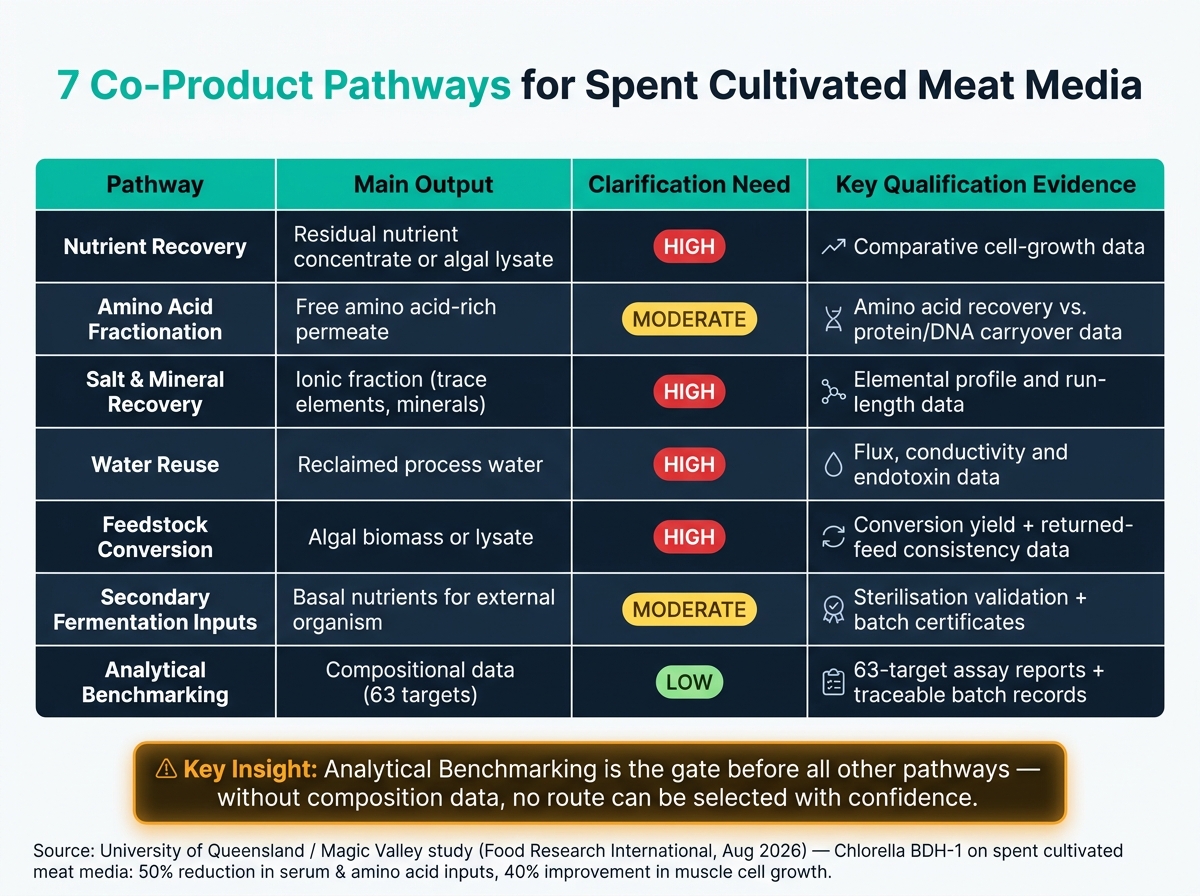
7 Co-Product Pathways for Spent Cultivated Meat Media
Once you have supplier data, the next step is to compare each route on the same technical basis. In practice, the best pathway comes down to two things: how much of the target fraction you can recover, and how much clean-up it takes before reuse. The tables below line up impurity burden, downstream steps, and the proof needed to qualify each route.
Table 1: Target Fraction, Impurities and Clarification Needs
| Pathway | Target Fraction | Dominant Impurities | Clarification Needs |
|---|---|---|---|
| Nutrient Recovery | Residual amino acids and growth factors | Metabolic by-products, cell debris | High - biomass separation |
| Amino Acid Fractionation | Specific amino acid groups | Lactate, ammonia, salts | Moderate - TFF or membrane filtration |
| Salt and Mineral Recovery | Trace elements, minerals | Organic metabolites, residual proteins | High - purification plus ion exchange |
| Water Reuse | Process water | Dissolved salts, metabolites | High - clarification plus membrane polishing |
| Feedstock Conversion | Algal biomass, lysate | Spent nutrients, metabolic residues | High - biomass separation |
| Secondary Fermentation Inputs | Basal nutrients | Mammalian cell fragments | Moderate - HTST sterilisation |
| Analytical Benchmarking | Compositional data (63 targets) | Not applicable | Low - samples ready for assay |
A quick read of Table 1 shows a clear split. Analytical Benchmarking sits at the low-intervention end: samples are already in a form suitable for assay. At the other end, Nutrient Recovery, Feedstock Conversion, and Water Reuse all need heavy clarification because the recovered stream still carries biomass, dissolved metabolites, or both.
Amino Acid Fractionation and Secondary Fermentation Inputs land somewhere in the middle. They still need treatment, but the separation problem is narrower. That matters on the plant floor. A stream loaded with cell debris, residual protein, and lactate is a very different job from one that mainly needs sterile handling and a membrane step.
Table 2: Unit Operations, Reuse Route and Qualification Evidence
| Pathway | Downstream Unit Operations | Reuse Route | Qualification evidence |
|---|---|---|---|
| Nutrient Recovery | Algal co-cultivation, lysate preparation | Internal media supplement | Comparative growth data [4] |
| Amino Acid Fractionation | TFF, membrane filtration | Internal or external use | Compositional analysis [4] |
| Salt and Mineral Recovery | Purification, ion exchange | Internal or external | Elemental analysis |
| Water Reuse | Perfusion, TFF, polishing filtration | Internal process-water loop | Flux, conductivity and endotoxin data |
| Feedstock Conversion | Co-cultivation, biomass recovery | Internal media supplement | Comparative growth data; lysate characterisation [4] |
| Secondary Fermentation Inputs | HTST sterilisation, terminal filtration | External fermentation feed | Sterilisation validation records; batch certificates [2] |
| Analytical Benchmarking | Broad-spectrum assay panels | External service | 63-target assay reports; traceable batch records [6] |
Table 2 adds the part that often decides whether a route is usable or just interesting on paper: qualification evidence. For internal media reuse, compositional data alone usually isn't enough. You need comparative growth data, and in some cases lysate characterisation as well [4]. For external fermentation feed, the bar shifts towards sterility assurance and release documentation, which is why Secondary Fermentation Inputs relies on HTST validation records and batch certificates [2].
There’s also a practical difference between pathways that return material to an internal process loop and those that support an external service or feed route. Water Reuse depends on process-control data such as flux, conductivity, and endotoxin performance. Analytical Benchmarking, by contrast, is much less about recovery chemistry and more about assay scope, batch traceability, and report quality [6].
Route maturity varies across all seven pathways: analytical benchmarking is the most commercially established, while feedstock conversion and secondary fermentation inputs remain at pilot or early deployment stage. These side-by-side comparisons help narrow the shortlist before choosing the routes that make the most sense for cultivated meat facilities.
Conclusion
Spent media value depends on composition and treatment goal
Across all seven pathways, the value of spent media comes down to what is in it and what you want to do with it. Upstream media formulation, cell line, and process mode shape the spent media composition. That, in turn, determines which of the seven pathways is worth testing and which one is likely to fail at the first filtration step.
Filtration, benchmarking and qualification data decide viability
The comparison above makes one point pretty clear: data decides viability, not assumptions. Work from the University of Queensland and Magic Valley showed that measured composition and side-by-side growth data are what justify putting a route into use [1][2]. Analytical benchmarking, TFF performance, and release and validation records are what separate routes you can run in a plant from routes that only look good on paper.
Treat co-product pathways as part of process design
That is why co-product handling needs to be designed with the facility from the start, not bolted on later. When teams retrofit co-product pathways after a site is already built, those routes often fall short because filtration, sampling, and qualification workflows were never built into the process. It helps to treat spent media valorisation as part of process design rather than waste handling, so the seven routes can function as usable process options instead of staying theoretical.
FAQs
How do I choose the best pathway for a spent media stream?
Choose the best pathway by looking at your bioreactor set-up, production scale, and cost targets. Start with a mass and energy balance to work out which components, such as amino acids, glucose, or inorganic salts, can actually be recovered.
Then compare each option against upstream constraints, impurity load, and filtration demands. Recovery routes such as microalgae or filtration-based recycling can cut costs by up to 90% if the system is stable and properly qualified.
Which spent media components matter most before recovery or reuse?
Before recovery or reuse, teams need to check the main nutrients and waste products in spent media.
A simple starting point is this:
- Glucose and glutamine often need to be topped up
- Lactate and ammonia usually need to be removed as they build up over time
- Growth factors and cytokines may still have residual activity that affects cell development
That check gives you a clearer view of whether recovery or reuse is technically viable.
What supplier data should teams request before pilot work?
Before pilot work in cultivated meat production, teams should ask for technical data that shows process stability, batch-to-batch consistency, and compliance.
That means looking closely at raw material characterisation and qualification data, impurity load data, filtration needs for aseptic processing, and analytical benchmarking, including assay reports for amino acids and minerals.
If that sounds basic, it is. But it’s also where many teams get caught out. A raw material might look fine on a product sheet, then create trouble in sterile processing or shift media performance from one lot to the next.
Cellbase can help teams find verified suppliers with clear technical documentation.


